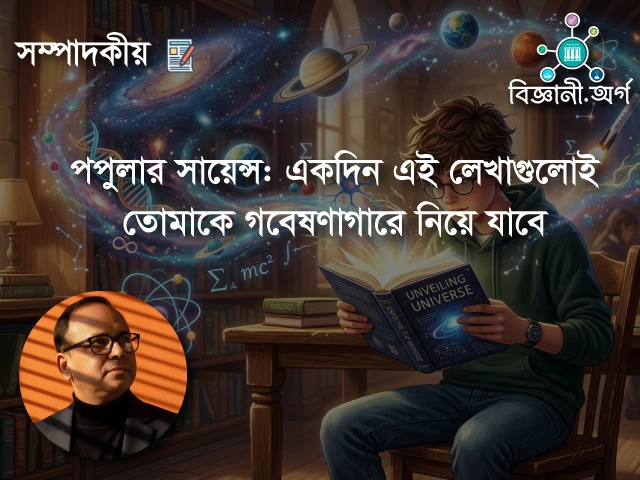
Sitting in a quiet corner of the school library one afternoon, when a teenager picks up a book—where tales of the cosmos are told like fairy tales, or the human body is explained as if it were a living city—suddenly a light flickers on inside their mind. They realize that science isn’t just about exam questions; science is stories, adventure, and wonder. From that very moment a different kind of dream is born—not only will I study science, I will tell stories about science as well. And that art of storytelling is what we call popular science writing.
Popular science writing isn’t about oversimplifying science, but about making science speak in human terms. Turning complex equations into life stories, transforming dry facts into words of inspiration—these are at the heart of this craft. A good popular science writer is like a translator, turning the secret language of the laboratory into phrases anyone can understand. Rather than hiding the beauty of science, they bring it to light.
There was a time when science spoke only with scientists. Its realm was the journal of research papers and conference podiums. But now, science wants to enter people’s homes, school classrooms, and teashops. Popular science writers are the ones who bring it down to that level. They explain how the dance of molecules is tied to our breathing, they show how sunlight is not just light, but an endless rain of energy. These things are written in textbooks, but they truly touch the heart only when they become stories.
In the context of Bangladesh, this kind of writing is even more necessary. Here, there are many talented students, but also a great fear of science. Many believe science is not for them, that science is too difficult. Popular science breaks that fear. It says, you don’t have to be a genius to enter science—you just need to be curious. It tells you that science is hidden in everyday life—from turning on the lights to talking on the phone. This realization is what inspires a young person to turn toward science.
A good popular science writer never looks down on the reader. They assume the reader is capable of understanding; only the language needs to be familiar. So they reduce the clutter of difficult terms but never reduce the depth of thought. Instead, with simple metaphors, stories, and real-life examples, they bring complex ideas to life. For example, they might say, our brain is like a capital city where billions of neurons are tangled like telephone wires. Suddenly, terms like neurons and synapses stop being unfamiliar—they become vivid images.
This kind of writing has a profound psychological impact on young minds. They begin to learn that science is not about rote memorization—it’s about understanding. The joy of this understanding takes them beyond textbooks. They start watching YouTube videos, searching for science-based books, and asking questions about things around them. That questioning is the first sign of a future scientist.
Through popular science writing, a strange bond forms between writer and reader. The writer seems to take the reader by the hand into unknown worlds—sometimes to the depths of the ocean, sometimes inside an atom, sometimes to the heart of a star. The reader is never alone on this journey; they are accompanied by the warmth of language and the pull of a story. After this journey, they are never the same; the world seems bigger in their eyes.
Often we see that even when new scientific discoveries make it into the newspapers, they fail to touch us, because they are written in a language that becomes a wall for many readers. Popular science breaks down those walls. It brings the results of the laboratory to people’s doorsteps. A farmer learns why new seeds are better, a parent discovers why vaccines matter, a student understands how artificial intelligence could change their future. This understanding is the beginning of social change.
If a student grows up reading popular science, a kind of humanity develops in their way of thinking. They see that science isn’t just about machines—it’s about people, too. Curing disease, saving the environment, reducing poverty—science plays a role everywhere. This realization teaches them to consider science as an instrument of humanity, not just a career.
When a writer’s own experiences, failures, and questions enter their writing, the reader begins to see themselves in those stories. They start to think—if this person can do it, then so can I. This small thought one day turns into a big decision: I will study science, I will work with science, I will bring science to the people.
Ultimately, popular science writing is not just writing—it is a kind of social responsibility. It warms the relationship between people and science. It tells the new generation: science is not your enemy—science is your friend. That friendship shapes the future of a nation. If a teenager today falls in love with space after reading an article, tomorrow they may invent a new machine, write a new story, or research something that changes the world.
That’s why popular science writing is not just a literary practice—it is a movement: a movement for knowledge, curiosity, and hope. You do not need much to be a soldier in this movement—you just need a pen, a mind, and an irrepressible question: “Why?” And in searching for the answer to that “why,” one day you yourself may become the writer who lights a new spark in another young mind.