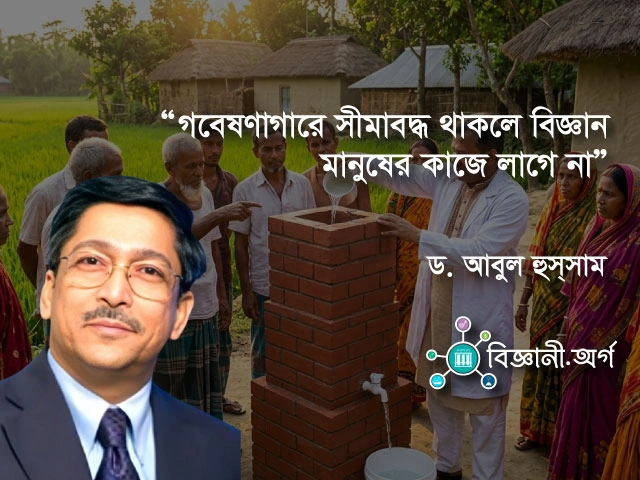
Every year in Bangladesh, countless research papers are published, theses are completed at universities, and the names of Bangladeshi researchers appear in international journals. Yet, the influence of that research on ordinary lives remains very limited. Many ideas born inside laboratories never reach the field level. Highlighting this contrast, Dr. Abul Hussam’s observation is extremely significant. In his words, “Science does not benefit people if it remains confined to the laboratory.”
Dr. Hussam’s work is a practical example of this statement. There has been a lot of research on arsenic contamination in Bangladesh. Data has been collected on arsenic levels in water, maps have been created, reports have been written. But the questions of ordinary people were more fundamental: How can we get safe water? By moving beyond laboratory measurements to seek answers to this question, Dr. Hussam developed a practical technology such as the Sono filter. This demonstrates that the true value of research is realized only when it is applied in people’s everyday lives.
There is a structural weakness behind this problem. In our country, the success of research is often measured by how many papers are published or in which journal they appear. Whether that research is actually applied in the field receives comparatively less attention. As a result, researchers naturally focus more on theoretical or lab-based work. Yet, in the realities of a developing country, the need for applied research is even greater.
To bridge this gap between the laboratory and the field, effective collaboration between universities, government, and the industrial sector is necessary. Dr. Hussam’s work shows that if a researcher puts field problems at the center of their research, it is possible to build a bridge between technology and people’s lives. He did not just write research papers; rather, he developed a technology with local realities in mind that is usable in rural settings.
Another important aspect here is user participation. Often, the opinions or real-life experiences of local communities are not considered during the planning of research projects. As a result, when the technology enters the field, it does not align with users’ needs. In Dr. Hussam’s innovation, local realities were considered, making it easy for people to accept the technology. This proves that to make research effective, users must also be regarded as partners in the research process.
This message is especially important for young researchers in Bangladesh. Alongside learning to work in the lab, they must develop the mindset to go out to the field, observe problems firsthand, listen to people, and turn those problems into research questions. Only then will research be vibrant, effective, and socially relevant. When science born in the laboratory changes lives in the field, only then does it truly fulfill its purpose.
Read the full interview of Dr. Abul Hussam: