



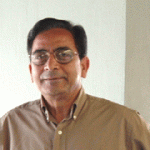
Once, tube well water was considered the symbol of safe drinking water in rural Bangladesh. But in the 1990s, arsenic—the silent killer—was detected in that very water. Invisible, tasteless, and odorless, this poison accumulates in the body over time, causing cancer, skin diseases, and many other serious health problems. In the midst of this grave crisis, it was expatriate Bangladeshi scientist Dr. Abul Hussam who stepped beyond the lab to find real-life solutions for real people. His invention, the “Sono Filter,” is still considered one of the most effective and practical solutions to Bangladesh’s arsenic problem.
From Kushtia to the United States: The Making of a Scientist
Dr. Abul Hussam grew up in Kushtia. His father was a doctor and worked in a pathology lab. Watching colorful solutions, glassware, and various experiments in his father’s lab as a child, he became fascinated by chemistry. From class nine, he started setting up small labs with friends, conducting experiments. This curiosity led him to Kushtia College and then to the Department of Chemistry at the University of Dhaka. He earned his BSc and MSc degrees in Chemistry from Dhaka University.
In 1978, he went to the United States for higher studies. He completed his PhD in Analytical Chemistry at the University of Pittsburgh. Analytical chemistry is essentially the science of measurement—detecting precisely how much of a contaminant is in water, the proportion of various metals, and so on. Just as we use a glucometer to measure blood sugar, the instruments in this field can detect harmful substances present in water.
After his PhD and postdoctoral research, Dr. Hussam joined George Mason University. He currently serves as a Professor of Analytical Chemistry there, as well as the Director of the Center for Clean Water and Sustainable Technologies. His research focuses on water pollution, especially on developing effective and affordable technologies for arsenic contamination prevention.
From Laboratory to Rural Bengal: The Birth of the Sono Filter
By the mid-1990s, the severity of arsenic contamination in Bangladesh had become scientifically clear. In regions like Khulna, Kushtia, and Faridpur, tube well water was found to contain dangerous levels of arsenic. Witnessing the presence of this poison in the water of his own birthplace moved Dr. Hussam deeply. It became clear to him that working solely in the lab wasn’t enough; people needed a technology they could use themselves.
Research showed that special iron particles, or nanoparticles, are capable of absorbing arsenic in water. Simply put, iron binds the toxin and removes it from the water. Based on this idea, Dr. Hussam developed a low-cost water purification system using locally available materials. This three-pot filtration method later became known as the “Sono Filter.” It works without electricity and is suitable for rural use.
This filter selectively removes arsenic and other environmental toxins. Field tests revealed that even where arsenic levels in water were very high, the Sono Filter could reduce them to safe levels. This was considered a groundbreaking innovation in the struggle for safe water in rural Bangladesh.
International Recognition and a Sense of Duty to the Homeland
Dr. Hussam’s invention also gained international recognition. Various U.S. agencies and research organizations tested the Sono Filter’s effectiveness and recognized it as a safe and efficient technology. Despite receiving international awards and accolades, his main goal remained bringing this technology to the people of Bangladesh. Dr. Hussam’s work serves as a shining example of how an expatriate can have direct, positive impact on the lives of people back home.
His Message for the Youth
According to Dr. Hussam, science is of little value if it is confined to exam papers and textbooks. From childhood, one should try hands-on making, have the courage to ask questions, and nurture curiosity about the world around us. For example, how is soap made or how is water purified—the seeds of future inventions often begin with these simple curiosities. He believes if a young person takes science not just as a profession but as a passion, only then they can truly become a researcher.
A Living Example of Inspiration
Dr. Abul Hussam’s life story proves that being a scientist is not just about writing research papers; it also comes with the responsibility of bringing real change to people’s lives. From the curiosity of a boy in Kushtia to long years of research in American laboratories, his invention has now returned to the water pitchers of rural Bangladesh. This effort to secure the right to safe water is a profound inspiration for Bangladesh’s youth. It shows that when knowledge is put to use for human welfare, science becomes the most humane endeavor of all.
🔗 Profile Link:
https://science.gmu.edu/directory/abul-hussam
Dr. Abul Hussam’s research has set a precedent in solving rural water problems in Bangladesh. The biggani.org team expresses gratitude for his contributions and hopes his work will continue to widely benefit the people of the country. It stands as a source of inspiration for young scientists.
The interview was conducted by Dr. Moshior Rahman via telephone on April 19, 2007.
The Innovator Behind the Sono Filter: Dr. Abul Hussam
Dr. Abul Hussam is a Professor of Analytical Chemistry at George Mason University and Director of the Center for Clean Water and Sustainable Technologies. His research primarily focuses on water contamination, particularly arsenic, and the development of practical, low-cost purification technologies. Dr. Hussam earned his B.Sc. and M.Sc. degrees from the University of Dhaka and completed his Ph.D. at the University of Pittsburgh. He is best known for inventing the “Sono Filter,” a device designed to remove arsenic and other contaminants from drinking water, which has been widely adopted in rural Bangladesh. His work integrates chemistry, nanotechnology, and environmental science to develop solutions that are both effective and accessible. Dr. Hussam continues to contribute to Bangladesh’s public health and environmental sustainability while being based in the United States.
💬 Q&A Session:
Q: How did you become involved in this research area?
A: My interest has always been in developing instruments. I wanted to help solve the arsenic problem in rural Bangladesh, which led me to invent the Sono Filter.
Q: How does the Sono Filter work?
A: It is a simple but effective water purification technology. The filter selectively removes arsenic and other toxins, providing safe drinking water.
Q: What has your experience been like contributing to Bangladesh from abroad?
A: Even while living overseas, it is possible to make a meaningful contribution. This filter has helped deliver safe water to rural communities in Bangladesh.
Q: What are your future research goals?
A: My goal is to develop more advanced, affordable, and environmentally friendly water purification technologies that are accessible to rural populations.
🔗 Profile Link:
https://science.gmu.edu/directory/abul-hussam
Dr. Abul Hussam’s work has set a benchmark in addressing Bangladesh’s rural water challenges. The biggani.org team acknowledges his contributions and is confident that his research will continue to benefit communities while inspiring young scientists. His dedication exemplifies how innovation and social responsibility can go hand in hand.




This comment has been sanitized for the English site.
This comment has been sanitized for the English site.
This comment has been sanitized for the English site.
thank you for giving us this nice site.
long live biggani.com
Dr. Hissum is not only a great scientists, he is a great man and patriot also. For that reason he has donated 70% of his prize money for distribution of sono filter in Bangladesh.
Bangladesh government should give him Independent Awards for his invention, generosity and to place him as a source of inspiration before young bangladeshi Scientists.[b][/b]
thank you for giving us this nice site.
long live biggani.com
Fun,Bollywood,mp3,Gallery,Tamil,Natok,Download,Movie,Free Software,Tutorials,Screensavers,Wallpapers,
Computer Bazar Update,market,Latest Bollywood News, Star Interviews, Bollywood Chat, Hindi Songs, Movies
Reviews and Previews, Bollywood Gossip, Shop Online, Free E-mail, Chat with Bollywood stars,
Download hindi songs in Real Audio and mp3 format and much much more..
Visit http://www.moonbd.com
I take pride about my country & my people.
This comment has been sanitized for the English site.
welcome