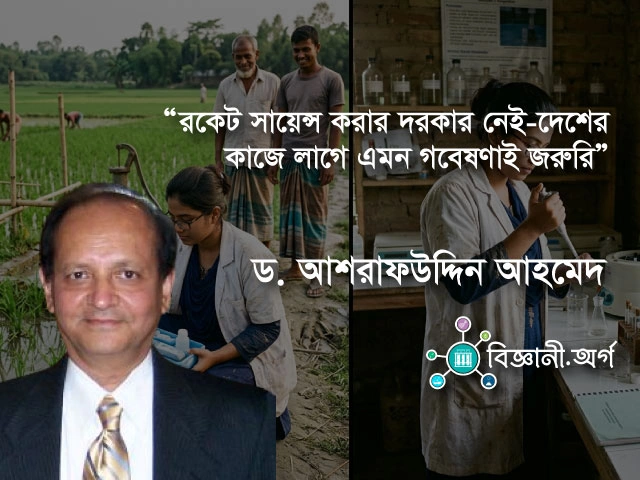
Many students imagine research as something involving cutting-edge technology, huge budgets, and complex theoretical work. As a result, they start believing that conducting research from a country like Bangladesh isn’t possible, or that it’s impossible for us to compete with developed countries and do “cutting-edge” research. Dr. Ashrafuddin Ahmed encourages us to look at this notion realistically. In his words, “No need for rocket science—research that benefits the country is what truly matters.” This perspective offers a practical guideline for the philosophy of research in Bangladesh.
The reality for developing countries is that their economic capacity, infrastructure, and research opportunities are not like those of developed nations. Access to advanced equipment, large research funds, or major multinational laboratories is limited. If we ignore this reality and blindly imitate the research style of developed countries, it often leads to frustration. According to Dr. Ashrafuddin, research goals should be set with the country’s needs in mind. Priorities should come from the fundamental question: which research can bring real change to the lives of the people?
Fields like agriculture, food security, water and environment, public health, and pollution control offer vast research opportunities in countries like Bangladesh. For example, developing new rice varieties, creating salt-tolerant crops, detecting and addressing arsenic contamination in water, or affordable diagnostic technologies for health. Such research might not grab the “high-impact” headlines in international journals, but its impact on people’s lives is direct and profound. From Dr. Ashrafuddin’s viewpoint, this kind of practical research is the true foundation of a country’s scientific progress.
Another important aspect of this viewpoint is that if research is seen only as something ‘ambitious’, many young researchers start doubting their own abilities from the outset. They think that without labs like those in developed countries, research is pointless. Yet, Dr. Ashrafuddin’s experience shows that many major discoveries begin with very simple questions. Even starting a small-scale investigation into a local issue is a key step in research. The ability to work within limited resources often makes researchers more creative.
Policy makers also have a crucial role here. If a country’s research policy and funding are guided solely by international rankings or external recognition, local needs remain neglected. Dr. Ashrafuddin believes that when investing in research, the primary questions should be: What problem in the country does this research solve? Which groups benefit? How can the research results be implemented in practice? When these questions are prioritized, research and development become interconnected.
Finally, this perspective brings a sense of liberation for young people. Practicing science does not mean everyone has to become a space researcher. Some may work on the production problems of local farmers, others on river pollution, or improving rural healthcare. Each of these is scientific research—if done with questions, inquiry, and evidence. Dr. Ashrafuddin Ahmed’s pragmatic vision teaches us that the goal of science should be to bring real change to people’s lives, not just to add complexity.
Read the full interview with Dr. Ashrafuddin Ahmed: