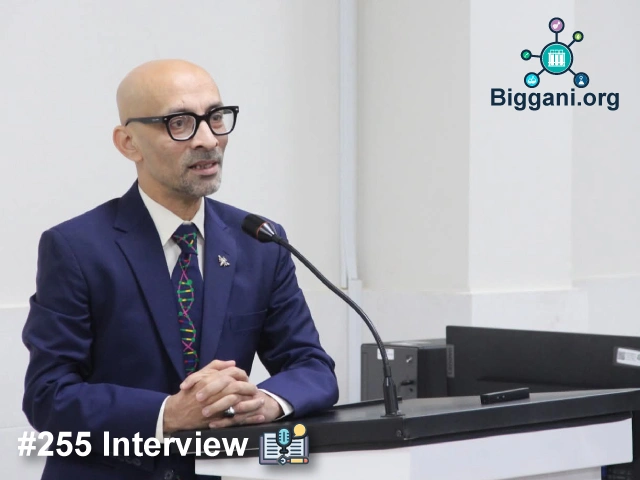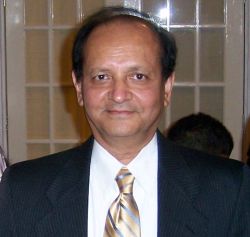
Scientist Dr. Ashrafuddin Ahmed
Interview date: 2 October 2010
This interview was conducted by Dr. Moshior Rahman of Biggani.org.
Born in Brahmanbaria, passing matriculation in 1966 and intermediate in 1968 from Annada High School to Dhaka College, then studying at the Department of Biochemistry at Dhaka University—this path led Dr. Ashrafuddin Ahmed’s research journey from Kyoto University in Japan to the NIH (National Institutes of Health) in the USA. One of the biggest lessons from his life is that science is not just about writing complex words in a lab; science starts from the question “Why does this happen?”
From Dhaka University to Japan: Delays Due to War, But Not Stopping
He completed matriculation in 1966, finished intermediate at Dhaka College and enrolled in biochemistry at Dhaka University in 1968. The freedom war delayed the normal academic schedule—his MSc was supposed to finish in 1972, but actually finished in 1974. Starting in January 1975, he began teaching at Dhaka University. Alongside teaching, his urge for advanced research brought him to Kyoto University—in microbial biochemistry.
PhD: An Enzyme That “Became Unstable Quickly”—and a Year-long Struggle
Dr. Ashraf’s PhD was on an enzyme involved in amino acid metabolism. He explains—enzymes are biological catalysts that speed up internal chemical reactions in the body. But the enzyme he was studying was “unstable”—it would quickly become inactive. Even after working hard for almost a year with no results, even his professor suggested abandoning the project.
At that point, he felt that if he failed after coming all the way from Bangladesh, it would not just be a personal failure—the country’s name would be associated as well. Driven by this sense of responsibility, he didn’t give up. In the end, he managed to stabilize the enzyme and, at the molecular level, discovered how the enzyme functions, identifying two or three new reactions.
Going to NIH: An Opportunity Through a Conference Connection
During his PhD, he met a scientist from NIH at a conference. That scientist wrote to Dr. Ashraf’s professor, saying if Dr. Ashraf was interested, NIH would make arrangements for him. And so, in 1983, he joined NIH as a postdoc.
Tryptophan Synthase: A “Textbook Enzyme”—Yet a Major Breakthrough
At NIH, his major work was with the enzyme Tryptophan synthase. This was already a “textbook enzyme”—a lot was known, making it difficult to do new work. But his supervisor said: the three-dimensional structure of this enzyme was unknown; after years of attempts, no high-quality crystals had been made. If that could be done, it would open new doors for research.
Dr. Ashraf says—he started working on October 3 and within just two months (by December 3), managed to create excellent crystals. Then, using X-ray crystallography, he and his collaborator solved the structure. For many years since 1987–88, the structure image from his work was used in biochemistry textbooks.
“How Does a Molecule Travel from One Enzyme to Another?”—No Longer Hypothesis, but Proof
Previously, it was assumed that the “intermediate” produced by one enzyme either left, attached to some carrier, or was just presumed to travel inside. Dr. Ashraf’s work demonstrated—a specific internal route exists for a molecule to travel from one active site to another inside the enzyme. This advancing science from “hypothesis” to “proven demonstration.”
How Enzymes Work—A Simple Example
He gives the example of breaking down glucose/sugar: in water or natural conditions, breaking down sugar could take thousands of years, but with enzymes, it happens in seconds. Enzymes make reactions quick, reduce energy waste, and break down processes into small steps—so there are no harmful changes like sudden increases in temperature.
“Tryptophan Synthase Only Creates, Doesn’t Break Down”—This Unasked Question Became His Major Work
Another important point: a similar enzyme, Tryptophanase, can both break down and form tryptophan. But everyone assumed that Tryptophan synthase only forms, not breaks down. Dr. Ashraf questioned—“Why can’t it?”
Many people said, “We don’t bother with that.” He showed—by changing the reaction conditions (pH, temperature, etc.), Tryptophan synthase can also break down tryptophan. Later, many admitted—they wondered why the question hadn’t been asked before!
Single-Crystal Microspectrophotometry and “Enzymes Can Work Inside Crystals, Too”
He could make very high-quality crystals—which led an Italian researcher to want to work with his crystals. At that point, Dr. Ashraf took on another challenge: can an enzyme that works in solution also function in solid crystalline form? He showed—it can, if the substrate (reactant molecule) has a path into the crystal interior.
He says, if kept properly in “mother liquor,” the crystals can remain functional for years.
Not Returning Home: Accepting the Reality
At one point, he thought he would return home, work at Dhaka University—he even prepared accordingly with books, equipment, plans to work with fewer resources. But toward the end of the 1980s, circumstances were tough; colleagues warned of limited research opportunities at home. So he had to decide—to stay in the USA.
Wake Forest University: New Enzymes, New Structures, Beginning of a New Program
He became a Research Assistant Professor at Wake Forest University, North Carolina. There he worked on two oxygen metabolism-related enzymes, stabilized one enzyme, and studied the crystal structure of another with a German team—all these activities he conducted there.
Special discovery: He showed that cysteine sulfenic acid (very reactive, only survives briefly in solution) can remain stable inside a protein. The structural biology work he began later developed into a major Structural Biology Program at Wake Forest Medical School.
Returning to NIH Again: Called Back Because of “No Breakthroughs”
Later, NIH told him—after he left, there had been no major breakthroughs, so he needed to return and revive the work strongly. He returned to NIH in a higher position, further expanded the three-dimensional structural studies—examining amino acid arrangements at the atomic level, making mutants for tests—all these things.
Technologies Used—His Own List
He says, the main tool for structure determination was X-ray crystallography. Additionally, he used:
- Circular dichroism
- UV-visible absorption spectrometry
- Electron microscopy
- Fluorimetry / fluorescence
- Molecular/computer graphics
- And site-specific mutagenesis (creating mutations at specific positions using plasmid/vector)—a brand new technology at the time; he learned it directly from its early development at NIH.
From Fundamental Research to Application: Infectious Disease and Botulinum Toxin
Later in his career he shifted focus from basic knowledge (textbook science) to infectious diseases, vaccine/drug development. One of his major achievements here: Botulinum neurotoxin—an extremely potent poison. He found that a part of this toxin acts like an enzyme. If the enzyme’s activity can be disrupted, the toxin becomes harmless.
He notes, while others tested “millions of compounds” on the market one by one, he used knowledge-based design: based on the three-dimensional structure of the enzyme and the active site’s charge (positive), he designed and tested peptides with opposite (negative) charge. With only a few dozen tests, most had excellent results, and his published inhibitors are known as “the best inhibitors.”
About Bangladesh: “Research Based on Our Needs”
Dr. Ashraf defines research very simply—asking questions from everyday life: “Why does this happen? What if a small change is made?” In his view, there’s no need for Bangladesh to rush into rocket science; what is important is research that benefits the country. He’s straightforward—sometimes gives “crude” examples: even from people’s daily habits, thoughts on “maximum utilization” can arise for research. The main point—research should be shaped by the country’s real needs.
He says, pollution, food shortages, agriculture—big research fields arise from these daily problems; and for much of this, a large lab isn’t necessary—what matters is initiative and thinking.
Final Thoughts
One idea keeps resurfacing in Dr. Ashrafuddin Ahmed’s story—science is both a responsibility and the courage to ask questions. From teaching at Dhaka University, to discovery of textbook-level findings in the world’s top research labs, and then to life-saving applied research—this entire journey sends a clear message to Bangladesh’s youth: to advance the country by becoming a scientist, one must first learn to question the world around them—and ground their research in real practical needs.
Watch the Interview on YouTube
Part 1
Part 2
Part 3
Some more of Dr. Ashraf’s works:
News
- Drug Target For The Most Potent Botulinum Neurotoxin Determined: http://www.sciencedaily.com/releases/2008/04/080429102646.htm
- Scientists determine drug target for the most potent botulinum neurotoxin <http://www.biologynews.net/archives/2008/04/29/scientists_determine_drug_target_for_the_most_potent_botulinum_neurotoxin.html>
- Dr Syed Ashraf Ahmed Discovers an anti-Dote to Botulinum Neurotoxin: http://www.voanews.com/bangla/news/a-16-2008-05-11-voa1-94430069.html
- Bangladeshi scientist’s discovery to save human lives: http://www.thedailystar.net/story.php?nid=43145
Some published writings
- Where science meets arts…: http://www.thedailystar.net/story.php?nid=148327
- Science of the mother tongue: http://www.thedailystar.net/story.php?nid=126432
- How long shall I live?: http://www.thedailystar.net/newDesign/news-details.php?nid=117722Mercury in Fish?: http://www.thedailystar.net/story.php?nid=136026
- Our Friends & Foe: http://www.thedailystar.net/story.php?nid=140852
- Let us not Forget: http://www.thedailystar.net/newDesign/news-details.php?nid=120463
- The Scent of Love <http://porshi.com/_arc_news_details.php?nid=391&rd=y&did=14> : http://porshi.com/_arc_news_details.php?nid=391&rd=y&did=14
- Whose Father Am I , Whose Uncle Am I <http://porshi.com/_arc_news_details.php?nid=235&rd=y&did=9> : http://porshi.com/_arc_news_details.php?nid=235&rd=y&did=9
- The Antics of a Ragged Street Kid <http://porshi.com/_arc_news_details.php?nid=493&rd=y&did=18> : http://porshi.com/_arc_news_details.php?nid=493&rd=y&did=18
- Scoundrel <http://porshi.com/_arc_news_details.php?nid=361&rd=y&did=13> : http://porshi.com/_arc_running_issue.php?did=13