


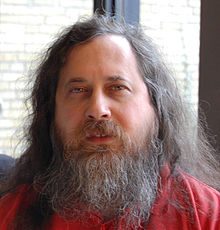
The desire for freedom exists within every human being. Since the dawn of civilization, people have been fighting to achieve freedom. In the world of information technology, a unique battle is also taking place—a battle for the freedom of software. The leading figure in this extraordinary fight is Richard Matthew Stallman. In the face of the greedy grip of software businessmen, it was he who taught the world to chant a courageous slogan: We want software freedom!
Richard Stallman, born on March 16, 1953 in New York City, wrote his first program shortly after graduating high school. At that time, he worked as a volunteer at the biology research lab of Rockefeller University. However, his career progressed towards mathematics and physics, even though his supervising teachers believed he might pursue higher education in biology.
In June 1971, as a freshman at Harvard University, he got the opportunity to work as a programmer at the Artificial Intelligence Laboratory at the Massachusetts Institute of Technology (MIT). That’s where his journey as a hacker began. Don’t be alarmed at the mention of hacking; back then, the definition of hacking was entirely different—it described those highly skilled in computers and their security. Stallman’s hacking journey began at MIT’s AI Lab. In a very short time, Stallman, known as ‘RMS’ (an abbreviation of Richard Matthew Stallman), became popular within the MIT hacker community. He was involved in some notable incidents as a hacker. In 1977, individual passwords were provided to all students’ computers in the MIT Computer Science Department lab. As expected, Stallman did not like these chains of passwords. He cracked the passwords, removed everyone’s passwords, and notified them all by email. Meanwhile, Stallman had begun his postgraduate studies in physics at MIT.
At the beginning of the 1980s, with the expansion of the information technology industry, copyright restrictions intensified. As a result, even after purchasing expensive software, users were being deprived of the ability to use them freely. To make matters worse, software businesses began to liken copying software or borrowing it from a friend without purchase to the dishonorable act of ‘theft.’ A significant incident also occurred in the MIT lab during this time. In 1980, one day Stallman sent a 50-page urgent file to the printer. The laser printer was on another floor. When Stallman went to check, he found only four pages in the printer tray, and those belonged to someone else—not a single page of his had printed. The Xerox 9700 model printer had been received for free from the manufacturer. To solve this problem, Stallman modified the printer software’s source code so that, after a print job or if the printer was busy, an automatic notification would appear instantly on the lab computers. However, MIT’s lab rejected Stallman’s modified software because it was created by transforming another piece of software. This incident had a major influence on the future freedom fighter for software—Richard Stallman.
Meanwhile, the MIT hacker community was also breaking apart. As the last member of the MIT hacker group, Stallman refused to sign a Non-Disclosure Agreement, which stipulated that he could not share the source code of software he developed with anyone. Richard Stallman labeled this agreement as ‘unethical’ and ‘antisocial.’ Turning away from a secured life, he resigned from his MIT programming job in January 1984, dedicating all his time to the creation of free software under the GNU project. (He had already announced the GNU project in September of the previous year.) Thus began the battle for software freedom. But starting a war is not enough—you need weapons and people. Stallman realized that merely distributing free software was not adequate—people also needed a free operating system to run those programs.
In 1985, the GNU project’s manifesto was published in March. This manifesto outlined the goals and objectives of the GNU project, along with the declaration of creating a UNIX-based free operating system. Though similar to UNIX, this operating system would be entirely free to use. That same year, on October 4th, Stallman established the Free Software Foundation, a non-profit organization to spread the free software movement. To prevent the distribution and modification of free software from falling prey to copyright, Stallman introduced a new concept called ‘copyleft.’ With copyleft, users could not only freely use the software but also modify it and even create new software by transforming it—all without seeking permission or paying any fees. Copyright takes away the user’s freedom, but copyleft strives to preserve it. However, to ensure the main developer’s credit is not diminished, certain conditions are attached. Notably, several licenses now exist under copyleft—GPL, LGPL, FDL. Many people were attracted to Stallman’s innovative ideas, leading individuals and organizations to join and contribute to the project.
Early 1990s… The GNU operating system was on the verge of being released, but one major part was still unfinished: the operating system kernel. This was simplified by Linus Torvalds, a student at the University of Helsinki in Finland. While working on the UNIX-based ‘Minix’ operating system as a hobby, Linus developed a kernel in March 1991. It was adopted as the kernel for the GNU operating system, giving birth to the most powerful weapon in the free software battle: ‘Linux’—named after Linus himself. As a result, many assumed Linus had created the entire Linux operating system. In reality, even without creating the majority of the Linux operating system, Linus Torvalds rose to global fame as its creator. After Linux’s arrival, the free software movement reached a new dimension. This open-source operating system opened up new possibilities for computer users and programmers alike.
Stallman prefers a simple lifestyle, much like an ordinary student. He considers Mahatma Gandhi, Martin Luther King, Nelson Mandela, and Aung San Suu Kyi among his greatest influences. Personally, he is an atheist; though born a Christian, he has never engaged in religious rituals. He often sleeps at his office after work, doesn’t use a mobile phone, and owns very little personal property. For almost three decades, his focus and dedication have been directed solely towards advancing the free software movement.
Just as he hopes the world of information technology should be free from commercial interests, Stallman also supports the idea that world politics should be similarly unbound. He believes that democracy cannot be achieved as long as political power remains in the hands of greedy businessmen. Thus, unless political power is regained from businessmen, the liberation of democracy—and thereby humanity—will not be possible. Additionally, as a pioneer of the free software movement, Stallman thinks the commercialization of software is not the world’s biggest problem. In his view, the number one issue today is environmental pollution and global warming.
Stallman has written numerous essays about free software. His most famous essay is titled “Why Software Should Not Have Owners.” Many argue that free software is a waste of talent or that there is no benefit in creating free software. All those questions are answered in this essay, which has now been translated into many languages. A fan of science fiction, Stallman himself has written two science fiction stories. To raise awareness about software copyright and patents, he has traveled around the world. In 2006, following a meeting with the state government of Kerala, India, the government decided to replace Microsoft Windows with open-source operating systems across nearly twelve and a half thousand high schools in the state.
Ignoring the threats of software copyright and patents, he was the first to show the world the dream of free software. His dream has touched the entire world. Perhaps the strongest example is our own Bangladesh. Despite our reputation as a nation resistant to technology, our young generation today is inspired by Stallman’s ideals. In any battle, many partake, but someone has to start it. He was the one who started this fight. So, who else but him could be the great leader in the battle for software freedom?
[This article is partially included in Bangla Wikipedia in a modified form. Image collected from the internet.]




this is one of the best topic that i ever read before…
This comment has been sanitized for the English site.
This comment has been sanitized for the English site.
This comment has been sanitized for the English site.
This comment has been sanitized for the English site.
This comment has been sanitized for the English site.
Computer, software, technology….. Aei term gulor shathe porichoy olpodiner na holeo abar khub beshidinero noy!
Jantam na onek kisui….. Aei marattok post ta theke onek kisu janlam!
Salute to Mr. Hacker ebong take, jini aei post ta koresen 🙂