



As I write this article, newspapers in Bangladesh are filled with budget discussions. By the time this reaches the readers, the budget may already have been announced. In our budget, instead of granting the space that economics, science, and technology deserve, politics tends to play a larger role. Yet, for countries like ours, economics, science, and technology should play the leading roles. We accept that we are poor. But is it really not possible to change this situation a little? Ours is the economy of a poor country, but still, we can polish and improve it. Instead of creating flashy budgets just to collect more votes before elections, can’t we do what would truly benefit our country’s economy?

[The promising nanotechnology train is approaching. Are we going to miss this train too?
While the whole world is striving to gain dominance in newly developed science and technology fields, we are largely ignoring them. Take Taiwan for example. In 2002, Taiwan allocated a six-year, $630 million budget for research and development in nanotechnology, calling it the Taiwan National Nanotechnology Program. They didn’t just spend money and waste it—every year, we see significant results from Taiwan in the field of nanotechnology. Nowadays, Taiwan’s name is mentioned in nanotechnology. If Taiwan had not prioritized this in their budget, they wouldn’t be in this position. Our neighbor India, at the beginning of this year, increased their science and technology budget by 16%, raising it to $4.5 billion. India has established the Nanotechnology Research and Innovation Foundation, known as IndiaNano for short. The importance India is placing on nanotechnology and its future direction is illustrated in the graph below, clearly showing that the adoption of nanotechnology from 2010 to 2081 will open up a massive market.
If we ignore science and technology, we will only fall further behind. Because we didn’t focus on information technology sectors, now Indians play a much larger role in IT. We missed that opportunity. If we had given proper attention from the start—even if we couldn’t compete with India directly, being even a step behind would have considerably boosted our economy. I often describe these lost opportunities with the “train model.” We stand on a competitive platform, and one train after another of opportunity passes us by. We can’t get on any of them; we just stand and watch the trains go. And once the train is gone—we lament and regret. Out of frustration, we want to tear our hair out. Now that Indians are succeeding in IT, we are burning with envy.
Many such trains are still passing by in front of us, and we still have the chance to hop on some of them. Among those opportunities, I must mention two key technologies first: (1) Biotechnology and (2) Nanotechnology. Biotechnology is getting some attention in Bangladesh, especially with genetic technology in agriculture—our scientists have managed to make a name for themselves. The main reason is that there are good institutes in Bangladesh related to this field. But comparatively, there is almost no practice or development in nanotechnology. Yet we should give it more importance. Those who excel in these types of technologies will be the ones to stay ahead in the vast markets of the future.
What is nanotechnology?
Simply put, nano is a unit of measurement. One nanometer is one billionth (1×10⁹) of a meter. Technologies related to this nanometer scale are called nanotechnology. You must have noticed how electronic devices get smaller every year—that’s all thanks to nanotechnology. Nanotechnology is not a completely new field that needs to start from scratch. It is closely tied to applied physics, practical physics, chemistry, electrical engineering, mechanical engineering, etc. Researchers and students from these fields can work in nanotechnology.
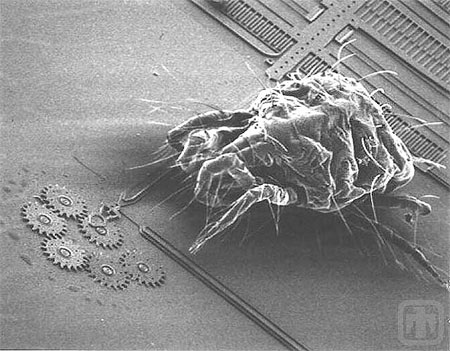
“Courtesy Sandia National Laboratories, SUMMiTTM Technologies, www.mems.sandia.gov”
What can we do?
Our budget should place greater emphasis on R&T (Research and Technology, i.e., science and technology). We should focus on those technologies that will bring us the most benefit. Basic research may not have a direct impact on our country’s economy, but some degree of foundational research is necessary. However, in a country like ours, the highest priority should be given to applied science or engineering sectors. For these kinds of initiatives, we need two things: a plan, and money. We can develop both long-term and short-term plans with experts in these fields. We can identify technologies that, if emphasized, would positively impact our economy. Along with that, funding is essential. We should establish good institutions and create opportunities for local companies to flourish. For that, government support and financing are required. By fostering internal competition, we can do well in these areas. It is crucial that the budget allocates funds for this purpose.
To succeed in these technologies, we need educated and skilled scientists and engineers. For that, universities must offer the opportunity to study advanced curricula. Topics related to nanotechnology should be taught to university students. Both public and private universities can take the lead here. By raising awareness, we can inform the people of our country about the immense potential that lies ahead of us.
Can’t we dream of a country where people come from abroad to Bangladesh to learn technology? I raise this question because, a while ago, a new machine was installed in our lab. Would you like to know which country it came from? Israel. They have made such progress in nanotechnology that I was truly amazed. Although international politics may have supported them, these technologies don’t come out of thin air—they are really working hard and making an effort. I was talking to the Israeli engineer. He said that after 1990, Israel treated nanotechnology as one of their top national challenges, and all their scientists rallied behind it. He studied at Hebrew University and noticed even back then that Hebrew University was receiving a lot of funding for nanotechnology and was taking it very seriously. Now, many companies focusing on nanotechnology have been established in Israel. These small companies are now installing equipment in around 200 places worldwide. The key reason is that Israel prioritized nanotechnology from the beginning and worked accordingly. Can’t we imagine such a scenario where Bangladesh’s technologists are taking their innovations abroad? I can’t describe in detail the machine that Israel developed, but if we try, perhaps we could develop similar devices at a lower cost, because our technologists would work for less than those in developed countries. There are many such areas where our engineers can compete. Even if we cannot lead the developed world, being somewhat behind still can energize our economy.
I see the most promising market in medical electronics. The integration of nanotechnology and biotechnology will create enormous future opportunities. If we can create good devices in these sectors, we can capture a big market. India right now is putting a lot of focus on this area and is already manufacturing some nanotech equipment. Moreover, the R&D (Research and Development) sections of many large companies are now based in India. Since they can find engineers at lower wages there, their workforce is growing—and this is driving India’s economy. We, too, can encourage such companies to set up R&D sections in Bangladesh. For example, Veeco is a world-renowned nanotechnology company. Their research labs are in China and India.
It’s not just about universities; political awareness is also necessary. Those involved in politics, who think about Bangladesh’s future and set directions, should be made aware of these issues. I am reminded of an American researcher I know (I won’t mention his name for professional reasons) who does excellent work in nanotechnology. Not only does he do great research, but every year he brings considerable research funding to his lab. The main reason for his success is that when he talks to politicians or administrators—people who usually don’t understand science—he never tries to explain with complex formulas but explains things in simple terms, the way politicians can relate. In one case, he described it this way—
When we scientists apply for grants, we usually write our proposals as if the grant will accomplish some grand scientific feat. But those making the decision are typically politicians or administrators—they don’t understand science. When I try to explain, first I mention the future problems we may face, then I present how, as a scientist, I can help solve them, and how my innovation will play a role. That makes it much easier for them to understand.
I believe we should first explain to Bangladesh’s policymakers why we need to focus on science and technology and the promising future we have in certain sectors. Since I work in nanotechnology, I know what remarkable potential it holds. Scientists in other fields can point out the opportunities in their sectors as well.
In short, we should cut unnecessary expenses and increase funding for science and technology, because that is what will help us survive. Reducing taxes for the rich and increasing them for the poor will never benefit Bangladesh.
June 9, 2006
This article was published in a condensed form in Ekattor on July 12, 2006.










This comment has been sanitized for the English site.
This comment has been sanitized for the English site.