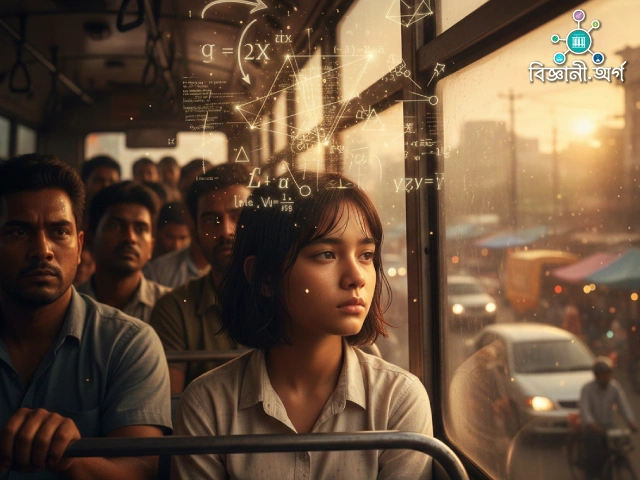
A bus stuck in the evening traffic. Inside, people are suffocating in the heat. Suddenly there’s no breeze—neither the driver nor the conductor knows why, and the passengers are just annoyed. But a boy and a girl sitting by the window are quietly thinking: where does air enter the bus, which direction is blocked, why isn’t the fan working? They may have forgotten their class math, but right now, their minds are caught up with a peculiar question. They realize that problems aren’t just inconveniences—every problem is a question. And every question marks the beginning of science.
Many of us think of a scientist as someone in a white coat, armed with complex formulas and intimidating instruments. But in reality, the journey to becoming a scientist begins with a tea cup, a rickshaw wheel, or the mystery of a dying phone battery. Having a scientific mindset isn’t just about getting a license to ask questions—it’s about feeling uncomfortable if you don’t. Questions like why a bulb lights up, why a tree dies, why the internet is slow—these little queries are what end up creating great minds.
Daily life in Bangladesh is full of problems. The water doesn’t come, the electricity goes out, the bus is late, the mobile network suddenly disappears. We get angry, we complain, but rarely do we try to understand. Yet this city is the biggest classroom of all. According to UNESCO research, students who learn from real-life problems develop problem-solving skills almost twice as much as others. That is, we should not run away from problems—we should learn to dive into them.
The biggest enemy to adopting a scientific mindset is habitual neglect. We witness many things, but we don’t question them. The clock ticks, the sun rises, water collects on the street—we accept it all without a thought. A scientist asks, “Why?” And chasing after that “why” is what builds the muscle of thought. For example, if you notice why cities get hotter than villages during summer—that one question could lead you toward climate science.
According to the World Bank, in the next two decades, the most in-demand skills will be problem-solving and critical thinking. Not degrees, but thought itself will be the commodity. Yet our classrooms still depend on rote learning. So, we get certificates, but we lose our curiosity. But curiosity is the energy that carries you from a school bench to the lab desk.
Analyzing everyday problems doesn’t mean solving complex mathematics—it means learning to observe slowly. If you ask yourself every night, “What did I learn today?”—this small habit sparks big change. One day, you might wonder why your phone heats up quickly, why network gets bad during rain, or why some people are more prone to certain diseases. These questions later become projects, theses, and innovations.
Isaac Newton’s apple story isn’t just a fairy tale—it teaches that the universe hides in the smallest events. Darwin understood that life changes just by watching birds on the Galapagos Islands. Einstein used to ponder the speed of light while sitting in a tram. None of them started out as great scientists—they were, above all, great questioners.
In today’s world, having a scientific mindset doesn’t just mean reading books—it means understanding data, spotting patterns, searching for connections. Your phone’s health app, Google Maps traffic, Facebook’s algorithm—all of these are living laboratories. If you don’t just use them but try to understand them, that’s when you start walking the modern scientist’s path.
In Bangladesh, we often say there are no opportunities. But opportunities are never just created—you have to seek them out. If you fill your surroundings with questions, then this very city will provide you with research material. The color of the river, the smell of the air, the taste of food—all of it is data.
Building a scientific mindset doesn’t mean you’ll find answers to all the problems. It means you refuse to accept that the answers are unknowable. That refusal is what sets you apart.
When the night ends and you’re alone, flipping through the pages of a book, remember—your surroundings are themselves a book. If you learn to read it, you too can be a scientist. From now on, don’t just stare out the window while sitting on the bus—start doing the calculation inside as well. That’s how ordinary life gradually becomes a laboratory.
This country needs young people who don’t just blame problems, but explain them. Who don’t just complain, but experiment. Who don’t cry in the dark, but search for light.
And that search begins today, right now, through your own eyes.