


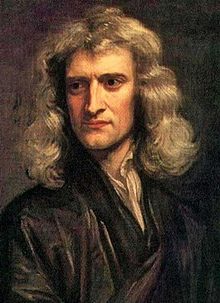
SIR ISAAC NEWTON [1642–1727 AD
An Astonishing Event in the History of Science. There was once a frail, thin, and also undersized child whose mother had almost given up hope for his life, yet this very individual shocked everyone and made extraordinary contributions to science. He was like an amazing gift for the world by the grace of the Creator. He is a bright star in the realm of science—Sir Isaac Newton. He was a physicist and mathematician.
Some of his Notable Contributions: Newton’s Laws of Motion—
a. Every action has an equal and opposite reaction.
b. Unless acted upon by an external force, an object at rest will remain at rest and an object in motion will continue to move in a straight line at constant speed.
c. The rate of change of momentum of an object is proportional to the force applied, and the change in momentum occurs in the direction of the applied force.
Newton’s Theory of Gravitation—
Every object in the universe attracts every other object by a force. This attractive force is proportional to the product of their masses and inversely proportional to the square of the distance between them.
He conducted research in almost every branch of science. It can be said, wherever he turned his hand, it yielded gems. His work in mathematics, astronomy, and physics stirred a great wave across the world at one time. In fact, Newton laid the foundation for these three sciences.
Scientist Newton was born in 1642 in the village of Woolsthorpe near Grantham in Lincolnshire, England. His father’s name was also Isaac Newton. His father died a few months before Newton was born. His mother, Hannah Newton, named her son Isaac Newton in memory of her husband.
When Newton was two years old, his mother married Barnabas Smith, the nearby church vicar. During this marriage, she transferred all her property to Newton’s name. He spent the first three years of his life with his widowed mother. At this time, his mother got married. Newton was cared for by his grandmother, almost as if he was unwanted. In effect, scientist Newton’s childhood and adolescence were spent almost like an orphan. He began his education at the local village school. He studied at this school until the age of 12.
He then went to a school called King’s in the nearby town of Grantham. At that time, his extraordinary intelligence became evident. From birth, Newton was of frail health. Yet his mischief knew no bounds. On the other hand, his teachers were amazed by young Newton’s knowledge and talent.
One day, Newton noticed that the school principal’s brother-in-law was always late to school. Newton said, ‘Sir, I will make a clock for you, so you can arrive at school on time after seeing the time.’ True to his word, he made a clock. A container of water was placed on top of the clock. A measured amount of water was poured into the container each day. The water dripped drop by drop onto the hands of the clock. As a result, the hands of the clock moved at a regular pace.
Scientists and seekers sometimes become so absorbed in their thoughts that they forget everything. Newton too would often be lost in new scientific ideas. One day, a man came to his house and showed him a prism (triangular glass) and asked how much it might cost. At that moment, considering the scientific importance of the prism, Newton said it was beyond his means to estimate its true value. So the man asked for a high price. Newton bought the prism at that price. From that prism, he later developed the theory of color (The theory of color).
After Newton’s mother was widowed a second time, she and his step-siblings began living together again. By a cruel twist of fate. Meanwhile, his mother could not manage the fields and property alone. Eventually, his mother pulled Newton out of school at age fourteen and brought him back to the village home. But alongside farm chores, Newton kept up his studies in the family library at a friend’s house.
Fate suddenly turned. His uncle William, impressed by his nephew’s appetite for knowledge, kept Newton with him. His uncle was affiliated with Trinity College, Cambridge. Newton reenrolled in school. This time, purely through his uncle’s efforts. A year later, Newton was admitted to Trinity College. A new chapter in life began.
Newton was extraordinarily gifted. He was also quite diligent. Newton had great skill in mathematics. It is said, he could easily solve any complex math problems. Still, he did not have a particular fascination for mathematics. Rather, the profound mysteries of nature seemed to attract him the most. Newton strongly believed, that only science could unlock these secrets of nature.
In 1665, Newton earned his bachelor’s degree. During his college years, he discovered some highly complex topics—binomial theorem, fluxions (which is now known as Integral Calculus). He also discovered how to calculate the density of solid objects (the method for calculating the area of curves or the volume of slides). In 1666, along with developing the fluxion method, he began pondering the force of gravity. Amazingly, Newton was only 24 years old then.
A story from the theory of gravitation. On college break, he came home to his mother. In the garden, sitting with his beloved, surrounded by nature. In that moment suddenly, an apple fell. He became lost in thought. Without realizing, he put a smoldering cigarette in his girlfriend’s hand. As a result, his girlfriend ran away. Meanwhile, Newton’s mind was struck by the question, why did the apple fall to the ground instead of rising up into the sky? This question revolutionized human thinking. Thus began the theory of gravitation. Even though this thought had arisen long before. Newton published his research in his timeless book “Mathematical Principles of Natural Philosophy”|
At the time, he was a 25-year-old young man. At this time, he tried to determine the motion of the moon and other planets. Even though there were some errors in his theories, the authorities at Trinity College selected him as a fellow in recognition of his accomplishments. A rare achievement indeed.
Then he started researching the nature and path of light. For this work, he developed the reflecting telescope (Reflecting telescope).
Later, the advanced telescopes used for space research were based on this invention. He was the pioneering pathfinder of this field.
Newton was appointed as professor of mathematics at Trinity College. During this time, he immersed himself in research on the spectrum of light. The Royal Society of England, too, elected him a member after he began his scientific research. At that time, he was only 29 years old. He was placed alongside England’s greatest scientists. At the first meeting of the Society, Newton presented a paper on optics. Even if others did not agree with his ideas, other members of the Society highly praised his scientific paper.
Through his tireless research, Newton proved, If the vavied as the invevse square, the orbit would be an elipse with the center of the force in one focus— because of this discovery, the establishment of the theory of gravitation became much easier. Until then, no one knew the exact size of the sun and the moon. Newton determined it. Thus, the theory of gravitation was established. And he wrote a comprehensive account of the theory in his book Principia Mathematica
. The publication of this book made it seem very complicated and incomprehensible to most people. Because of this, one of Newton’s philosophical friends once asked, how it was possible to understand the meaning of his writings. Newton gave him a list of books and said, if you read these books first, then you can understand my theory.
In 1647, his book Philosophiae Naturalis Principia Mathematica was published. In the first volume, Newton discussed the laws of motion. The three laws of motion are: i) Every object continues in its state of rest, or of uniform motion in a straight line, unless it is compelled to change that state by forces impressed upon it. ii) The change of momentum of an object is proportional to the force impressed; and takes place in the direction in which that force is impressed. iii) For every action there is an equal and opposite reaction.
In the second volume, Newton discussed the motion of gases and fluids. By considering gas as a collection of elastic molecules, he proved Boyle’s law. While analyzing the effect of pressure on gases, he also indirectly determined the speed of sound waves.
In the third volume, he discussed in detail the theory of gravitation. He realized that it was the effect of gravity that caused the planets to revolve around the sun. Similarly, the moon revolves around the earth. The gravitational force between two objects is proportional to their masses and inversely proportional to the square of the distance between them. The distance between the earth and the moon is 60 times the radius of the earth. From this distance, the moon orbits the earth. Newton observed that the universal law of gravitation applied not only to the sun and the planets, but also to all their moons, the earth, the seas, and the moon, and even in the phenomena of tides, and generally between any two objects.
Newton’s theory was criticized. The way he interpreted the universe in his theory made it seem as if it was the story of a lifeless creation by a chaotic mind. In response, Newton said the universe had been created in such a tidy and harmonious way it seemed there must be a divine creator behind it.
In 1671, he was elected a member of the Royal Society of London. In 1672, his first scientific book ‘Optics’ was published. From 1684–1686, he wrote his famous book ‘Principia’. In 1689, he was elected as the Member of Parliament for Cambridge University. In 1696, he became the warden of the Royal Mint and later its master. In 1703, Newton received an unprecedented honor. He became the president of the Royal Society. He held this position until his death.
Even Newton himself could not fully grasp the magnitude of his theories. Despite his phenomenal discoveries, he was an unhappy man. This great scientist passed away on March 20, 1727.
Email: [email protected]









This comment has been sanitized for the English site.
This comment has been sanitized for the English site.
This comment has been sanitized for the English site.
This comment has been sanitized for the English site.