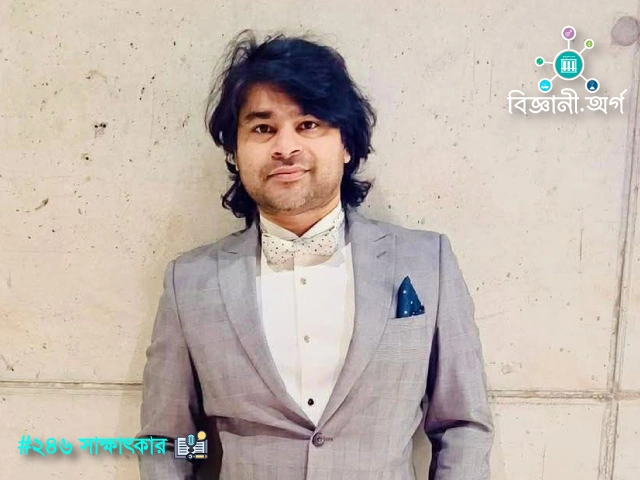
This time, in our series interviewing young scientists, we spoke with scientist Shahria Arfin Tanim. He is currently working as a researcher at Learnify Research Lab (LRL) and as a Research Assistant (RA) at the Advanced Machine Intelligence Research Lab (AMIR Lab). Read his interview below:
First, please tell us a little about yourself.
I completed my undergraduate studies from the Department of Computer Science at American International University-Bangladesh in December 2023, and I am the founder of Learnify Research Lab.
What is the focus of your research?
My primary research focus is on decentralized learning methods, especially in the context of federated learning. In this approach, artificial intelligence (AI) models are trained on multiple devices such as smartphones or computers, without the need to centralize data. By keeping data on local devices and only sharing model updates, federated learning preserves user privacy and increases data security.
Additionally, my research extends into areas like large language models, computer vision, and pattern recognition. In these fields, I work on developing AI systems that can understand and generate human language, analyze visual data, and detect patterns in complex datasets. A significant aspect of this work includes the analysis of medical and agricultural images, where AI is applied for disease diagnosis, advanced diagnostics, and improved crop management. Collectively, these fields contribute to the creation of more intelligent, efficient, and privacy-preserving AI systems that have important applications in healthcare and agriculture.
How does your research benefit us?
People can benefit from this kind of research in a variety of important ways:
- Privacy: Federated learning keeps your personal data on your device instead of sending it to a central server. As a result, the risk of your information being stolen or misused is reduced, since it does not rely on a centralized system.
- Improved Healthcare: AI can analyze medical images, providing doctors with more accurate and faster assistance in disease detection and diagnosis. This allows for better medical treatment and enables people to receive the necessary services more quickly.
- Agricultural Development: AI can assist farmers by analyzing images of crops, identifying diseases, managing resources, and making more accurate yield predictions. This leads to healthier crops and more efficient farming practices.
- Advanced AI Tools: Progress in language models and computer vision enables AI to understand and interact with humans even more effectively. This can lead to the creation of improved virtual assistants and innovative smart educational tools.
In summary, this research helps create AI that is more private, effective, and supportive in everyday life, advancing healthcare, agriculture, and technology.
Would you like to share any of your research experiences with us?
At the beginning of my research, I used a pre-trained deep learning model focused on classification tasks to detect a specific disease. During this work, I encountered significant challenges related to data collection and privacy. Since the data consisted of medical images, protecting patient privacy was extremely important. Additionally, the organizations supplying the data were reluctant to reveal their identities, making the data-sharing process even more complex.
Another issue was data availability. For example, if a disease is more prevalent in Africa but less common in Asia, there is a huge difference in the relevant data available for effective model training. This lack of data made me realize the need to look towards decentralized methods, and federated learning emerged as a promising solution. Federated learning enables decentralized model training, eliminating the need for data centralization and reducing privacy concerns.
Given the importance of protecting patient privacy, I see federated learning as a powerful solution for medical applications. Currently, I am focusing on addressing a known issue in federated learning called non-IID (non-independent and identically distributed) data, which needs to be resolved to fully unlock its potential in this context.
What qualities do you think a scientist should have?
As a researcher, I believe that patience and dedication are the most important qualities one must nurture. These traits are fundamental; once developed, innovative thinking, keen observation, and the ability to solve complex problems simply will naturally follow.
Do you have any message for young students in Bangladesh who want to pursue science?
Keep your curiosity alive and never stop asking questions. Patience and persistence are crucial, as you will often face challenges in research. Collaborate with others and always work ethically. Maintain your passion while also taking care of yourself. As Marie Curie said, “Nothing in life is to be feared, it is only to be understood.” Your work is valuable—always keep moving forward!
Wishing you success
Your LinkedIn website address
https://www.linkedin.com/in/shariaarfintanim
Your website, research links, etc.
https://www.researchgate.net/profile/Sharia-Tanim-2
https://learnifyresearchlab.com/index.html
Your contact information:
shariaarfin096 @ gmail.com, official @ learnifyresearchlab.com