News Desk, Biggani.org
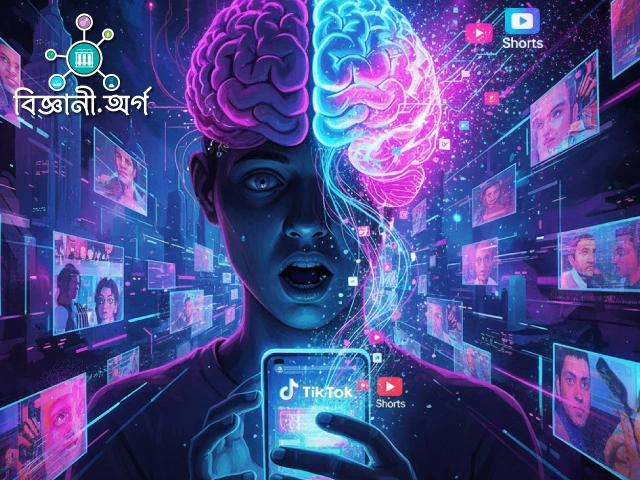
These days, a single swipe on your mobile phone brings up a stream of short videos—sometimes 15 seconds, sometimes 30, and sometimes a full minute. Dog shenanigans, cooking recipes, dance steps, or comedy sketches—before you can finish one video, another pops up. But did you know that mindless scrolling not only wastes your time but is also gradually changing the way your brain functions?
According to a recently published study (Chang Liu et al., NeuroImage, May 2025), short video dependency or addiction is having a profound effect on the brain’s decision-making abilities, risk assessment, and self-control.
📊 Main Focus of the Study: Video Addiction and Brain Function
The research was conducted on university students in China who showed signs of addiction to short videos. Through brain scans and various decision-making tests conducted on the participants, researchers found—
- Short video addicts are less afraid of financial loss,
- they tend to take riskier decisions,
- and they spend less time and thought on making decisions.
Along with these behavioral traits, brain imaging (MRI) showed:
- The prefrontal cortex, involved in self-control and long-term planning, showed reduced activity.
- The sensory-motor areas showed hyperactivity, especially when facing potential losses.
This pattern is very similar to gambling or gaming addiction—the brain at those times becomes more focused on instant rewards than on future risks.
⏱️ Short-term Fun vs. Long-term Harm
A single short video may last only 20–30 seconds. But caught up in this brief pleasure, we end up losing hours. And it’s not just time—this leads to:
- Disrupted sleep,
- Increased mental fatigue,
- Diminished attention,
- And weakening memory.
The study found that those addicted to short videos also exhibit impulsive behavior when making important real-life decisions—like impulsive shopping, hasty job decisions, or rash steps in relationships.
🧠 The “Reward Loop” and the Brain’s Neural Circuitry
Scientists say short video platforms create a “fast-reward loop”. You watch something, enjoy it, and your brain releases dopamine—the neurotransmitter linked to pleasure and rewards. Then your brain craves that feeling again, so you scroll for another video…
This cycle becomes so entrenched that the brain slowly loses interest in natural sources of joy. Activities that require time, effort, and patience in real life (like reading books, doing research, creative tasks) no longer bring the same satisfaction.
🧬 Small Videos, Big Impact: Young People Most at Risk
University students now make up the largest group of short video users. At this age, the prefrontal cortex—the brain’s center for future planning, moral judgment, and self-control—is still developing.
If the brain becomes accustomed to this kind of “clickable entertainment” at this stage, it may lead to problems managing life in the future.
The study revealed that participants most addicted to short videos had almost identical brain response patterns, pointing to the fact that this addiction is not just personal—it’s a sign of neurobiological changes.
📱 TikTok, Reels, Shorts—Who’s Responsible?
This is not a warning against technology itself, but rather against how it’s used.
- Social media platforms now use AI-based algorithms that show you more of the content you’re most susceptible to. This creates a kind of personalized addiction cycle.
- Videos are designed so users keep watching one after another—this is called “infinite scroll design”.
- You want to stop, but can’t—that’s the hallmark of addiction.
🧭 How Can You Tell If You’re Addicted to Short Videos?
If you regularly notice the following signs, it’s time to be alert:
- You start watching videos just to save time but spend over an hour,
- You go to bed late because you’re watching videos,
- You feel uneasy or irritable if you can’t watch videos,
- You keep reaching for your phone in between tasks just to scroll,
- Your head feels heavy after watching videos, but you can’t stop.
🧩 What’s the Solution? Hit the Brakes Yourself
Technology isn’t our enemy, but without control, it can become one. Here are a few steps you can take:
- Start a digital diet: Set a specific daily time for video watching and block the video apps the rest of the time.
- Take surprise breaks: Stop scrolling every 30 minutes and sit quietly with your eyes closed for 5 minutes.
- Use control apps: For example, Digital Wellbeing (Android), Screen Time (iOS).
- Seek real joy: Read books, walk in nature, talk with friends, learn something new—these are sources of lasting happiness.
- Stop nighttime scrolling: Avoid watching videos for 1 hour before bed; your sleep will improve and your mental health will benefit.
📢 Social Awareness Is Needed Too
Schools and universities should introduce classes on digital hygiene—where students can learn about screen time, brain effects, self-control, and related topics.
Government initiatives can also require short video apps to implement mandatory “Usage Time Alerts”.
🔚 Final Thoughts
The world of short videos is like a magical maze—once you’re in, it’s hard to get out. But research shows that if you’re not aware, it’s not only your time at risk; your decision-making ability, future planning, and brain health can be jeopardized too.
If we want a knowledge-based society, our youth need to learn to think—not just watch. Protect your brain—pause, reflect, then scroll.