(Editor: I read an excellent article on smart grids written by Shankar Sen in the Kolkata-based magazine Abakash. For the readers of Biggani.org, I am publishing the article here verbatim to share it.)
Electric Power
The same engineering methods that were used since the beginning of power generation are mainly still in use today. Advanced technology has given us massive power plants, high-voltage transmission systems, stepwise voltage reduction for consumer areas to suit different consumer needs, and unprecedented improvements in both control devices and control methods. To properly distribute the electricity produced from different centers, a network was created, known as the regional grid. Later, these regional grids expanded to state-level grids, and eventually, state grids were interconnected to form a national grid. All these steps aimed to reduce energy loss, keep electricity prices affordable, and to allow surplus electricity from one region to be used in areas with shortages. However, as the grid expanded, its stability became more fragile, requiring various engineering techniques to keep it under control.
But the problem lies elsewhere. In many countries today, prolonged use has left the transmission and distribution systems worn out, and in this electronic and computer era, simply supplying electricity to consumers is not enough: its quality, reliability, and price must also be appropriate. In addition, alongside population growth and urbanization, new areas must be electrified, leading to the establishment of new centers and expansion of the transmission and distribution system, making the management system more centralized. The relationship between producers and consumers becomes one-sided and undemocratic. As a result, service quality for consumers of various sizes is compromised.
Nowadays, in this “dumb” electric grid, communication is one-way only: from the consumer to the utility or electricity supplier. Here, attempts are made to increase or decrease production in line with demand using ‘electro-mechanical’ control systems. When suppliers cannot meet demand, various problems arise in the system, such as ‘load-shedding’ or ‘blackouts’.
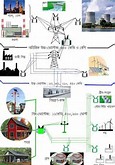
On top of that, renewable energy production is increasing significantly these days. To reduce carbon emissions, the public demands further expansion and enhancement of renewables, alongside the gradual phasing-out of fossil fuel and nuclear power plants. Additionally, solar electricity is being added to the grid in homes, large offices, and factories—ranging from small to large capacities. This transition can be achieved in an orderly way by moving to a ‘smart grid’ (see Figure 1).
The main concept of a smart grid is constant analysis, control, and maintaining a sharp focus on communication capability and efficiency, which allows the national grid to be used with higher efficiency and lower energy loss.
In this digital era, communication systems have become two-way, enabling real-time balancing of supply and demand—almost instantaneously. As a result, sudden peaks in demand can be significantly smoothed out. In this model, users, or consumers, are not only consumers of electricity but can also participate in production—at once both consumer and stakeholder. In this sense, there is a parallel with the ‘Internet.’ Globally, several hundred million computers—small, medium, and large—are intricately linked in a vast ‘invisible’ network, exchanging information independently.
In a smart grid, the energy produced and the transmission and distribution networks are managed skillfully and efficiently, reducing line losses through the use of many decentralized producers. As the share of renewable sources in total production increases, the smart grid will more efficiently and swiftly manage energy use.
Smart technology—smart meters, automated control systems, and digital sensors—enables consumers to access real-time electricity prices, helping them to save money. Consumers can shift their energy usage to low-demand times, when line losses are lower and the ‘dirtiest’ power plants are inactive. Furthermore, grid-control devices can provide early warnings of potential grid hazards.
It will take 10 to 30 years for full implementation of the smart grid, depending on the relevant government’s policy. The U.S. state of California has begun installing smart meters for its nine million customers. The Netherlands is changing the meters for its seven million household customers by 2012. Naturally, bringing electricity to new areas—such as the regions near the Sahara Desert—will be less expensive. According to calculations by the International Energy Authority (IEA), smart grid transformation worldwide will require $16,000 billion (U.S.) by the year 2030.
According to the U.S.-declared ‘Grid 2030 Vision,’ plans are in place for building a 21st-century grid through which every person, at any place, in any condition, can get all the electricity they need, affordably, efficiently, and reliably.

Figure 1: Outline of the Smart Grid system
Reference:
“Building a Smarter Grid”, State of the World into a Warming World, 2009, Worldwatch Institute, W.W.Norton & Co. London, New York.
http:// www.ruggedcom.com/SmartGrid, www.doe.energy.gov,
OE Home: Our Work
Shankar Sen