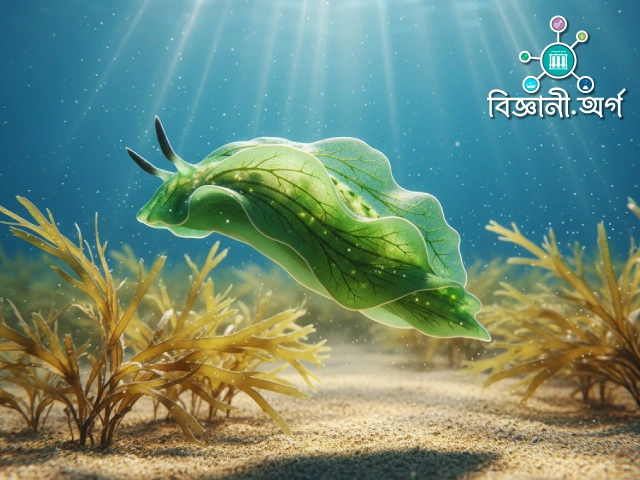
In science fiction, we often encounter scenes where animals are seen making their own food from sunlight. But in the real world, this remarkable tale is brought closer to reality by a unique marine creature—a green sea slug called Elysia chlorotica. Resembling a leaf, this animal is known as the “solar-powered sea slug.” It is an exception in the animal kingdom, because it can generate energy from sunlight just like plants do.
However, they cannot naturally perform photosynthesis like plants. The secret lies in a strange adaptation process called “kleptoplasty.” When this sea slug eats algae called Vaucheria litorea, it not only digests the algal cells but also retains the light-sensitive organelles called chloroplasts within its own cells. In this way, a sort of “borrowed” solar factory starts to work inside the slug’s body, providing it with extra energy for weeks or even months.
This adaptation is significant. Animals generally depend on plants, as only plants use sunlight to make sugars and supply energy at the base of the food chain. Yet here is an animal that can itself harness energy from sunlight. Examples like this blur the boundaries we thought were so clear between animals and plants.
Elysia chlorotica is not the only example. Several other sea slug species use this same trick, though less effectively. Most slugs destroy the algal chloroplasts within a few days, and so can’t maintain photosynthesis. Elysia chlorotica is special because it stays “green” for months at a time.
And it’s not just slugs—other animals on earth have developed strange ways to tap energy from sunlight. Corals and sea anemones host tiny algae called “zooxanthellae” within their tissues. These algae make food from sunlight and share it with the coral, while the coral in return provides a safe haven and nutrients. This partnership is so successful that coral reefs are now among the most biodiverse habitats on earth.
We even glimpse this strategy among vertebrates. Inside the eggs of the North American spotted salamander, special algae reside. These algae make oxygen and energy from sunlight right inside the egg, helping the tiny embryo survive. In the animal kingdom, this is a unique example—here, photosynthetic aid is found directly inside the body of a vertebrate animal.
Another controversial example is the pea aphid, a tiny insect. Research suggests it can use special pigments—carotenoids in its body—to produce a small amount of energy from sunlight. Though evidence is still limited and debated, it stands as another exceptional example of sunlight-dependent animal adaptation.
This raises a question—if getting food from sunlight is so beneficial, why haven’t more animals followed this path? The answer lies in the complex physiology of animals. The fine structures and genetic arrangements needed for photosynthesis in animal cells don’t easily evolve. This ability is the result of millions of years of plant evolution, and it’s nearly impossible for animals to develop it from scratch. As a result, only a few animals have learned to harness the sun’s energy in special ways—by either hosting algae or “stealing” parts of algae.
This also raises a kind of philosophical question. We’ve long thought of animals and plants as residents of separate worlds. But animals like Elysia chlorotica or corals remind us that the boundaries of nature are not so rigid. Life has, at different times, found various ways to survive, and these strange uses of sunlight are exceptional examples of that creativity.
Finally, there’s a relevant social angle to this discussion. Today, as humanity searches for sustainable energy, nature presents us with a peculiar inspiration. Even though it’s limited, the way animals have managed to gather energy from sunlight reminds us—the most fundamental source of energy is the sun. Perhaps one day, the union of biology and engineering will allow us to mimic these natural tricks and invent new technologies.
The story of animals harvesting energy from sunlight is thus not just a scientific curiosity, but a reflection of the eternal struggle for survival. The tiny slug called Elysia chlorotica teaches us that defining life is not about rigidly boxed rules, but an ongoing journey of creative adaptation. And it is within that journey that nature’s greatest wonder lies—the art of survival.