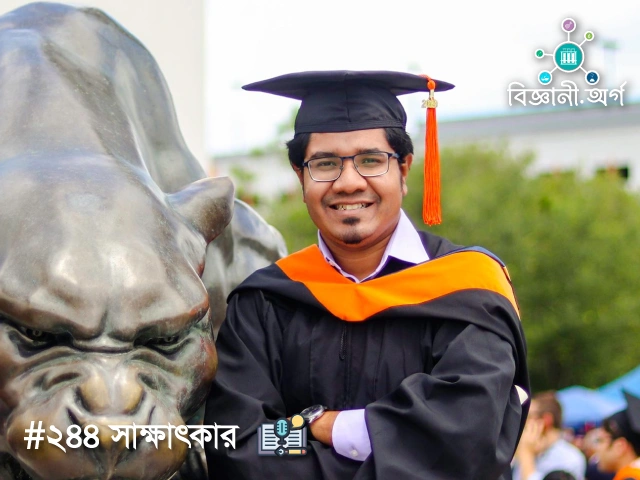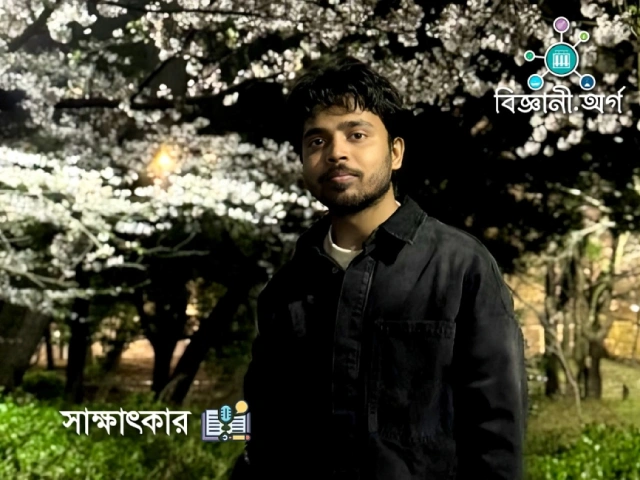
Syed Shahriar Hasan is currently pursuing a Master’s degree in Information Science at the Japan Advanced Institute of Science and Technology (JAIST), where he is conducting research under the MEXT Scholarship. Previously, he completed his undergraduate studies in Electrical and Electronic Engineering at the International Islamic University Chittagong (IIUC).
Alongside his studies, he has worked as an Adjunct Faculty and Teaching Assistant at IIUC. He actively led as the Treasurer of the IEEE IIUC Student Branch, and as the Campus Director and Head of Brand Marketing for the Hult Prize at IIUC.
Currently, his research focuses on Density Functional Theory (DFT) and Perovskite-based materials, which are opening new horizons in renewable energy and sustainable material sciences. He primarily works on computational modeling and theoretical material science, which could play a significant role in the future of solar energy production and green technology.
💬 Q&A Session:
Question: How did your research journey begin?
Answer: My journey in research began in my second year of undergraduate studies. At that time, my understanding of research was limited, but I had a strong desire to learn. While working on a project to provide electricity to the campus using solar energy, I developed an interest in research. Although the project was not published, it marked the start of my research journey. Later, publishing journal and conference papers helped build my confidence in research.
Question: What has your experience been like studying at JAIST as a MEXT scholar?
Answer: The MEXT scholarship has been a great blessing for my research career. It has allowed me to focus entirely on my research. For example, the same research that took two months in Bangladesh took only 15 to 20 minutes in Japan—this difference highlights the gap in research infrastructure between the two countries.
Question: What is the focus of your current research?
Answer: Although I am in the Information Science department, my research is mainly centered on Theoretical Material Science. I am trying to find new materials that are more effective, environmentally friendly, and sustainable for solar energy production.
Question: How did your collaboration with researchers in Bangladesh begin?
Answer: I collaborate with teachers, friends, and junior researchers from various universities in Bangladesh. These collaborations mostly started through idea sharing and mutual learning. Working together creates a wonderful environment for knowledge exchange.
Question: What was the biggest challenge studying abroad?
Answer: In the beginning, I was somewhat confused by differences in language, culture, and research standards. However, I took these challenges as learning opportunities and gradually adapted myself. Maintaining a positive attitude and self-confidence was key.
Question: Why is research on perovskite and DFT important?
Answer: DFT helps us analyze the electronic and optical properties of materials quickly and at low cost. Especially, Perovskite materials could revolutionize renewable energy generation. For young researchers in Bangladesh, it is an ideal field, as it does not require large infrastructure—only computational skills and curiosity are enough.
Question: How has your involvement with IEEE and Hult Prize supported your research?
Answer: These organizations have taught me leadership, teamwork, and communication skills. By participating in various seminars and workshops, I was able to gain new ideas and develop creativity in problem-solving.
Question: What advice would you give to young researchers?
Answer: Dream big, and work with perseverance and patience to fulfill those dreams. Don’t just think about personal success; consider how your research can contribute to society and the country’s welfare. Accept failure as an opportunity to learn.
🔗 Profile Links:
Google Scholar
LinkedIn
Syed Shahriar Hasan is among those young researchers who are presenting Bangladesh anew on the international research map. His DFT-based research in solar energy and sustainable materials science is expected to play a significant role in future green technologies.
Biggani.org team wishes him success in his future research journey and believes his path will inspire the youth of Bangladesh.
Searching for future energy in sunlight – Bangladeshi young scientist Syed Shahriar Hasan
Sayed Sahriar Hasan is a graduate student at the Japan Advanced Institute of Science and Technology (JAIST), pursuing a master’s degree in Information Science under the prestigious MEXT Scholarship. Originally from Chattogram, Bangladesh, he completed his Bachelor of Science in Electrical and Electronic Engineering (EEE) at the International Islamic University Chittagong (IIUC).
Before joining JAIST, Hasan served as an Adjunct Faculty and Teaching Assistant at IIUC, contributing to academic development while continuing his research interests. He has also been an active member and leader in student organizations such as the IEEE IIUC Student Branch (Treasurer) and the Hult Prize at IIUC (Campus Director and Head of Brand Marketing).
His current research focuses on Density Functional Theory (DFT) and Perovskite-based materials—computational studies aimed at discovering efficient, sustainable materials for solar energy generation. By combining materials science and computational modeling, Hasan’s work seeks to advance renewable energy technologies for a more sustainable future.
💬 Q&A Session:
Q: How did your research journey begin?
A: It started during my second year of undergraduate studies. I didn’t fully understand what research meant back then, but I was eager to learn. I began a project to power our university campus using solar energy, aiming to reduce costs and even supply excess power to the national grid. Although that project was never published, it sparked my passion for research. Soon after, I published my first journal and conference papers, which encouraged me to pursue research more seriously.
Q: How has your experience been as a MEXT scholar at JAIST?
A: Receiving the MEXT scholarship was a true blessing—it allowed me to focus entirely on my research without financial worries. The difference between Bangladesh and Japan in terms of research infrastructure is remarkable. For example, a project that took me two months to complete in Bangladesh took only about fifteen minutes at JAIST. This efficiency comes from the advanced facilities and structured research environment in Japan.
Q: What is the main focus of your current research?
A: Although I belong to the Information Science department, my work mainly focuses on theoretical materials science. I study new materials that could improve solar energy generation while being sustainable and environmentally friendly. My goal is to identify materials that are cost-effective, durable, and capable of driving green innovation.
Q: You’ve collaborated with several Bangladeshi researchers. How did those partnerships form?
A: Many of my collaborators are friends, juniors, or professors from Bangladesh. Our collaborations often start through academic interest, shared curiosity, and institutional agreements. Working together helps us exchange ideas and broaden our understanding.
Q: What has been your biggest challenge studying and researching abroad?
A: The biggest challenge was adapting to a new environment and understanding Japan’s academic culture. The language barrier, research methodology, and work pace were initially difficult. But I viewed these as opportunities to learn. Over time, I adapted by maintaining consistency, staying positive, and building strong communication within my lab.
Q: Why is DFT-based perovskite research important for young scientists in Bangladesh?
A: Density Functional Theory (DFT) allows researchers to explore the electronic, optical, and thermal properties of materials with minimal cost and time. Perovskite materials, in particular, hold great promise for renewable energy. Since DFT-based work mainly requires computational resources, young researchers in Bangladesh can contribute to world-class research even with limited infrastructure. It’s an ideal field to begin a global research journey.
Q: How did your leadership experiences with IEEE and Hult Prize help your research career?
A: My involvement with IEEE and Hult Prize taught me leadership, teamwork, and communication skills. Participating in workshops and seminars expanded my perspective and inspired creative problem-solving approaches—skills that are essential for any researcher.
Q: What advice would you give to young Bangladeshi students aspiring to study or research abroad?
A: Dream big, and pursue your goals with determination, patience, and integrity. Don’t just focus on personal success—think about how your research can benefit your community, your country, and the world. Accept challenges and failures as opportunities to grow. Every experience will shape you into a more capable and insightful researcher.
🔗 Profile Links:
Google Scholar
LinkedIn
Sayed Sahriar Hasan represents a new generation of Bangladeshi scientists making their mark in international research. His work on DFT-based perovskite materials bridges the gap between theoretical science and real-world renewable energy solutions.
The biggani.org team extends its warmest wishes to Mr. Hasan for continued success. His passion, discipline, and forward-looking research serve as an inspiration to young scientists in Bangladesh and beyond.