A fascinating feature of the human body is this: we always assume the brain is the center of all decisions. Yet, in the grand saga of billions of years called evolution, the brain was only fashioned near the end—a mere luxury. Long before that, the organ guiding life on Earth was the stomach. This may sound surprising at first, as we have never been taught to think of the stomach as an organ that makes decisions. But if you take a moment to reflect, you’ll see that for every creature, food is the first problem, survival’s first condition, and evolution’s first step. That’s why the stomach developed before the nerve cords of the brain. And this ancient organ still sits deep within our bodies, controlling human behavior, hunger, emotion, and survival instincts—doing all this without us even realizing it.
At the dawn of evolution, Earth’s first life forms were extremely simple. They had no brain, but they did have a place to take in food—a pouch where chemical particles from the environment would be broken down into usable energy. This “pouch” was the most primitive stomach. And it was life’s greatest revolution. Turning the chaos of the outside world into inner order. In fact, the brain developed later, only to quickly fulfill the needs of the stomach and interpret the environment more efficiently. In short, the stomach was the master, the brain its later assistant.
This lineage continued to humans. Our stomach is no longer just a pouch, but a complex chemical laboratory, a decision-maker, a barometer of emotions. Most importantly, the stomach still drives our behavior, acts as the secret director of our likes and dislikes, and stores a biological history of our ancestors’ survival.
Human emotions, hunger, and stress are so deeply connected to the stomach that many researchers are now beginning to say,
“The stomach is the first brain.”
As poetic as this sounds, it has a very strong scientific foundation. Many of the brain’s decisions depend on signals from the stomach. No matter how much we think of ourselves as “intelligent primates,” every day starts with the stomach’s hunger signals and ends with instructions from its weary clock. Even love, fear, and excitement leave a chemical footprint in the stomach, the way clouds leave trails in the sky.
If we look at human ancestors, food availability was the biggest uncertainty. A Stone Age morning meant preparing to search for food; if no food was found, the entire physiological system changed. In such situations, the stomach was the most active organ. When hungry, the hormone ghrelin was secreted, directly instructing the brain, “Getting food now is critical.”
Oddly enough, the brain was forced to follow this command. That instinct remains intact even today. When we are hungry, we feel dizzy, irritable, unfocused—these are all stomach-originated instructions.
Another ancient truth: the stomach has always been one of the organs most sensitive to the environment. Rainfall, cold, insecurity, fear of predators—these caused stress in our ancestors and that stress first manifested in the stomach. Its activity would slow, acid levels would rise or drop, appetite patterns would change. The reason is simple: when survival becomes crucial, the stomach switches to energy storage mode. Even now, not eating (or overeating) due to stress is not a modern problem, but a millions-of-years-old biological reflex.
Another strange aspect of the human stomach: it is exceptionally skilled at analyzing the environment. How safe or risky a food is—the stomach makes this decision in an instant. Its mucosal receptors finely analyze smell, taste, temperature, and toxins. Even after food enters the mouth but before digestion, the stomach can detect its chemical signature. That’s why, after getting sick from a food once, just seeing it a second time can make us nauseous—this is a learned stomach memory, not the brain’s.
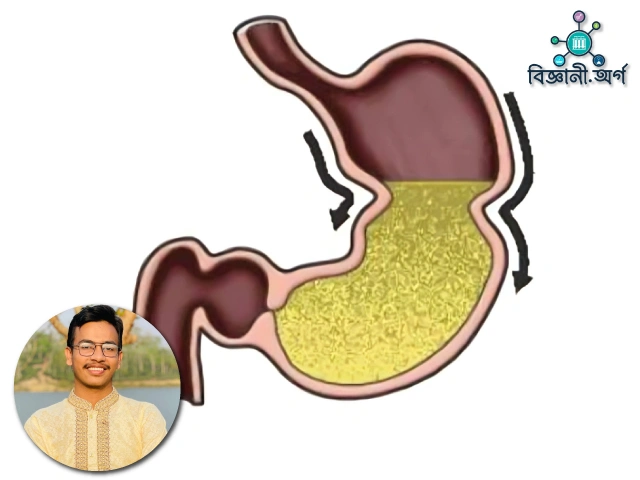
From an evolutionary perspective, the stomach is a biological sentinel. Foodborne diseases used to be humanity’s leading cause of death. Thus, the stomach became the ultimate gatekeeper. Extremely acidic HCl has been our weapon in that ancient battle. When you think about how powerful this acid is—it can even corrode bits of metal—but the stomach protects itself with a mucus–bicarbonate shield. This defense system is regenerated daily. Every 3–5 days, the stomach’s entire inner lining is renewed, like a city building new walls every day to stand ready against enemies.
The relationship between the human brain and stomach is like an organic island—on the surface it seems everything is brain-controlled, but deeper down the stomach makes the first decision. Hunger may seem like a “simple feeling,” but behind it there is a complex hormonal cascade. Ghrelin is secreted, the vagus nerve sends signals to the brainstem, from there the hypothalamus appetite center is activated, and then the behavioral urge arises. In other words, the brain’s sensation of hunger is stomach-dependent.
The reverse is also true. When you feel fear, the first response is that the stomach feels it—what we call ‘butterflies in the stomach’. Or when you hear bad news, you feel a heaviness in your gut and your appetite vanishes. The evolutionary logic is straightforward: in such moments, the stomach switches instantly from digestive mode to survival mode. It reduces acid secretion, slows peristalsis, and conserves energy.
This switching ability was a key tool for survival.
Every threat our ancestors faced left its mark on the stomach. Safe forests, unsafe caves, lack of food, the presence of predators, social conflicts—all these shaped the stomach–brain axis. As a result, to this day humans are emotional eaters, stress fasters, pleasure seekers—these are not just habits; they are evolutionary codes.
Perhaps the most intriguing thing is that, even when humans learned to speak, to think, to form societies, the stomach never gave up its ancient responsibilities. It remains the driving force of our biological programming. That’s why the connection between mental health and the health of the stomach is so deep that modern medicine is beginning to call it not just gut-feeling, but gut–thinking.
Current research shows:
The human gastrointestinal tract contains about 500 million neurons, known as the enteric nervous system.
This system is so complex it often operates the digestive system independently of the brain. Strangely enough, the stomach and intestines don’t need the brain’s permission to function.
If we consider humans as a “walking ecosystem,” then the stomach is its center. Emotional security, food preference, survival instinct—the stomach is the first to teach all of these. When hungry, we get irritable; when satisfied, we are calm; when unwell, we develop flavor aversion—this is not the brain’s achievement, but a stomach-coded biological algorithm.
Another profound truth: the stomach even played a role in creating civilization itself. Early humans discovered fire and began cooking mainly for the stomach. Raw food was difficult to digest; cooked food provided energy more easily. Cooking reduced the burden on the stomach, freeing up energy for the brain. As a result, the human brain experienced a huge leap forward. In other words, the stomach’s needs made the brain larger, and that brain later built human civilization.
There’s a famous saying from H. L. Mencken—
“Man is what he eats.”
But science says—
“Man is how his stomach evolved.”
Our eating habits, thoughts, emotions, and willpower are all inextricably linked to that ancient organ. No matter how wise or logical we think we are, our lives are still tied to the stomach’s secret chemistry.
It is our ancient teacher, sensitive guardian, and silent director of survival.
Maybe that’s why we still listen to our gut before taking action.
Before going for an interview, before entering the exam hall, before receiving bad news—the stomach is always the first to sense that something is about to happen. The brain realizes later; the stomach always knows first.
And so it can be said,
The brain, knowledge, civilization—all came after the stomach.
The true first brain of humanity is the stomach; when all around was darkness, it was the one to show the way.
Md. Iftekhar Hossain
MBBS 1st Year, Cox’s Bazar Medical College, Bangladesh | Main interests: behavioral science, neuroscience, and habit science.