News Desk, Biggani Org
📩 Contact: [email protected]
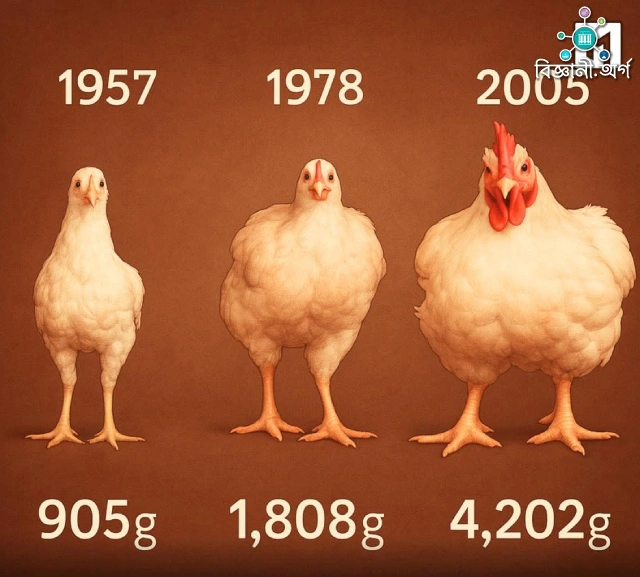
When you buy a chicken weighing a kilo or more from the market today, you might not realize that fifty years ago its ancestors were much smaller—roughly around 1 kg. Over the past five decades, the average weight of chickens raised for food has increased by nearly 364%. This isn’t just a statistic, but a complex reflection of animal husbandry, genetics, agricultural technology, and shifting consumer preferences.
What Were Chickens Like in the Past?
In the 1970s, the average weight of a domesticated broiler chicken was about 2 pounds (around 900 grams). Back then, they were typically raised in open yards at home and grew at a natural pace. But over time, consumer demand rose, eating habits changed, and a revolution occurred in industrial agriculture management.
The Science Behind the Weight Gain
The biggest driving force behind this change is selective breeding. Researchers and farmers have chosen chickens that grow quickly, put on more weight with less feed, and have comparatively larger breast meat. Especially a hybrid breed called Cornish Cross has become the mainstay of industrial farms.
Alongside this came improved feed optimization, which helps chickens absorb food more efficiently and gain weight faster. They’re kept at regulated temperatures, lighting, and in confined environments, so they don’t expend extra energy.
Hormone and Health-related Controversies
There have often been allegations of using growth hormones to accelerate chicken growth, although in developed countries like the United States, the USDA has banned such practices. However, the question remains—are these rapidly growing bodies truly healthy?
It’s often observed that chickens reaching nearly 4 kg in just 5-6 weeks have legs that cannot bear the body’s weight. Problems appear in the heart, bones, and lungs. Their ability to walk is reduced; some chickens cannot walk at all. This condition is called the “Broiler Welfare Crisis”—a silent issue that usually escapes the notice of ordinary consumers.
Meat Quality and Flavor
As chicken weight has increased, their natural lifespan has dropped, leading to a loss in meat flavor and quality. Many now say that store-bought broiler meat lacks the aroma and taste of the past. The reasons may include artificial feed, slaughter at a young age, and a lack of genetic diversity.
Environmental Impact
Questions have arisen—what kind of environmental effects do these high-production poultry farms have?
- Large amounts of methane and ammonia gases are emitted.
- Poor waste management leads to soil and water pollution.
- Chicken feed production relies heavily on soy and corn, the farming of which destroys forests worldwide.
Ethical Questions: How Fair Is It?
When we call this kind of production a ‘success’, are we ignoring the animals’ suffering? Animal Welfare Organizations have repeatedly pointed out that chickens are not given the scope for their physiological needs, freedom of movement, or chance for natural growth.
In many developed countries, chickens sold as ‘free-range‘ or ‘organic chicken‘ are allowed to move naturally, eat natural feed, and are given enough time to grow. However, these are relatively expensive and beyond the reach of most people in developing countries.
In the Context of Bangladesh
In Bangladesh, too, the demand for broiler chickens is constantly rising. They’re relatively cheap, easy to cook, and can be produced rapidly. But now is the time for our agricultural experts, farm owners, and policymakers to consider—how safe is this production method for our public health and environment in the long run?
Many young farmers in both cities and villages are now starting deep litter or organic poultry farming. These farms are comparatively more sustainable and healthy, although the production costs are higher.
What’s the Way Forward?
Worldwide, research is underway on how to make food production more sustainable, fair, and healthy. Ideas include—
- Lab-grown meat (Cultured Meat): Where meat can be produced from cells without killing live animals.
- Using different chicken breeds: Those that are healthier, more environmentally resilient, and face fewer problems.
- Increasing consumer awareness: So that people consider health and environmental impact, not just low prices.
Conclusion
A chicken’s body is not just a container of meat—it encompasses a complex world of science, economics, environment, and ethics. That’s why we need to know the stories behind every meal we eat. In the future, the world will not rely on production alone, but rather sustainability, ethics, and scientific decision-making will form the foundation of food security.
📚 Learn more:
- USDA – https://www.usda.gov
- Compassion in World Farming – https://www.ciwf.org.uk