News Desk, Biggani.org | [email protected]
Dhaka, July 13, 2025
In the dark depths of the ocean, scientists have recently discovered a strange entity that is challenging our long-held definitions of life. Its name—Sukunaarchaeum mirabile. As mysterious as its name sounds, its existence and life cycle are even more astonishing.
Scientists already say this discovery could change the textbooks of biology in the future. That’s because Sukunaarchaeum creates a peculiar balance between what is alive and what is inanimate.
⚛️ Alive or Dead?—A Miraculous Existence
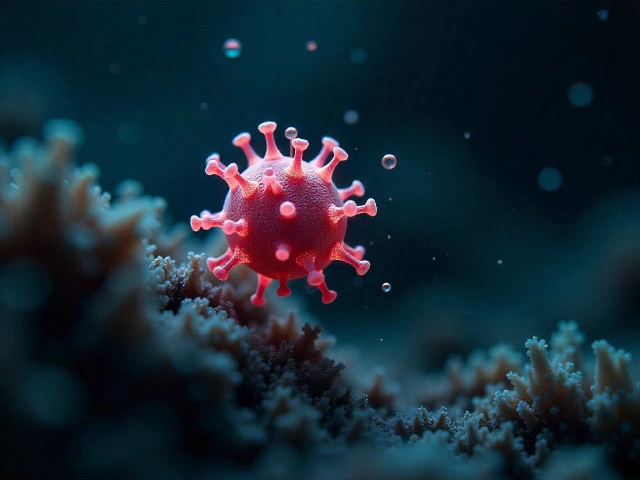
There’s nothing obvious to see. Sukunaarchaeum looks like a tiny virus—extremely small, and detectable only with an electron microscope. But here’s the twist! This entity can make its own protein-making machinery (ribosomes). That’s something even viruses cannot dream of.
So is Sukunaarchaeum fully alive?
No! Because it cannot exist alone. To survive, it must take shelter within another organism. All its metabolic activity and energy production depend entirely on its host.
That’s why it’s being called a “living Zombie”—neither fully alive nor completely inert.
🧬 Sukunaarchaeum DNA: The Core Version of Life?
The most astonishing feature of this entity is its genome or genetic material. Sukunaarchaeum’s entire genome consists of only 238,000 base pairs.
For comparison, the human genome has about 3.2 billion base pairs!
This comparison shows that Sukunaarchaeum is almost like a miniature version of life—equipped with only the essential functions, with all the extras left out.
It’s being called the “minimal operating system” of life—a basic calculator, coded only with what is absolutely necessary for survival.
🔬 How Profound is the Significance of This Discovery in Biology?
This organism is not just a new species. It is a representative of an ancient form of life that still hides deep within the Earth. Scientists suspect that Sukunaarchaeum might be an ancient prototype of life—a living fossil.
This discovery raises several profound questions:
- How far does the boundary of what we call “life” truly extend?
- Is there a new category of existence between organisms and viruses?
- If we qualify entities like Sukunaarchaeum as alive, do we need to redefine life itself?
This entity proves that life may be a spectrum, not split by clear hard lines. Between living and nonliving, there can be many shades of gray.
🌌 The Search for Life in the Universe: Will Our Perspective Change?
When we look for life in space, we usually search for Earth-like features—oxygen, water, cells, metabolism, and so on.
But Sukunaarchaeum shows us that life can exist beyond these conventional definitions.
This teaches us that extraterrestrial life may exist with completely different structures and under different conditions. If a parasitic, minimal-genome entity like Sukunaarchaeum is possible, then the probability of life elsewhere in the universe multiplies exponentially.
🧪 How Did Scientists Find Sukunaarchaeum?
This organism was first discovered on the ocean floor at a hydrothermal vent in the Pacific Ocean, an environment marked by superheated water jets and bizarre chemical conditions.
Scientists used modern metagenomic sequencing technology to analyze its genome. It was found that most of its genes are unlike anything previously observed.
They noted that Sukunaarchaeum is a member of the nanoarchaea group, organisms characterized by their tiny size and parasitic nature.
🧠 Possibilities and Research Horizons for the Future
Sukunaarchaeum shows us how minimal the structure of life can be. It stands as a unique example for synthetic biology. In future, scientists may analyze such organisms to create minimal cells designed for specific functions—like producing targeted chemicals, pollution control, or drug delivery.
At the same time, it raises new questions:
- Are our biology textbooks updated enough?
- What kinds of entities might future research uncover?
- How many unknown life forms still hide in the depths of the sea or beneath the Earth’s surface?
🔚 Conclusion: Sukunaarchaeum Holds Up a Mirror to Us
Sukunaarchaeum mirabile is a living riddle. It is truly unique in the world of science—not only does it teach us something new, it challenges our old ways of thinking.
For so long, scientists have shaped the definition of life based on a certain set of guidelines. Now, along comes this tiny entity to say—“Your guidelines might be incomplete.”
Such an existence reminds us that nature still holds many mysteries, and there is much left to discover.
And this is exactly why science is a name for infinite wonder.
📌 Sukunaarchaeum mirabile might change our very outlook on science. Perhaps it’s time to rewrite the definition of life.
🔍 Do you also believe that the boundaries of life are not so simple? Share your thoughts with us on the biggani.org Facebook page or by email at [email protected].