

Author- Pradip Deb
As you are reading this piece, I’m assuming you love science and think about it deeply. You’re not yet certain what you’ll become in the future—what your profession will be, how your days and nights will unfold. No one ever truly knows. But surely you are dreaming of becoming something. You’re studying in such a way that your education becomes a vital part of turning that dream into reality. Whether you become a doctor, engineer, teacher, writer, BCS cadre, police officer, or politician—no matter what, since you love science and enjoy reflecting on scientific activities, you’ve already met the first two requirements of becoming a scientist.
But simply loving science isn’t enough to become a scientist. You need long-term preparation. Science is a very complex subject, and the path of science is a challenging road. You may have noticed that, on the pages of Bigganchinta, we try to explain various complex scientific concepts in a simple way. When you read those, you might think—this is easy. Yes, if understood correctly, scientific theories are quite simple. But the scientists who discovered those theories—the path to their discoveries wasn’t easy at all. When you read about a scientific topic—written in a way that’s easy for you to grasp—you feel good, your love for science develops. This is science from the user’s perspective, or what is called “user-level science” in English. The affection you feel for science at this level, if you want to become a scientist, you’ll have to nurture it for many years and take it much further. If you are a science student in school or college and aspire to become a scientist or researcher in the future, loving science isn’t enough—you’ll also have to embrace the challenging path of scientific education and research.
Suppose you want to become a scientist by crossing the tough journey of scientific research. But how do you know which path is right for you? Which route will lead you to your goal? There’s no easy or obvious way to answer these questions. However, if you have enough understanding of the scientific world and have taken some preliminary preparation before entering it, you’ll be able to identify the path on which you both enjoy walking and which also brings you closer to your goals.
According to statistics published by UNESCO’s Institute of Statistics [1], the total number of scientists worldwide is approximately 8.8 million. Here, it’s important to clarify who we’re calling “scientists.” Not everyone who completes studies in science becomes a scientist. There are around 12.7 million MBBS doctors and 27 million BSc engineers worldwide, but those simply fulfilling their routine professional duties are not all scientists. Even among science teachers, those merely teaching in classrooms or carrying out administrative work are not scientists. Scientists are those who are engaged in regular research in science, generating new scientific knowledge, and for whom scientific research is a regular part of their professional life. Anyone working in any branch of science can become a scientist if they are regularly conducting scientific research.
In terms of population ratio, Israel has the highest number of scientists. There, for every million people, there are about 9,500 scientists. Next is South Korea (8,500 scientists per million). In Japan, the number is 7,000 per million. In the US, Canada, Germany, and Australia, the number is around 4,500 per million. In China, around 2,000 per million. In India, only 300 per million. In Bangladesh, the number is even lower—only 100 per million. In this country of 170 million people, there are only 17,000 scientists. That means, for every 10,000 people in our country, there is just one scientist.
What is the reason for such stark inequality? The annual budget allocation for scientific development is certainly a major factor. In Israel, about 5% of the annual budget is allocated for scientific research. In the US, it’s 2.84%; in Germany, 3.1%; in Japan, 3.26%; in China, 2.19%; in South Korea, 4.53%; in Australia, 1.87%; and in India, 0.65%. In Bangladesh, there’s virtually no separate budget for scientific research in the annual allocation. Whatever allocation exists, much of it goes toward foreign trips of scientific officers.
But lagging behind in science research isn’t only due to low budget allocation. The biggest barrier to creating scientists lies within our education system itself. Suppose you’re in class nine now, enjoy physics, and want to become a physicist in the future. But you have no idea how to become a physicist. Perhaps your school or college teachers never told you what kind of preparation is required to become a physicist.
In Bangladesh, there isn’t an easy way to gain true insight or understanding about the real world of science that would help you prepare in advance. In your school science books, whatever is written, your teachers compel you to memorize and write in exams exactly as it’s written. You’re forced to do this—otherwise, you won’t get good marks. To achieve high marks, besides school and college, you attend coaching centers where they teach you exactly how to answer exam questions for maximum marks. In the science stream at SSC and HSC, you’re required to study subjects like physics, chemistry, information technology, math, biology, etc. The workload is so high that there’s barely any opportunity to develop a true love for these subjects. Instead, constant fear of losing marks if you slip up even a little leads to extreme anxiety. As soon as your HSC exams finish, preparations for the admission war begin.
Those who get into medical school spend their lives working as doctors in hospitals and clinics. Many pursue higher medical degrees like FCPS, MD, MRCP, etc. But very few doctors have the interest, time, or opportunity to engage in real research in medical science.
Those who study engineering get hands-on opportunities to learn their craft. There are some opportunities for research and innovation outside the syllabus. But after graduation, many engineers in the workplace become more interested in passing the BCS exam and becoming administrators, rather than practicing engineering. In our country, there are very few technologically advanced industries, so not all engineers get suitable jobs. Therefore, many go abroad, earn foreign degrees, and stay overseas—some of whom get a chance to become scientists.
After doctors and engineers, those who remain enroll in honors classes in any branch of science at university. Even deciding which subject to choose can be a big challenge because, before university admission, you have no idea what each department teaches or what your future options will be after graduation. Or, if you wish to become a nuclear physicist in the future—there’s no guidance about which skills you should develop from school onwards. In our country, the number of scientific research institutions is very low. The number of scientists is also small. So students rarely get a chance to speak with real scientists or observe their work up-close. We don’t even have a science museum where you could go and learn science hands-on.
But in developed countries, where the number of scientists is much higher—the education system is quite different. In all advanced countries, the education system is designed in a way that, at every stage from science student to scientist, there is proper training and support. Take the United States for example. There, from the very lowest grades, various types of science project competitions are organized for school students. Nationwide, the best projects are selected, and those interested in science get suitable training. Even in primary school, working scientists are occasionally brought in to introduce themselves to the students. Sometimes students are taken to research labs—they can directly observe how scientific research is done and how scientists work. High school students are given opportunities to participate in real science projects through various competitions. Institutions like NASA offer students chances to work on different projects. Real scientific research begins from the university level. Not all the emphasis is on memorizing textbooks and passing exams. Those who enroll just to get a job and earn money have separate courses from those who are interested in research. Developed countries have solid systems in place for producing scientists.
Given the current state of education and the workforce in Bangladesh, becoming a scientist is certainly difficult, but not impossible. If you truly want to be a scientist, it’s possible to do so right from our country. For that, you need to start preparing from your school and college days. If you become a doctor—there’s no barrier to becoming a medical scientist. In fact, since we have such a large number of diseases and patients, if you have an interest in research, you’ll find many opportunities here to become a medical scientist. If you become an engineer and are interested in innovation—you can solve many of our country’s technical problems. And if you want to do research in any branch of basic science—physics, chemistry, or biology—you also have endless possibilities.
If you want to conduct research in any branch of science, there’s one thing you must always remember: there are no shortcuts in scientific research. No makeshift solutions, no place for cheating or lies. There’s no room to tamper with research results. If anyone does, it will always be exposed by someone. Scientific research is universal. In other words, any result you find sitting in Bangladesh, the same result should be found anywhere in the world under the same scientific conditions. There is no shame or fear in admitting mistakes in science research—scientists learn by making mistakes.
One of the most essential conditions for being a scientist is learning to ask questions. In science, there’s no scope for accepting anything without question. The job of a scientist is to discover the unknown. That is, scientists do not know in advance what the result of their research will be. The curiosity to discover the unknown is what makes them scientists.
So how will you proceed? Whatever you study in science—you must understand it thoroughly. Not only should you understand it yourself, but you also need to develop the skill to explain it to others. If you understand something and can explain it in your own words to someone else, it will become even clearer to you. Talk to the teachers in the subject you want to specialize in; let them know about your interests. Teachers are always happy to find engaged students. If necessary, reach out to university teachers on your own initiative. If it’s not possible to speak to the teachers before admission, talk to the students from that department. If you have access to the internet, you can find information about all kinds of research online. There are many competitions including science olympiads—participate in them regularly. Identify your weaknesses in understanding scientific concepts. There is no shame in not understanding something. It’s much more important to figure out what you don’t understand, rather than memorizing without understanding. Although we may not have direct opportunities to talk to world-renowned scientists, by reading books about their scientific lives, you can still learn how they conducted their research.
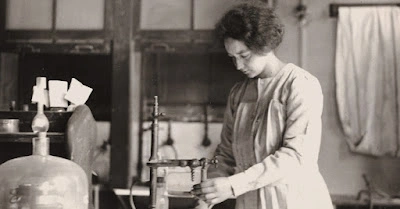
Irene Curie – Started scientific research in her youth under the guidance of her mother, Marie Curie
In the next decade, there will be many opportunities for research in quantum computing and information technology. Many new avenues will open to solve the issue of clean energy. There will be massive changes in space research. There will be tremendous opportunities to integrate biotechnology and medical science. In climate change and technologies for adaptation, infinite possibilities for research are emerging. Nanomedicine and nanotechnology, biochemistry and new drug discovery—projects like these will require hundreds of thousands of scientists in our country. If you want to be a scientist—keep preparing yourself, and you will succeed.
References
1. UNESCO Science Report, Paris, 2021.
Published in the 100th issue of Monthly Bigganchinta