How complicated can a mere game really be?
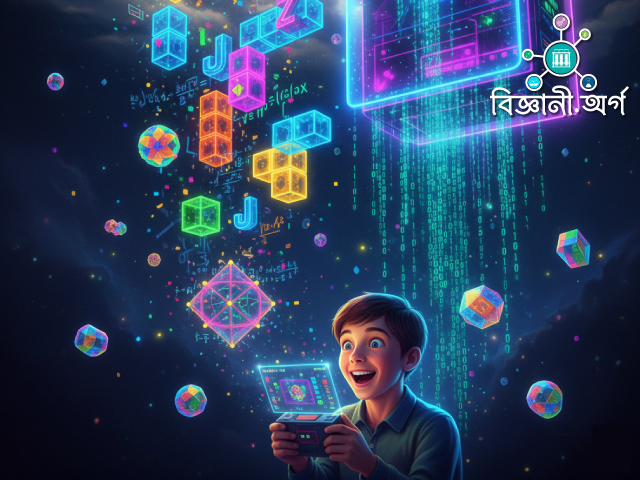
Have you ever thought that a simple game like Tetris, created in the 1980s, could pose a massive challenge even for today’s supercomputers and mathematicians? Yes, that’s exactly the case.
🔹 A Game That Made History
In 1984, Soviet Union programmer Alexey Pajitnov created a small video game—Tetris. In it, differently-shaped blocks fall from the top, and players must arrange them to fill rows, which then disappear. That little game went on to conquer the world. In the 90s, Tetris on the Game Boy screen became an obsession for a whole generation.
But behind this game lies complex mathematical and computational mysteries—some of which are even known as unsolvable problems.
🔹 Simple Game, Complex Mathematical Structure
If you think Tetris is “just a game,” you’re mistaken. For mathematicians, it’s an extremely complex puzzle from both geometrical and computational perspectives.
The main goal in Tetris—filling an empty space of a specific size with various blocks—is a type of Parquet Problem: Can you cover a region entirely using tiles of particular shapes?
These problems belong to a branch of mathematics called “complexity theory.” Here, it’s investigated how difficult a problem is to solve, and what kind of computational power is needed to do so.
🔹 P vs NP Problem and Tetris
In complexity theory, problems are generally divided into two classes:
- P class: Problems that can be solved quickly by conventional computers.
- NP class: Problems that are hard to solve, but if you’re given a possible solution, it’s relatively easy to check if it’s correct.
The question arises with Tetris as well—if you already know which blocks will appear, and how many, can you clear the whole board? The answer isn’t so straightforward.
In 2003, researchers at the Massachusetts Institute of Technology (MIT) proved that Tetris can be compared to an NP-Complete problem—the Three-Partition Problem.
🔹 What is the Three-Partition Problem?
Suppose you have some numbers—say {1, 2, 5, 6, 7, 9}. Can you divide these into three subsets so that each subset has the same sum (for example, 15)?
Example: {1, 5, 9} and {2, 6, 7}—both give a sum of 15.
This problem is so difficult that it’s NP-Complete. Researchers have shown that this problem and the problem of clearing a Tetris board are mathematically identical. That means, if you can solve the Three-Partition Problem, you can solve the Tetris board-clearing problem—and vice versa.
🔹 Tetris: A Game That Outwits Computers
These problems are not just difficult—they have even been proven to be undecidable.
In 2004, two researchers from Leiden University in the Netherlands—Hendrik Jan Hoogeboom and Walter Kosters—conducted a study on the I-shaped block in Tetris. They asked: If it’s specifically stated how 40 I-blocks will be placed, is it possible to clear the board?
The answer is—this question is as complex as Gödel’s Incompleteness Theorem, and it’s impossible to give a definite answer—not even with infinite computing power!
This is a type of mathematical problem for which there is no guaranteed solution or proof of impossibility—it’s undecidable.
🔹 But Tetris Players Don’t Worry About All This!
Yes, none of this complexity comes to mind when you’re immersed in the game. In real life, the blocks are dropping so fast that you simply don’t have time to think about it all.
But research has shown—Tetris isn’t just fun, it’s also a mathematical puzzle.
🔹 A Teenage Player Breaks the Record
Up until 2010, Level 29 was considered the ultimate stage in Tetris. But in 2023, a 13-year-old player used a special technique called “Rolling” to reach Level 157—causing the game to crash!
“Rolling” is a type of finger-flicking technique that allows for very rapid input.
This event proves—when the mathematical complexity is beyond the reach of computers, humans can open new doors with technique and creativity.
🔹 The Future of Games in the Eyes of Science and Mathematics
Tetris is not just a part of history; it’s still a subject of research for mathematicians and computer scientists. Its complexity proves that inside even a simple game, there may be extraordinary mathematical problems hidden.
We often hear—math is hard, games are a waste of time. But Tetris shows—a game can be an inspiration for mathematical exploration.
🔹 Conclusion: It’s the Hidden Complexity, Not the Simplicity, That Amazes
The game of Tetris teaches us that we shouldn’t dismiss something just because it looks simple on the surface. Sometimes, behind that simplicity, lies a vast mathematical universe.
Next time a Tetris block falls into your hands, remember—you’re not just playing a game, you’re engaged in a grand battle of complex mathematics!
📢 Have you ever experienced the joy of math or science while playing a game? Share your story with us at biggani.org!
📨 [email protected]