Author: News Desk, Biggani.org
When conducting research and trying to reach a conclusion, a common question often arises—is the result we found simply a coincidence, or is there a real effect or difference behind it? One of the key statistical tools that help us find the answer is the Z-Test.
Although the name might sound a bit intimidating, the Z-Test is actually a lot like an X-ray machine. If used correctly, it tells us whether a piece of data or a sample actually differs from the population mean and how significant that difference is.
📘 What is a Z-Test?
A Z-Test is a statistical test primarily used for hypothesis testing. It determines whether a sample is significantly different from a specific mean, or whether there is a real difference between the means of two samples.
It is mainly used when:
- You have a large sample size (usually n > 30),
- You know the entire population mean and its standard deviation,
- And your data follows a normal distribution.
✅ Advantages of Using a Z-Test
- Accurate Hypothesis Testing:
The Z-Test is a reliable method for hypothesis testing. For example, if you have an idea about a specific average (such as the average exam score of students in a school is 70), the Z-Test can tell you whether your sample (say, results from 30 students) is consistent with that average. - Reliability:
For large datasets and where variance is known, the Z-Test can provide very dependable and strong evidence. - Simple and Well-Known:
Many researchers and students are familiar with the concepts of the Z-Test. It operates with straightforward mathematical formulas, making research results easier to interpret.
❌ Risks of Misuse
Although the Z-Test is very effective, not following some important conditions can lead to misleading results:
- Application to Small Samples:
The Z-Test is designed for large samples. If used for small samples (n < 30), the results may be incorrect. In such cases, the T-Test is more appropriate. - Data Not Normally Distributed:
The Z-Test assumes that your data is normally distributed. If not, the results can be misleading. - Application with Unknown Variance:
The Z-Test works accurately only when you know the population standard deviation. If not, the results may be invalid or incorrect. - Blind Reliance:
Relying solely on the Z-Test can lower the quality of your research. You need to understand where it is effective and where it is not.
🔁 Modern Alternatives
There are now several modern methods that can overcome the limitations of the Z-Test, such as:
- Bayesian Methods: Decisions are made not just on estimation but on prior beliefs and data.
- Bootstrapping: Re-samples data to analyze any dataset, even small ones.
🛠️ How to Run a Z-Test in Practice?
It’s very easy to run a Z-Test using a programming language.
🔹 In R:
You can perform a Z-Test using the z.test() function from the BSDA package. Example:
library(BSDA)
z.test(x = sample_data, mu = 70, sigma.x = 10)
🔹 In Python:
Use the ztest() function from the statsmodels library. Example:
from statsmodels.stats.weightstats import ztest
ztest(data, value=70)
📊 Analyzing the Results
From the results of a Z-Test, you get a Z-value and a p-value.
- Z-value indicates the position of your data on the scale of a normal distribution.
- p-value tells you the probability that the result occurred by chance.
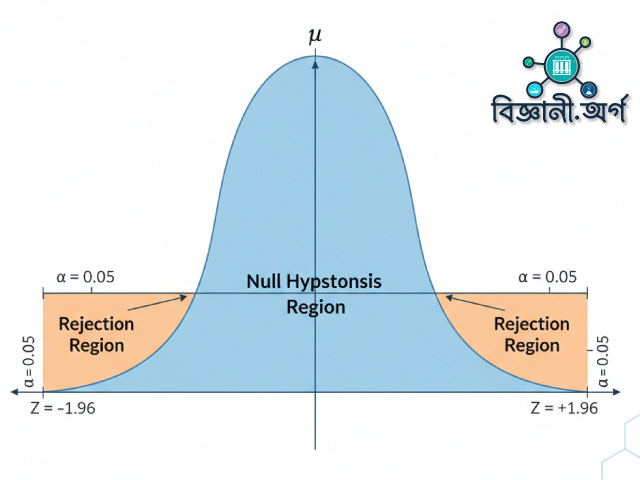
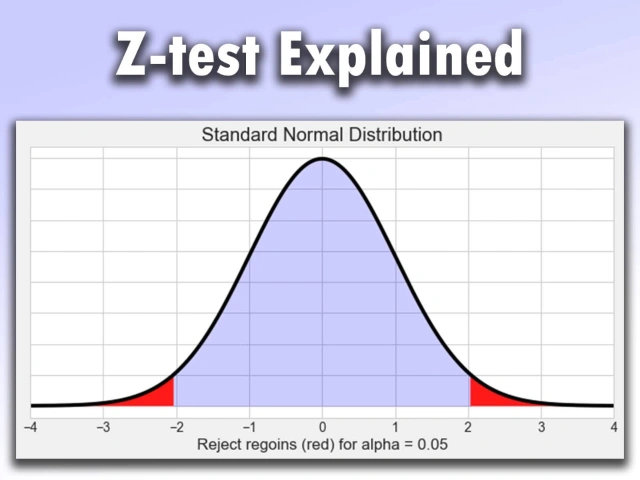
Suppose you are using a 5% (α = 0.05) significance level. If the Z-value falls outside ±1.96, you can reject the null hypothesis (the assumption you are testing). The following Wikipedia image explains this concept:
🔗 Null Hypothesis Region Visual
🎓 Want to Learn More?
If you want to learn about Z-Test and many other important statistical methods in detail, you can check out the following online course:
📚 Statistical Methods in R
➡️ Course Link: https://statisticsglobe.com/online-course-statistical-methods-r
In this course, you’ll learn how to properly use Z-Tests and other tools in research, and how to reach more reliable conclusions with them.
🔍 Conclusion
The Z-Test is a simple, effective, and widely used statistical method. However, its accuracy depends on whether its conditions are met correctly. To ensure research quality, you should consider not just the Z-Test but also other modern methods.
From university students to professional researchers, learning and understanding the Z-Test is important for everyone. That’s because it can shed light not only on exam results but also on many real-life decisions.