If you ask Google or an artificial intelligence chatbot, “How many people have ever been born on this planet?”—you’ll get an answer quite quickly. The figure is around 117 billion. But doesn’t that seem a bit low to you? Think about it: the current world population is about 8.2 billion. That means nearly 7 percent of all the people who have ever lived are alive today!
This 117 billion number includes everyone who saw the light of earth, even those who died in childhood. However, over time, the average human lifespan has increased across the world. As a result, some strange questions about population emerge. For example, a 2014 article in The Economist claimed that of all the people in human history who made it past the age of 65, half are still alive today! Could that possibly be true? And how are such calculations even made?
Let’s uncover the story behind the fascinating math of demography.
Why Is This Calculation So Difficult?
For decades, demographers have worked on such questions. Their biggest challenge is the lack of reliable data. To know how many people were alive at any given time, as well as their average lifespan or birth rates, accurate data is needed. While today this information is available thanks to censuses, for the world centuries ago it’s nearly impossible. Regular statistics gathering or censuses simply didn’t exist back then! So, demographers must largely rely on estimates.
What are these estimates based on? They use clues from the size of ancient cities, population densities, and archaeological evidence to come up with an approximate number. However, these estimations can differ greatly between studies. For instance, some say the world population in 1 AD was 170 million, while other research says 300 million—almost double.
Another fundamental question comes into play—exactly whom do we mean by “humans”? Only our species, Homo sapiens, or all members of the Homo genus, who have walked this planet for hundreds of thousands of years?
Despite all these challenges, the fact that we even arrive at a figure like 117 billion is quite astonishing. Even if scientists believe it’s not an exact number, its order of magnitude is considered fairly reliable. In other words, the real number is probably close to this estimate.
Population Modeling: The Mathematics of Humanity
The rate of population growth has not always been the same throughout history. In ancient times, the population grew very slowly, but in recent centuries, growth has become astonishingly rapid. The reason is that although birth rates have dropped, death rates have fallen even more sharply.
Translating this ever-changing growth rate into a mathematical model is quite complex. That’s why demographers use a particular method. They divide all of history into several smaller periods. For example, from 50,000 BC to 2022, the timeline is split into several segments. In each period, the rate of population growth is considered roughly constant.
The rate of population growth at any given time can be expressed using an exponential function, which works much like compound interest in a bank. Even if there were only a few people at the start, numbers increase rapidly over time.
Now, the question is: how do we figure out the total number of people ever born? For that, you have to sum up the number of people alive at every point in time. In mathematical terms, this is called integration. But there’s a catch. If you’re reading this article, you’re alive right now. You were alive ten years ago, too—and you were counted as part of the world population then. If we just add up these numbers, every person gets counted multiple times.
The solution is to divide the total population of each period by the average lifespan of people during that time. Finally, add the results for all periods, and you’ll get that magical number!
A Simple Method and Its Results
Does the math feel a bit complicated? German math teacher Bruno Scheja shared a simpler method for his students. Since his students didn’t know complex techniques like integration, they used a straightforward approach.
They calculated the average population between two given years. For example, if the population in 1900 was 1.6 billion and in 1945 it was 2.5 billion, they took the average as 2.05 billion for those 45 years. Then they multiplied this average by the duration (45 years) and divided by the average lifespan of that period. Repeating this for each segment, they came up with a total figure—which was quite surprising!
Let’s compare both methods using the data employed by demographer Carl Haub. He assumed that humanity began 50,000 years ago with just two people. Using his data and the more complex mathematical approach, the result came to about 93 billion. The currently popular figure of 117 billion is based on even more up-to-date data and assumes that humanity began 200,000 years ago.
On the other hand, when the German students used their simple method, the result turned out to be over 140 billion! Although there seems to be a big difference between these numbers, both are actually of the same “order of magnitude” (between 10 billion and 100 billion). This proves that even with a simple idea, it’s possible to get pretty close.
Solving the Mystery of Those Over 65
Now, let’s return to that astonishing claim—that of all the people in human history who reached age 65, half are still alive! In 2017, a group of demographers set out to check this statement.
After their research, it turned out the claim was not correct. According to their calculations, of all the people in history who reached age 65 or over, only about 5.5 to 9.5 percent are still alive today.
While this number is much lower than the original claim, isn’t it still remarkable? Think about it: if a lottery determined in which era of human history you would be born, and you were guaranteed to live to 65, your chance of still being alive today would be about 1 in 10! In the context of human history spanning hundreds of thousands of years, that’s truly extraordinary.
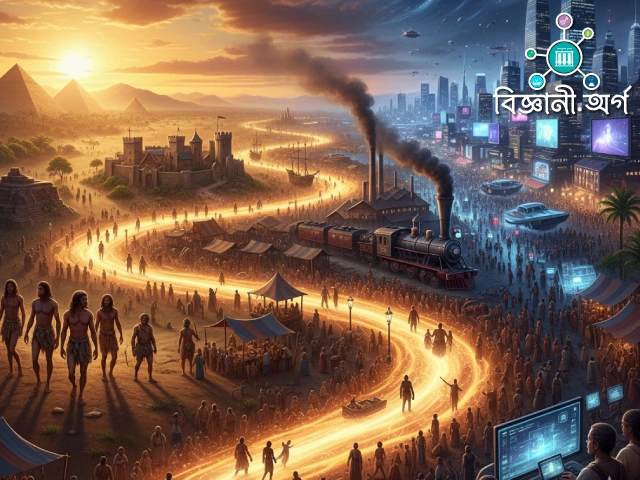
In the end, these numbers aren’t just statistics. They offer a glimpse into the vastness of human history and invite us to reconsider our own place in the river of time.