News Desk, Biggani Org | [email protected]
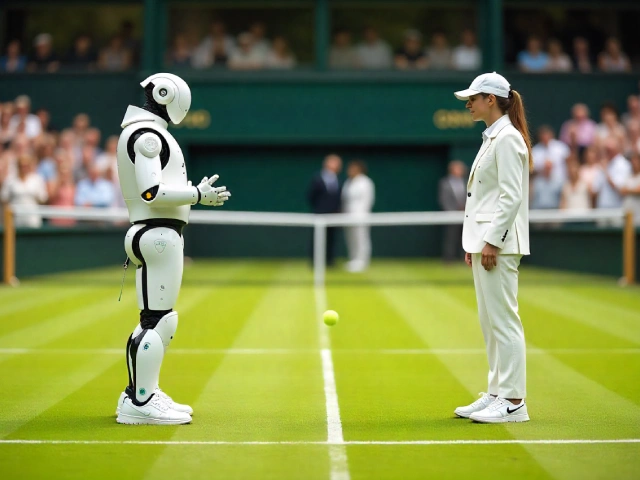
For the first time in its 147-year history, the 2025 Wimbledon Tennis Tournament has witnessed a groundbreaking change—there are no longer any human line judges on the court. Their place has been taken by an AI-powered automated decision-making technology that uses cameras and sensors to determine whether the ball is in or out, and announces the decision in a recorded voice.
The reasoning behind this technological addition is clear—to reduce errors, speed up the game, and lessen the mental pressure on referees. The US Open and Australian Open have already taken this route, and now the most traditional and oldest Grand Slam in tennis, Wimbledon, joins their ranks.
How Does This AI System Work?
Wimbledon’s AI-driven Hawk-Eye Live technology uses multiple high-speed cameras and sensors placed around the court to track the position and speed of every ball. An automated algorithm then analyzes this data to determine if the ball is in or out, and the decision is announced via an artificially recorded voice.
At first glance, this might seem flawless. In reality, although the technology has improved greatly, a piece of what the “human eye” and “human intuition” brought to the court now seems lost.
Players’ Objections: Does Technology Make Mistakes?
Not everyone is satisfied with this new AI system. During the tournament, some players have expressed doubts about the technology in certain matches.
World-renowned player Carlos Alcaraz said during his third-round match, “If I had the opportunity to challenge, I would have asked for at least three calls to be reviewed.”
His comments suggest that the AI system is still not entirely error-free. Similarly, Jack Draper and Emma Raducanu have both complained that the AI made several incorrect decisions.
This raises the question—does this dependence on AI reduce the players’ freedom to challenge decisions?
In the Eyes of the Audience: The Loss of Human Touch
Wimbledon is famous for its beauty, traditions, and rituals. Many spectators feel that the line judges in their white uniforms added a “human aura” to the tournament. In their view, by implementing AI decision technology on the court, Wimbledon has lost a part of its “soul.”
On social media, many have written—“Wimbledon should have preserved its tradition. Let technology come, but the human touch matters most.”
Some spectators even say that the immediate emotional reactions of players and fans to a few mistaken calls made the thrill of the game even greater. AI is suppressing those feelings.
Human vs. Machine: The Real Comparison
On one hand, technology is praised for its quick decisions, neutrality, and consistency. On the other, human line judges brought experience, situational judgment, and a certain emotional connection with the audience.
Human line judges could make mistakes, but there were people to take responsibility for those errors. If AI makes a mistake, who takes the blame?
The History of Technology in Tennis
The introduction of AI at Wimbledon isn’t sudden. Since 2006, technology has played an increasing role in tennis’s major tournaments. That’s when the “challenge system” was introduced, giving players the opportunity to challenge calls if they suspected an error. This system relied on Hawk-Eye technology.
But now even that challenge system has been abolished. AI itself is now the “final say.” This is a major reason for objections from many players and spectators—they want technology to be an aid, not a master.
What’s Happening in Other Tournaments Around the World?
The Australian Open and US Open have already fully implemented AI technology. These two tournaments have embraced modernity, whereas Wimbledon has long prioritized tradition.
However, Wimbledon’s decision has surprised many, because the tournament is renowned for its customs, dress codes, and historic style. For such a tournament to become AI-dependent has struck many as rather contradictory.
Is the Technology Really Reliable?
So far, Hawk-Eye Live technology claims an accuracy rate of over 99%. But the question is—if a crucial point is decided incorrectly just 1% of the time, what could that cost?
The AI system relies solely on sensor data and algorithms, but when it comes to the nuances of the game—movement, weather, ball spin, decision-making under pressure—the human mind is still ahead.
Where Are We Heading?
There’s no doubt that artificial intelligence has brought positive changes to many areas of our lives—healthcare, transportation, industry, and even education. Sports is no exception.
But the question remains—amid all this technological advancement, are we losing our traditions, emotions, and humanity?
Technology should be supportive, not something that replaces the human touch.
Some Thoughts for Readers in Bangladesh
Use of technology is increasing in Bangladeshi sports as well—DRS in cricket, VAR in football, and so on. Imagine if one day our national sports fields also make such a decision—”Human referees are to be replaced by AI referees!” What will our response be then?
Before such a decision is made, we should ask ourselves:
- Is technology enhancing our experience, or is it merely chasing speed?
- Are we only seeking efficiency, or do we also want to preserve some feelings and traditions?
Conclusion: Coexistence with Technology Is Needed
This change at Wimbledon sends a strong message—technology is gradually transforming our daily experiences. But not every transformation is for the better.
We want better technology, but we also want to make sure the human touch isn’t replaced by robots. This new AI era at Wimbledon throws us a big question—are we moving forward, or are we losing something?
What do you think? Should AI line judges at Wimbledon become permanent, or should the place of tradition and human emotion be restored to people again?
Share your thoughts at biggani.org-. Will you choose technology or tradition?