Guest Author – Azizul Haque
Assistant Professor, Yeungnam University.
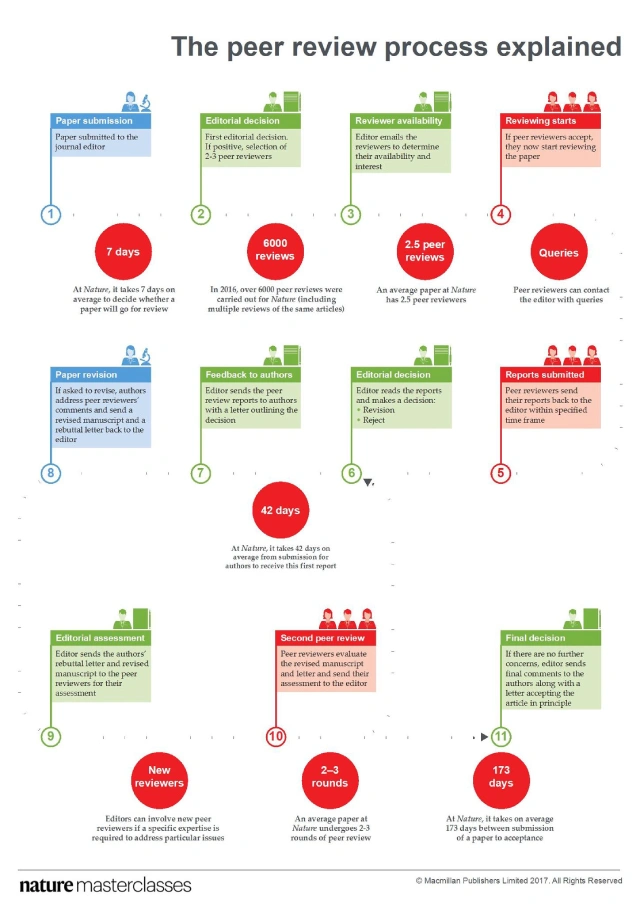
One of the most important and constructive steps in publishing a research paper is the Peer Review. Through this process, other researchers in the relevant field evaluate the quality, acceptability, and originality of the manuscript. Below, the entire process is explained step by step following the example of Nature publications, so that new researchers can understand it clearly.
Step 1: Paper Submission
After completing all stages of the research, researchers prepare their finalized manuscript according to the target journal’s guidelines and submit it through the submission system.
Step 2: Initial Editorial Decision
The editor reviews the manuscript carefully to decide whether it meets the subject’s criteria and is suitable for further review. If the editor finds the research appropriate and important, it is sent for Peer Review. Otherwise, the manuscript is either rejected outright or sent back for initial revisions.
Step 3: Selection and Invitation of Reviewers (Reviewer Availability)
The editor selects 2-3 qualified reviewers and contacts them via email to ask if they are interested and available to review the manuscript. After receiving their agreement, the editor finalizes the reviewers and initiates the manuscript review process.
Step 4: Reviewing Starts
The reviewers begin by thoroughly analyzing and evaluating the paper. They check the quality of the paper, the originality of the research, the accuracy of the information, and the clarity of the presentation. If the reviewers have any confusion, questions, or doubts during the review process, they can contact the editor directly.
Step 5: Reports Submitted
Within the stipulated time, reviewers complete their evaluations and submit their reports, providing detailed comments, recommendations, and directions for necessary revisions.
Step 6: Editorial Decision
The editor analyzes the opinions and reports of the reviewers to make a decision: Revision (needs modification) or Reject. If revision is needed, the authors are asked to revise and resubmit the manuscript. On the other hand, if the research is not suitable for publication, it is rejected.
Step 7: Feedback to Authors
Once the review process is completed, the editor sends the review reports to the authors and provides instructions on necessary corrections.
Step 8: Paper Revision
The authors revise their paper according to the reviewers’ valuable comments and suggestions. Together with the revised paper, they prepare and submit a detailed rebuttal letter, clearly stating what changes have been made and how each of the reviewers’ comments has been addressed.
Step 9: Editorial Assessment
At this stage, the editor sends the revised manuscript back to the reviewers. If necessary, for specific cases, new reviewers may be appointed for additional evaluation.
Step 10: Second Peer Review
The reviewers once again thoroughly review the revised manuscript and assess the changes made to address their previous comments. They then provide their updated opinions and recommendations.
Step 11: Final Decision
If there are no further issues or required corrections, the editor sends an Acceptance Letter for the manuscript. However, sometimes minor corrections may be requested before publication.
Note: Collected from Facebook.