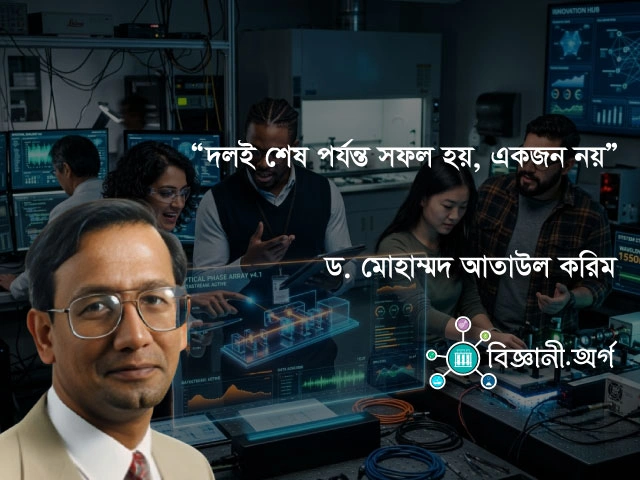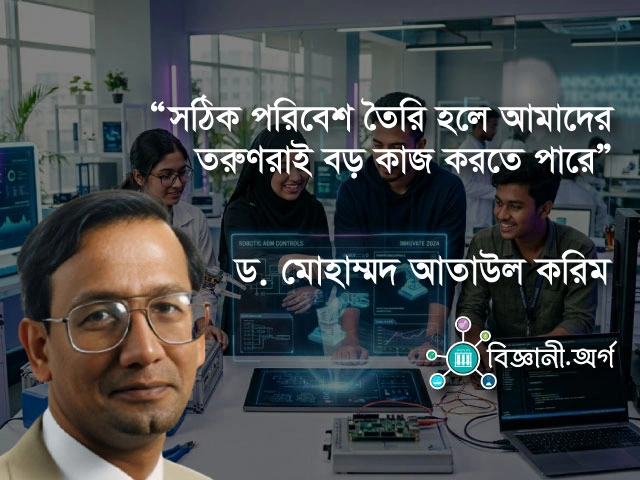
There are often two kinds of opinions about the youth of Bangladesh—one group expresses frustration over a lack of potential, while another believes that the country’s future rests in the hands of its young people. Scientist Dr. Mohammad Ataul Karim, who has long been engaged in research and academic leadership abroad, belongs to the second group. He firmly believes, “If the right environment is created, our youth can achieve great things.” Behind this conviction lies his years of experience and practical insights from regular engagement with Bangladesh.
While working at universities in the United States, Dr. Karim observed how a supportive environment can turn an average student into an extraordinary researcher. There, students benefit from essential research infrastructure, mentors, funding, and opportunities for international collaboration. In such a comprehensive environment, young people learn to take risks and are encouraged to test new ideas. In his view, talent is distributed equally across nations; what makes the real difference is the opportunity and environment for nurturing that talent.
He sees the same potential in Bangladeshi youth as well. Despite many limitations, students from Bangladesh are achieving success in international competitions and contributing to research after pursuing higher education abroad. Highlighting these examples, Dr. Karim says that the main problem isn’t a lack of capability, but rather the environment. Without adequate laboratories, modern equipment, trained mentors, and long-term planning, much of the talent goes to waste. By “right environment,” he means a system where asking questions is encouraged, failure is seen as part of learning, and new ideas are supported.
Building this environment isn’t solely the government’s responsibility; it requires a collective effort from educational institutions, the industrial sector, and society at large. Strengthening research-based education at universities, creating connections between research and industry, and offering young people opportunities to work on tangible projects are all part of establishing the right environment. In Dr. Karim’s experience, when young people are able to link research to real-world problems, both their interest and sense of responsibility increase.
He also believes that for young people to seize big opportunities, the mindset of those in leadership positions needs to change. Trusting the youth, valuing their initiatives, and allowing them room to make mistakes—these are essential for fostering an innovative environment. From his experience in the United States, he observed that sometimes even a small opportunity given to a student becomes the foundation for major research projects in the future.
Ultimately, the statement “If the right environment is created, our youth can achieve great things” is not just a message of hope; it is a policy call. If Bangladesh can foster a supportive environment for research, innovation, and creativity, its youth can become the main driving force behind the country’s scientific, technological, and societal progress.
Read the full interview with Dr. Mohammad Ataul Karim: https://biggani.com/dr_ataul_karim/
Read the full interview with Dr. Mohammad Ataul Karim: