


Ibn Sina’s Contributions to Medical Science
During the Islamic Golden Age, from the 7th to the 13th century CE, Muslim scientists made remarkable contributions to various fields of science. Their contributions to medical science are particularly noteworthy. Among them, one of the most prominent figures is Ibn Sina, known in the West as Avicenna. His contributions to medical science are still remembered and relevant today.
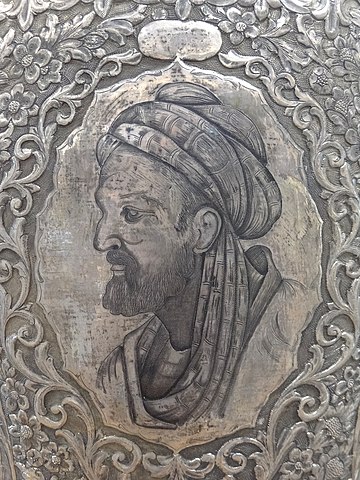
(The article features a modern depiction of Ibn Sina on a silver-ornamented vessel, as well as his tomb and museum in Hamadan. Collected from Wikipedia.)

Biography of Ibn Sina
Ibn Sina, whose full name is Abu Ali al-Husayn ibn Abdullah ibn Sina, was born in 980 CE in Bukhara, Iran. His father was an educated man who provided Ibn Sina’s primary education. From early childhood, Ibn Sina displayed great intelligence and a strong passion for acquiring knowledge. By the age of ten, he had memorized the Quran and mastered all the major sciences and philosophies of his time.
Ibn Sina’s Contributions to Medical Science
“Al-Qanun fi al-Tibb” or “The Canon of Medicine”
Ibn Sina’s most notable work is “Al-Qanun fi al-Tibb” or “The Canon of Medicine.” This massive medical encyclopedia is divided into five volumes. For nearly six centuries, it was used as a medical textbook in various European universities. “Al-Qanun” provides detailed discussions on diagnosing diseases, treatments, medicinal plants, surgery, and other medical topics.
Disease Diagnosis and Treatment
Ibn Sina made extremely important contributions in the field of disease diagnosis and treatment. He placed special emphasis on symptoms and methods of diagnosis. According to Ibn Sina, accurate diagnosis is the first step to accurate treatment. He advanced the methods of disease diagnosis by analyzing blood, stool, and urine.
Medicinal Plants and Drug Preparation
Ibn Sina conducted thorough research on medicinal plants and their uses. His “Al-Qanun” contains information on about 800 medicinal plants and their applications. He devised various methods to prepare medicine from plants, many of which remain relevant today.
Surgery
Ibn Sina made notable contributions in the field of surgery. He conducted research on different surgical procedures and instruments. He refined some of the prevailing surgical techniques of his time and invented entirely new ones. Ibn Sina’s methods in surgery are highly important even in modern medical science.
Other Works of Ibn Sina
Ibn Sina’s contributions extend beyond medical science into other scientific disciplines as well. His works have served as a source of inspiration for scientists and researchers around the world.
Philosophy and Metaphysics
Ibn Sina made significant contributions to the fields of philosophy and metaphysics. His philosophical thinking was heavily influenced by the Greek philosopher Aristotle. He created a bridge between Greek philosophy and Islamic thought. His philosophical works were highly influential in medieval Europe.
Physics and Astronomy
Ibn Sina also made contributions in the fields of physics and astronomy. He conducted research on optics, motion, and various theories of space science. His book “The Book of Healing” contains detailed discussions on physics and astronomy.
Contributions of Muslim Scientists
Like Ibn Sina, many other Muslim scientists have contributed to different branches of science. Below are the names of some distinguished Muslim scientists and their contributions.
Al-Razi (Rhazes)
Abu Bakr Muhammad ibn Zakariya al-Razi, known in the West as Rhazes, was a distinguished Muslim physician. He made outstanding contributions to medicine, chemistry, and philosophy. His most famous work is “Kitab al-Hawi” (The Comprehensive Book of Medicine), which provides detailed descriptions for diagnosing and treating various diseases.
Al-Khwarizmi
Muhammad ibn Musa al-Khwarizmi was a renowned Muslim mathematician, astronomer, and geographer. He pioneered the branch of mathematics known as “algebra,” and the word “algorithm” is derived from his name. His famous work “Kitab al-Jabr wal-Muqabala” (The Compendious Book on Calculation by Completion and Balancing) remains highly relevant in mathematics today.
Al-Hasan ibn al-Haytham (Alhazen)
Abu Ali al-Hasan ibn al-Haytham, known in the West as Alhazen, was a distinguished Muslim physicist and optician. He made outstanding contributions in the fields of optics and ophthalmology. His famous work “Kitab al-Manazir” (The Book of Optics) remains extremely important in the field of optics.
Conclusion
The contributions of Ibn Sina and other Muslim scientists to medical science and many other fields are extraordinary. Their research and innovations are still relevant and important in our lives today. For students, learning about the life and contributions of these Muslim scientists is extremely important, as it will help prepare them for their future careers and open doors to new opportunities.
In the future, the work of these great Muslim scientists will remain exemplary in the advancement of science and technology. Their innovations and research will continue to help advance the sciences and medicine, serving the welfare of humanity. Ibn Sina and other Muslim scientists will always be an inspiration for us, and their works will remain a valuable asset for generations to come.










Leave a comment