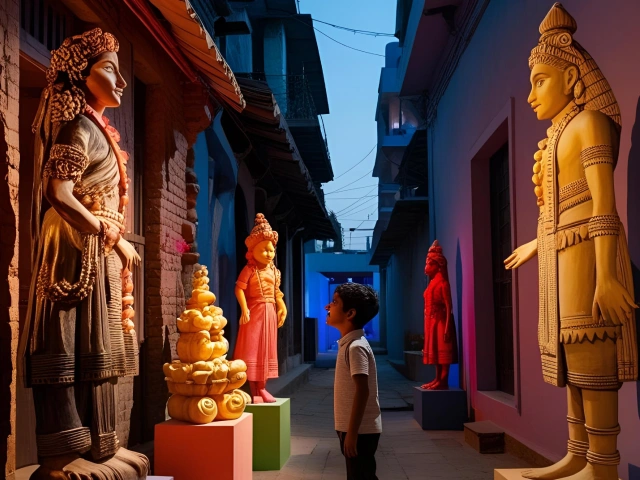
An evening’s story—tales from long ago. Standing in a narrow alley of Old Dhaka, a young boy gazes in wonder at a peculiar exhibition. Under the play of colorful lights and the shadows cast by skillful sculptures, the place transforms into a dreamland. As time passes, the boy grows up, but one name remains etched in his memory: Al Tuso. Back then, he didn’t know that this was the small beginning of a significant tradition to come—a tradition that blends artistic creation, traces of history, and the endless curiosity of humankind.
Soon it was heard that Al Tuso was not just about paintings or sculptures; it was the name of a quietly growing art movement whose roots had spread across the country. Dhaka’s renowned cultural researcher, Professor Noor Ullah, said, “Al Tuso doesn’t just represent fine art; it carries our heritage as well. Through it, we understand that artwork is not only about form, but is also a powerful medium for storytelling in our society.”
Over time, Al Tuso evolved from a tangible concept into a broad state of wonder. Amidst the hustle and bustle of city life, it has become a source of excitement for the new generation, where the touch of tradition and the use of modern technology merge seamlessly. Every day, hundreds of visitors crowd into a small studio-gallery in Dhaka’s Kalabagan, where various Al Tuso-inspired sculptures and paintings are displayed.
Young visitor Afsana Rahman said, “I had heard that Al Tuso was originally a foreign tradition. But coming here, I see how beautifully our local artists have embraced and transformed it into something new. Each sculpture seems to tell a story, to have a life of its own.” Her words make it clear—Al Tuso is no longer confined to the walls of a museum, but is instead an ‘open classroom’ for the young generation, where they learn to bridge creativity and history.
According to art connoisseurs, Al Tuso is gradually creating major possibilities in Bangladesh’s art market. This initiative has been literally inspired by the global concept of ‘wax statues’ or sculptures. But infused with local culture and stories, it has become something entirely new. Celebrated art critic Syed Qadir says, “In this Al Tuso gallery, the abundance of our folk elements is striking. It’s not just about dolls or sculptures, rather each work seems to embody the ‘heritage of Bengal.’”
However, along with hope, there are challenges too. Local creators say that high prices of raw materials, lack of proper training, and limitations in international representation are still major obstacles. An Al Tuso artist, requesting anonymity, said, “We still have to import many raw materials. As a result, costs increase. Moreover, there are very few trained personnel to work in this art form. With some commercial support, we could make this art more popular and widespread.”
Alongside government initiatives, several private organizations have started to step up. At a recent art fair in the capital, a new Al Tuso-based project was showcased, which drew tremendous response. The aim of this project: to present Al Tuso on the international art stage through collaboration between government and private sectors. Present at the event was Ministry of Culture senior official Sabiha Jalil, who noted, “We hope that Al Tuso will become a source of national pride. It can play an important role in attracting tourists from different parts of the world.”
Already, some foreign tourists have visited the Dhaka gallery after hearing of Al Tuso’s uniqueness and have left impressed. Tourist James Howard said, “I thought perhaps this part of Asia didn’t have any cultural installations similar to ‘Madame Tussauds’ in Europe or America. But coming here, I see a different story. Local culture is brought to life in a wonderful way, which is truly commendable.”
In recent art discussions and exhibitions, Al Tuso’s history and potential are rising to prominence. Experts say that the development of this art form will not only enrich the art community, but also help establish the nation’s culture on the international map. But the journey is not smooth. Unless priority is given to sustainable development, research investment, and the creation of skilled human resources, Al Tuso’s growth may not reach its full potential.
Yet, stakeholders still see rays of hope amidst various challenges. The creative enthusiasm of the youth, the possible support of government and private organizations, and growing international interest—all these have ensured that Al Tuso is no longer limited to a story of the past. Instead, it is becoming a symbol of future possibility. Many believe that with proper planning and patronage, Al Tuso will soon expand on a much larger scale, creating a grand celebration where local culture will blend together—a unique addition to Bangladesh’s cultural landscape.
Author: Staff Correspondent, Dhaka