On a desolate evening in Dhaka, sitting in an old bookshop, Kazi Arif suddenly stumbled upon an entirely new world.
From a pile of dust-covered books, a small volume was peeking out—Omar Khayyam’s “Rubaiyat.” The pages were yellowed, some corners torn here and there. Yet, even so, there seemed to be a mysterious glow hidden within. After reading the introduction, Arif realized these poems are not just food for thought, but also an experience that allows one to see life anew.
The more he turned the pages, the deeper he sank into an endless ocean of philosophy.
Every poem was a candid quest for life and death, love and ultimate truth. Arif says, “This Rubaiyat is not just a play of rhythm; it has opened the doors of my mind. I feel as though I am learning to gaze with curious eyes into the many layers of my own existence.”
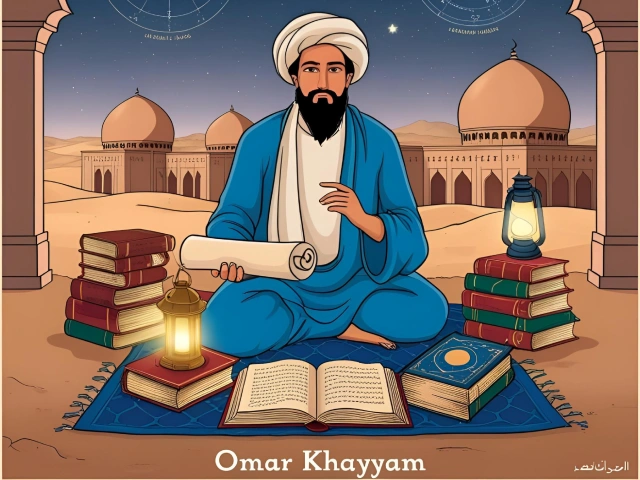
Omar Khayyam—whose full name was Ghiyath al-Din Abu’l-Fath Omar ibn Ibrahim al-Khayyam—was at once a poet,
mathematician, philosopher, and astronomer. He was born in Nishapur, Iran, at the end of the 11th and the beginning of the 12th century. His astonishing talent and scholarship were not limited to sweet poetry alone; he also achieved extraordinary feats in mathematics and astronomy. History reveals that he played a crucial role in the reform of the Jalali calendar.
Renowned international scholar and Professor of Bengali at Shahjalal University of Science and Technology, Dr. Asma Jahan, says,
“Though Omar Khayyam’s Rubaiyat often revolves around themes of love and wine, it is replete with multidimensional philosophy. On one hand, he identifies the transient and fleeting nature of human life; on the other, he immerses himself in the quest for eternal truth.”
But the greatest catalyst for Khayyam’s fame was British poet and translator Edward FitzGerald.
After the Rubaiyat was translated into English by his hand, Khayyam’s name spread to every corner of world literature. Yet, to truly savor the original poetry, many still read Khayyam’s Rubaiyat in Persian. Some readers believe the artistry of the poems is somewhat diminished in the English translation, but even so, this rendition has broadened their popularity among general readers.
Many might wonder—how did a medieval intellectual
find a place in the hearts of people today? Linguist and poet Alim Ullah Khan says, “Khayyam’s strength lay primarily in his view of life. He showed that life must not only be deeply understood, but also enjoyed. The search for truth is a matter of profound contemplation, but the lesson of joy cannot be abandoned. In today’s world, where people are trapped by stress and mechanical routine, Khayyam’s philosophy offers a message of ultimate freedom.”
At Dhaka’s book fair, fiction writer Mahmuda Haque has witnessed firsthand the interest among young readers in Khayyam’s poetry.
She says, “Even though today’s young readers are tech-savvy, once they taste Omar Khayyam’s Rubaiyat, they are astonished. These poems teach them to interpret life anew, to question themselves.”
Behind this enthusiasm lies the Rubaiyat’s simple language and its attempt to capture fundamental truths of life in short verses.
Love, time, death, or impermanence—behind each quatrain, he seems to hint at a mystical illumination. Elsewhere, there is a tone of irony or doubt, where he has not hesitated to question God or creation itself. Rabindranath Tagore himself once said in a speech, “Khayyam’s philosophy makes life fearless; it reminds us that through the virtue of great art, man himself becomes a traveler of his own universe.” Though this was not a direct reference to the Rubaiyat, many find a kinship between Khayyam’s poetic philosophy and Tagore’s worldview.
On the other hand,
many religious conservatives have found some of Khayyam’s poems controversial. This has stirred debate and criticism, both in the past and in the present. Nevertheless, literary critics believe Khayyam was far ahead of his time, and he is still remembered for bringing a current of freedom in intellectual thought.
The question arises, then:
Is his worldwide popularity solely because of his “Rubaiyat”? A look at history shows that Khayyam made outstanding contributions to mathematics and astronomy as well. His mathematical treatises contained foundational ideas on important topics like binary numbers, the law of triangles, and the concept of zero. He also introduced many innovations to observe planets and stars and deepen the understanding of astronomy in his era.
His multifaceted contributions continue to intrigue society—how did one individual nurture such equal dedication and mastery in so many fields? That is why, for today’s readers and researchers, Omar Khayyam remains a symbol of eternal inspiration.
Popular reader Sumaiya Rashid shares,
“I found a new edition of the Rubaiyat at the book fair. Alongside Khayyam’s poems, there was also a discussion of his life and scholarship, beautifully including his mathematical work. Honestly, the more I read, the more amazed I am that one person could possess so many talents.”
In conclusion,
the fascination surrounding Khayyam is not limited only to his poetry. In philosophy, science, and literature—his reach has stirred people’s minds for centuries. On one side, there are stories of love and time awakened by melody and rhythm; on the other, the deep pursuit of astronomy and mathematics—through these two poles, he seemed to have touched history itself. He has shown that devotion to creation is not confined to religion or any single belief; rather, true liberation can be found in knowledge, beauty, and independent thought.
Reporter: Tahmida Rahman, Dhaka