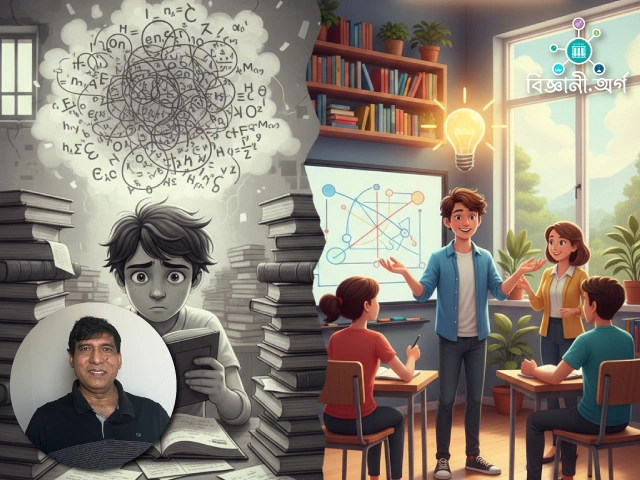
A common belief has persisted in our education system for a long time—good results are synonymous with good learning. If a student scores high marks in exams, it is assumed that they have understood the subject. However, Dr. Kazi Hossain’s experience encourages us to rethink this notion. According to him, learning is not just memorizing information; it is about understanding concepts, asking questions, and being able to apply that knowledge in real life.
While studying in Bangladesh, he himself faced the limitations of this memorization-based education. He admits that rote learning for exams was never easy for him. Rather, his strength lay in understanding topics through reasoning. But, as our education system has long prioritized memorization, the true scope of learning is often suppressed for many students. Dr. Kazi Hossain believes that if a student merely memorizes textbook information to pass exams, without understanding its meaning or application, that learning does not become sustainable in the long run.
When he went abroad for higher education, he encountered a new kind of learning environment. There, a teacher’s role is not just to provide information; instead, it is to teach students how to think. Asking questions in class, engaging in logical discussions with teachers, and expressing one’s own views are considered essential parts of learning. This environment builds students’ confidence and makes the learning process participatory. According to Dr. Kazi Hossain, the key in this environment is “understanding”—why something is the way it is, how it came to be, and what its real-life impact is.
He explains learning with a simple analogy. If someone only memorizes street names, they will not be able to reach their destination. But if they understand directions by looking at a map, they can find their way even in a new city. In the same way, memorizing a scientific formula or concept may help in exams, but if one understands the reasoning behind the concept, that knowledge helps in solving new problems as well.
Dr. Kazi Hossain further says that making mistakes is an important part of learning. In memorization-based education, mistakes are often seen as failures. However, in concept-based learning, a mistake is viewed as an opportunity to learn something new. In foreign education systems, he has seen teachers treat mistakes as a natural part of the learning process. This way, students are not afraid to ask questions; rather, they gain the opportunity to understand deeply through making mistakes.
His message to Bangladeshi students is clear—learning should not be confined to exams, but seen as a part of life. We must seek the meaning behind the information in textbooks, look for opportunities to apply it. If we build the habit of understanding over memorization, that knowledge will benefit not only in exams but also in real life.
Dr. Kazi Hossain’s experience reminds us that true education is not limited to a report card. Education is the power to think, the courage to ask questions, and the mindset to make learning a part of life. If this perspective can be adopted, today’s students can become tomorrow’s thoughtful researchers and citizens.
To learn more about this discussion, readers can view the full interview with biggani.org’s published Dr. Kazi Hossain here.