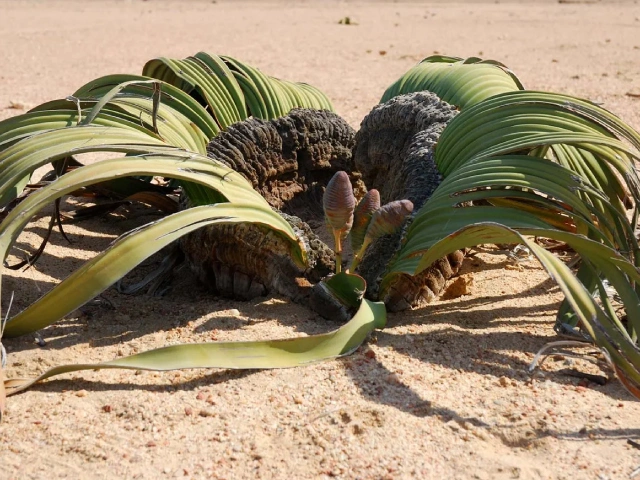
Marching across the sun-scorched sands of the desert, scientist Friedrich Welwitsch suddenly stopped in his tracks. Before his eyes was a mesmerizing sight: a chaotic plant with two enormous leaves, as if it had crash-landed here from another planet onto this lifeless expanse. A mix of curiosity, wonder, and a hint of fear gripped him as he knelt down. He hesitated to touch it—was this merely a trick of his imagination?
The plant discovered on that day in 1859 was named Welwitschia mirabilis (Welwitschia mirabilis). The name “mirabilis”—meaning extraordinary—is well earned due to the plant’s astounding characteristics. Native to the desert region between Angola and Namibia in Africa, this plant grows only two leaves in its entire lifetime. Remarkably, these leaves never stop growing. As time passes, the leaf tips become frayed by desert dust and sand, but new growth constantly emerges from the base.
“Standing before this marvel of nature, I was truly stunned,” says young botanist Afifa Rahman. She recently encountered the Welwitschia on an expedition. In her words, “It’s like a living fossil—witness to history, with the story of millennia of climate change inscribed in its leaves.”
Scientific analysis indicates that this plant typically lives between 400 and 1,500 years, with some ancient specimens reaching up to 3,000 years. Recent studies have found that the secret behind the Welwitschia’s longevity lies in its genes. About 86 million years ago, a unique genetic mutation enabled the plant to survive the desert’s harsh conditions. Special genes provide it with exceptional resilience to extreme heat and dryness, allowing it to thrive where few others can.
The world-renowned Kew Royal Botanic Gardens once dubbed Welwitschia the “ugliest plant in the world.” However, according to local Namibian resident Walter Ngunu, “To us, it’s not ugly. In fact, this tree is a symbol of life in the desert. Its leaves offer shelter to desert animals and birds, and they help to collect water. It is a treasure of our natural heritage.”
This plant has immense ecological importance as well. Its broad leaves catch organic material carried by desert winds, enriching the otherwise barren soil with nutrients. At the same time, Welwitschia serves as habitat for reptiles, birds, and other desert creatures.
Professor Dr. Kamrul Hasan of the Department of Botany at University of Dhaka says, “Welwitschia is a remarkable example in botany, teaching us just how astonishing life’s adaptation can be even in the harshest conditions. In the context of current climate change, researching such plants is crucial for our future.”
Thus, the plant once thought by scientists to be an ‘alien visitor’ has become an invaluable asset for environmental preservation.
This tree, standing tall for thousands of years, seems to say:
Life is truly a story of struggle and adaptation.