Night has deepened. Rain taps persistently against the window pane. In one corner of the room, a candle glows. That flame—orange, stretched upward, shaped like a teardrop—is all too familiar. As if a mysterious dancer in the darkness is silently performing their art. But what if you plucked this fire from Earth and sent it into space? Would it still remain the same?
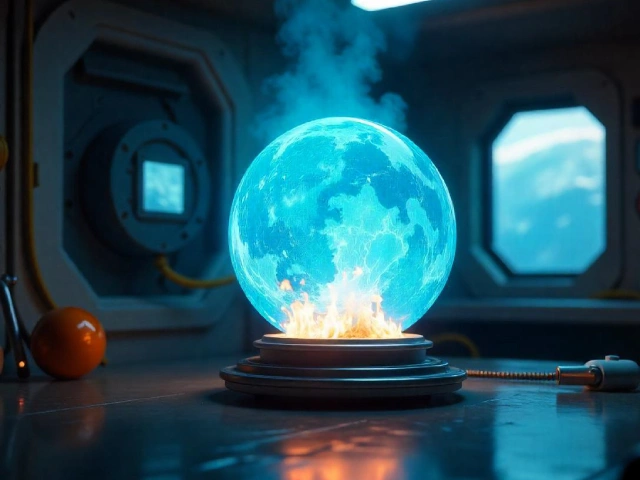
Before we find the answer, let’s embark on a journey of imagination. Picture yourself as an astronaut. Inside a laboratory at the International Space Station (ISS), you light a small flame. Instantly, a wondrous sight catches your eye—the fire is no longer fire as you know it! Instead of orange, there is now a perfect, bluish sphere. It looks like a tiny blue star, gently burning—no noise, no flickering, only a silent, unhurried flame.
The Scientific Truth Behind This Marvelous Change
The way we see fire burn on Earth is mainly due to “convection.” The cool, heavy air around us comes down and supplies oxygen to the flame. At the same time, the hot gases rise. Just as smoke ascends above the fire. This up-and-down movement gives the flame its stretched, pointed shape.
But in space, where there is no gravity—this process of convection doesn’t occur. The air slowly spreads out evenly in all directions, and oxygen reaches the flame uniformly from every side. This slow spreading process is called “diffusion.” As a result, the fire becomes much more stable, deep blue, and nearly perfectly spherical.
“Watching that flame, it felt as if a living blue particle was staring back at us,” said former NASA astronaut Dr. Katherine Thorne, who participated in fire-related experiments in space in 2014. She added, “That experience made me realize for the first time just how deeply we are bound to the rules of Earth. Everything is so different, so new, in space!”
Fire in Space: Not Just a Sight to Behold, But a Realm for Scientific Exploration
This unique phenomenon is not just a source of wonder—it serves as the basis for important scientific research. By understanding how fire behaves in space, we can make future space missions safer. At the same time, it could pave the way for more advanced and cleaner fuel systems on Earth.
“By observing how fire acts in a microgravity environment, we can develop new kinds of combustion technology,” says Dr. Robert Carson, lead researcher of the Combustion Science Group. “Such research could contribute to gas turbine engines, eco-friendly fuels, and even the fight against climate change.”
A New Perspective for Bangladesh’s Science Enthusiasts
Reacting to this research, Jarin Rahman, a student in the Physics Department at Uttara University, said, “Science is not just book theory—these stories prove that research means entering a world of wonder. I’m now interested in doing my own research on combustion in space.”
Such enthusiasm is what creates the scientists of the future. When science merges with imagination, it becomes like a story—not only expanding our knowledge, but also pushing the boundaries of our creativity.
In Conclusion…
A single flame—that warms our homes and gives us light on Earth—reveals an unprecedented form in space. This form is unique not only in color, but also in science, function, and beauty.
It seems to teach us—nature does not apply its rules in the same way everywhere. As the environment changes, reality changes, and so does our understanding.
Fire remains fire, but when the environment changes, its dance transforms into a unique ballet. Are you wondering how many more unknown wonders await us?