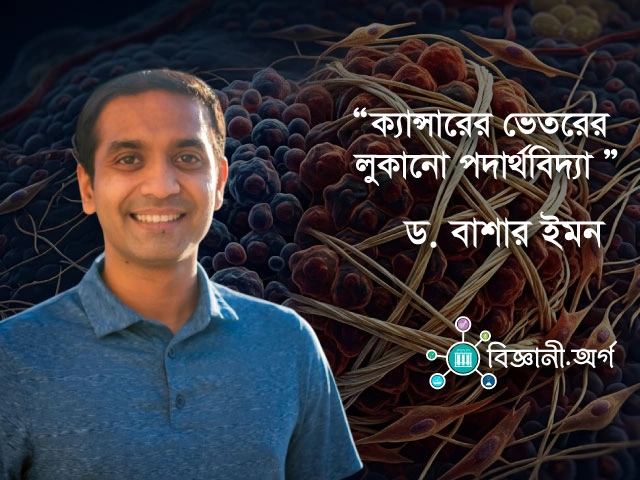
What we generally know about cancer is mostly in the language of medicine—which drugs work, which therapies are given, and what are the side effects of chemotherapy or radiotherapy. But very few people consider that the inner world of cancer is not only biological, but there is also a profound role for physics and mechanical properties.
Bangladeshi researcher Dr. Bashar Emon has brought this unseen aspect to the forefront in his research. He says, “When cancer is at stage 1, the tumor is very soft, but as it progresses toward stage 4, the tumor becomes much harder.” While this may sound simple, it’s actually a key signal of cancer progression hidden beneath the surface.
Just as we can tell if a fruit is ripe or unripe by pressing it in our hands, the softness or hardness of a tumor also gives clues about its condition. In the early stages, the tumor remains soft, meaning the cells are still relatively dispersed and less organized. But over time, the environment inside the tumor changes—the cells cluster more tightly, compress the surrounding tissue, and the entire tumor becomes hard or “stiff.” In scientific terms, this is known as tissue ‘stiffness.’
The question of why this change occurs lies at the heart of Dr. Bashar Emon’s research. He has shown that cancer cells alone are not responsible for this hardening. Rather, certain special cells inside the tumor, called fibroblasts, play a major role. Under normal circumstances, fibroblasts help to heal wounds in our body. For example, when we get a cut, fibroblasts deposit collagen and help bind the tissue as the wound heals.
But inside cancer, these cells seem to be steered “off-track.” The cancer cells influence them in ways that make the fibroblasts deposit excess collagen. As a result, a hard shell forms around the tumor. This stiff environment makes cancer cells even more aggressive and helps them spread to other parts of the body. In medical language, this spreading is known as metastasis.
Another important aspect of Dr. Emon’s research is the technology to measure this “stiffening.” Typically, cells are studied in labs on flat dishes. But in the human body, cells exist in a three-dimensional environment. To better mimic this real environment and measure how force or pressure works inside the cell, he has developed special sensors. By measuring very small forces—at the nano-Newton level—it becomes possible to understand how cells push or pull each other to exert influence.
This kind of research may not produce a new drug right away, but it is laying the foundation for future cancer treatments. Because, if we see cancer not just as a “cellular disease” but also as a “mechanical problem,” entirely new types of therapies might emerge—where controlling the stiffness of the tumor itself could halt cancer’s spread.
This new perspective on cancer from the hands of a researcher who started in civil engineering reminds us—there is no single path in science. When knowledge from different branches comes together, new doors open inside even the biggest problems.
🔗 Read the full interview: