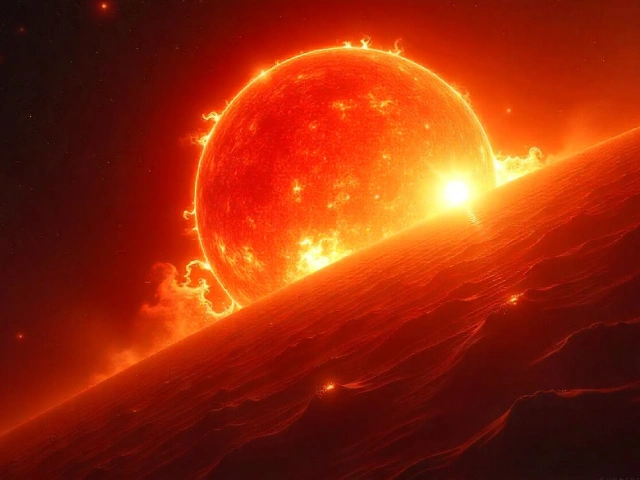
Astronomers have recently revealed an astonishing fact that compels us to rethink what we know about our own sun. Some stars in the universe—similar to the sun in size, structure, and temperature—experience powerful explosions called “superflares”. These superflares can unleash 10²⁹ (a 1 followed by 29 zeros) joules of energy in an instant, which is equivalent to what our sun emits in 20 minutes. The amount of energy released is so massive that it’s comparable to billions of nuclear bombs.
How Do Superflares Occur?
Inside the sun, there is a gaseous substance known as plasma, made of extremely hot and charged particles (such as electrons, protons, etc.). When hot and cold plasma mix, they create complex magnetic fields. If these magnetic fields suddenly and abnormally change, they eject a huge amount of charged particles from the sun’s surface into space at high speeds, which appear as flares or explosions. The most powerful of these are called superflares.
When these charged particles reach Earth’s atmosphere, they collide with nitrogen (N₂) and create a special isotope—beryllium-10 (Be-10). By examining the presence of Be-10 in Earth’s ice layers, researchers have found evidence of at least five major flares in the past 10,000 years.
Is It Possible for the Sun?
NASA’s Kepler telescope observed nearly 500,000 stars and identified 2,889 superflares among 56,000 sun-like stars. This means, on average, one superflare occurs every 100 years. This is a cause for concern regarding our sun too, since it is also a typical star capable of producing such flares. However, the sun usually generates only small or medium flares. Still, scientists have not ruled out the rare possibility of a major superflare.
What Could the Impact Be on Earth?
Much of Earth’s life is protected thanks to the planet’s magnetic field, which shields us from harmful space radiation and particles. But the impact on technology could be catastrophic. Astronomer Phil Plait says, “If a major flare occurs, even the most protected satellites could be destroyed. Electric grids could fail, causing widespread blackouts that might last from months to years.”
In addition, communication systems, the internet, banking systems, and even air travel could be disrupted. Although engineers are implementing specific measures to safeguard against such disasters, it may not be possible to effectively defend against a very powerful superflare.
How Can We Prepare for the Future?
Even if a cosmic disaster like a superflare can’t be prevented, advance warning and adequate preparation are possible. Scientists regularly monitor the sun’s activity to issue timely alerts so that emergency measures can be taken in advance. In the future, making space technology more advanced to tackle such risks should be our main goal.
Have you ever wondered if a single solar explosion could shut down the entire world’s internet and power systems? Now is the time to be aware!