News Desk, Biggani.org | [email protected]
When we look back at NASA’s history, what catches our eye first are the astronauts’ bravery, the first footprints on the moon, or the dazzling rocket technology. But buried in the pages of history are countless faces whose silent work laid the foundation for those achievements. In her book “Hidden Figures”, Margot Lee Shetterly brings those quiet voices to light—especially those African-American women whose indomitable knowledge of math and science changed the course of America’s space program.
In the 1940s and 50s, the United States was a divided country—segregation was an institutional reality, women were confined by the boundaries of family, and science was largely a male domain. In this context, the fact that Black women worked in institutions like NASA is nothing short of remarkable. Yet their contributions remained hidden for so long, as if they were nothing more than “calculating machines”—human computers.
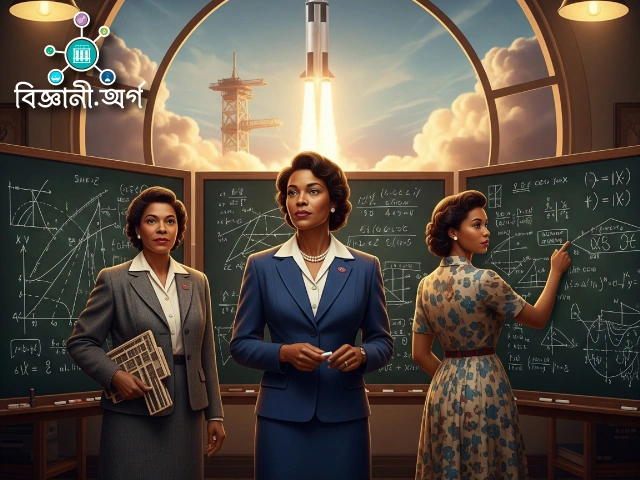
Katherine Johnson, Dorothy Vaughan, Mary Jackson—once, no one knew these names. Yet these were the women mathematicians who, with their own hands, calculated the trajectories for rockets—determining at what angle they should travel, at what speed to pierce Earth’s orbit and reach space. John Glenn’s historic orbital flight depended on Katherine Johnson’s meticulous calculations. With astonishing scientific precision and unyielding mental strength, these women transcended gender and race, honoring only the logic of mathematics.
But this story isn’t just about science or math; it’s a chronicle of a social revolution. At a time when African-American women had to use separate bathrooms and eat in separate cafeterias, gaining recognition for their work was a distant dream. Yet they worked silently, day after day, proving with their competence that talent is beholden to no nation, gender, or race. In Shetterly’s writing, we find each woman’s personal struggles, their family lives, their perspectives on society, and—most importantly—their unwavering belief in themselves.
As you read the book, you start to wonder, ‘Why has no one told these stories before?’ The answer is simple—history was written by those nearest to the centers of power. And the stories of the marginalized often get lost in the history of power. But Shetterly has brought that lost history back into focus, turning it into a record. This is not just the story of women or the Black community—it’s an inseparable part of human history.
The beauty of this book lies in the fact that it’s not simply a factual account. It is at once literature, history, and social analysis. We see how women who dreamed of becoming scientists carved out their identities by overcoming social pressures, the blows of racism, and the obstacles of patriarchy. The way Dorothy Vaughan, despite being a “supervisor,” received no formal recognition but learned computer programming herself to open doors for other women—this is not just a tale of inspiration, it’s an example of true leadership.
These stories are no less relevant in the context of Bangladesh. Here, too, we see how marginalized women fight to find their place in science and technology. A young girl studying science, who is often told by her family, “What’s the point of studying so much?”—perhaps she will one day invent a new technology for her country. But before that, what’s needed is a shift in social perceptions, the need to know such stories—stories that show how to rise up from anywhere, how to reach the light from darkness.
This is why “Hidden Figures” is not just a chapter in US history—it has become a source of global inspiration. A book that challenges its readers to ask—how can I overcome my own obstacles? How do I move forward by questioning society’s accepted norms? How do we honor those who work in silence?
A nation’s technological advancement doesn’t depend solely on scientists’ laboratories but also on its social consciousness. True progress is possible only when society learns to offer equal opportunity to all its citizens. These women were not just part of NASA; they were also architects of changing the social psyche. They teach us—one creates a place through work, and history can be written with one’s own skills.
Today, when we discuss women’s empowerment, scientific innovation, or diversity in technology, we must remember this history. History tells us—science is not just for a few talented individuals; it can be a tool for social change if we strive to create equal opportunity for everyone. Like a reminder, “Hidden Figures” shows us—even those in the shadows may one day step into the light, if we dare to tell their stories.
This book deserves a Bangla translation, deserves to be included in curricula, because it is more than just history—it’s a roadmap for the future. For young scientists, it’s a source of inspiration; for female students, a wellspring of confidence; and for our society, it’s a mirror—where we see extraordinary examples of overcoming limitations.
“Hidden Figures” points directly to our eyes, showing us that even if they are invisible, they are important; even in silence, they have a voice; and sometimes, the best stories in history are written behind veils of quiet. Now is the time to tell those stories, to spread them, and to let the new generation know—no matter how hard the path to your dreams, you are not alone.