News Desk, Biggani Org |
[email protected]
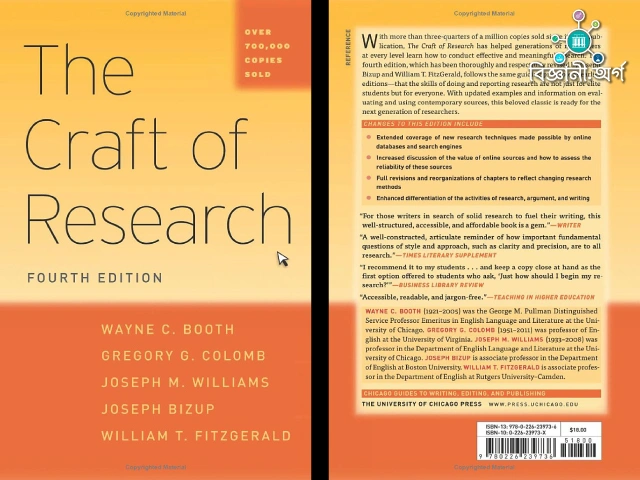
When a student first steps into the world of research, it often seems shrouded in mist. How do you begin, how do you ask the right questions, which sources are trustworthy, and how do you turn your thoughts into a coherent essay? These questions seem to shadow one another at every step. The book “The Craft of Research” steps in precisely at this point, illuminating the way and transforming a novice researcher into a confident, thoughtful writer.
This collaborative work by Wayne C. Booth, Gregory G. Colomb, and Joseph M. Williams does not regard research as merely gathering data or reading books. Rather, it treats research as an intellectual conversation, where the researcher is a participating citizen—someone who raises questions to inform, explain, or seek understanding on a subject. The book repeatedly inspires readers with the truth that the core driving force of research is ‘the question’.
At the very beginning, the authors clarify an important point—the purpose of research is not just to seek answers, but to pose significant and meaningful questions. As they state,
“Good research starts with a problem you want to solve, not just a topic you want to cover.”
This perspective is still rare in our country, where topics for essays are often dictated by a supervisor, with the aim being “to submit something.” Yet, this book makes it clear that a good question is the first step to good research.
Although Bangladeshi universities offer ‘Research Methodology’ courses, their main goal is often limited to teaching terminology and showing some frameworks. In contrast, “The Craft of Research” provides a completely different experience. It teaches readers how to gradually analyze a simple idea and turn it into a research problem, how to collect relevant information, and how to establish their own position logically.
One of the book’s greatest strengths is its simplicity of language and conversational tone. It’s not the distant guidance of an expert scholar; rather, it speaks like a classmate—“You might try thinking about it this way.” This intimate approach is particularly important for young people in our country, for whom fear or reluctance towards research often stems from it seeming more difficult than it really is.
The main message of the book—that research is not just about gathering information, but about building arguments—triggers a shift in the reader’s perspective. A researcher doesn’t simply present information; they form their own opinion based on that information and defend it with reasoning and evidence. This book delves into that craft—where every paragraph, every reference, and even every sentence is a part of the underlying structure of a big idea.
Another practical challenge of research is presenting one’s ideas in an organized way—in other words, writing. In this area as well, “The Craft of Research” is immensely helpful. The latter parts of the book analyze writing techniques, organization, the reader’s perspective, and even language style. It guides writers on how to anticipate possible objections from readers, how to arrange information to make the argument more effective—turning research not just into an ‘exercise in knowledge,’ but into a kind of ‘practice in philosophy.’
This book is thus doubly important in the context of Bangladesh. Although the quantity of research in our universities is increasing, there are many questions about quality. Often, research is reduced to data collection and ‘paper submission,’ with little depth of thought or analysis of the question itself. Addressing that gap, this book teaches young researchers to self-reflect—”What am I saying?” And, perhaps even more importantly, “Why am I saying it?”
Another powerful aspect of this book is its versatility. The book’s approach is valuable not only for research, but also for essay writing, preparing presentations, journalism, or policy-making. For any kind of analytical writing or critical thinking, this book can provide a reliable blueprint. Even if a reader does not pursue research, the book will still guide them toward disciplined thinking and self-critique.
The foundation of an advanced society lies in its thoughtful citizens. These citizens are cultivated not merely by knowing information but by questioning, analyzing, and creating new knowledge from it. “The Craft of Research” is exactly the type of guide that fosters such citizens—those who question the world around them, seek answers, and share their findings with others through reasoned arguments.
If we want a robust research culture to develop in Bangladesh, building infrastructure alone is not enough. What’s needed is a shift in mindset, where research becomes part of curiosity, exploration, and self-development. “The Craft of Research” can be the starting point for that transformation—especially when we aim to teach our students not just to read, but to think.
Therefore, for those embarking on the path of research, this book is more than a manual—it is the first step in mental preparation. For a researcher, teacher, or anyone seeking sound reasoning, “The Craft of Research” is a silent companion, always prompting you at each question—“Let’s move forward with logic.”