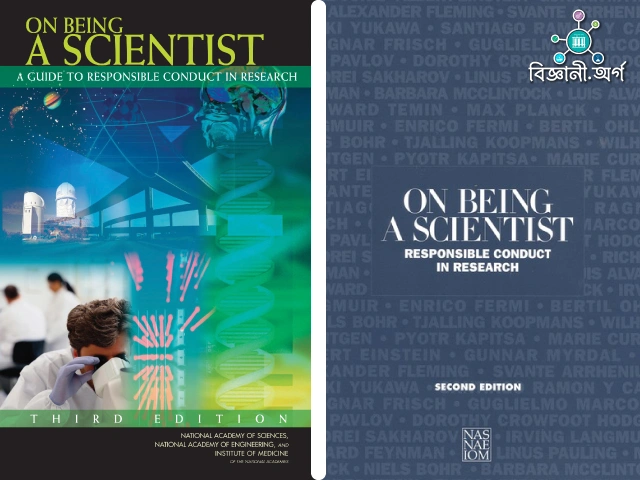
The path of science is not limited to laboratories, formulas, or analyzing data. At its core lies an unwavering ethical stance, social responsibility, and a commitment to honest research. The book ‘On Being a Scientist,’ written by the National Academies of Sciences of the United States, provides guidance on those invisible yet indispensable pillars upon which a young researcher’s professional foundation is built.
Reading this book reveals that entering the world of research is not just about gaining knowledge in a specific area; rather, it is entering into a kind of social contract. A scientist could, if they wished, distort data or take credit for someone else’s work. But the true identity of a researcher is established on the basis of the ethical norms that the scientific community has instituted to govern this immense power.
In a developing country like Bangladesh, where research activities are still advancing amid infrastructure and funding shortages, this book can serve as an essential guide. Academic fraud, data fabrication, or disputes over credit are commonly seen in our society, yet there is little discussion about the psychology, structural pressures, and remedies behind these issues. ‘On Being a Scientist’ shines a light on those very aspects.
This book is especially a hands-on guide for young researchers. For example, what should a researcher do if they spot a potential error in a colleague’s work? How can data be verified before publication? Why is maintaining transparency essential when accepting funding for research? Alongside answering such complex questions, the book illustrates concepts with real-life examples and scenarios, making them easy to understand.
One of the key aspects of research policy is co-authorship. In many universities in Bangladesh, there is a silent tug-of-war over who will be listed as an author on a research paper and who will be left out. Often, a senior teacher might put their name on a student’s entire project. The book explains this context from the perspective of honesty and honor—co-authorship is not just about credit; it is also an expression of responsibility.
However, ‘On Being a Scientist’ does not stop at merely highlighting the issues. Instead, it fosters a progressive mindset in which research is viewed as a social responsibility. The book repeatedly reminds us that when a researcher presents new data or theories, it is not just their own achievement but becomes a lasting contribution to the collective knowledge of humanity.
The pace of research is now much faster than before. New fields like artificial intelligence, genome editing, or strategic data analysis present researchers with pressing ethical questions. Should we create artificial life? Is it legitimate to develop drugs using confidential data? Researchers now face such questions daily. ‘On Being a Scientist’ does not view these dilemmas merely as ethical uncertainties, but analyzes them through the lens of logic and values.
In the context of Bangladesh, when a student wishes to go abroad for higher education, they often do not know how these ethical aspects of research are regarded or what standards must be met to maintain the international acceptability of research. This book can serve as a ray of light in that darkness. The path of research is not just about talent and hard work—there is a deep connection with ethics, respect, and honesty, which young researchers must learn and internalize.
Research is fundamentally a participatory social process. When we gather data, analyze it, or publish research papers, we become part of a larger scientific community. The most important requirement for establishing trust within this community is self-discipline. More than any external law or oversight, a scientist’s internal sense of ethics keeps them on the right path. One of the book’s main lessons is the importance of self-accountability.
The book also discusses building a supportive research environment. Whether at a university, a think tank, or a private lab, the role of leadership is central to building a culture of ethics. If superiors benefit from data distortion, nepotism, or policy violations, juniors also learn that “these things are acceptable.” ‘On Being a Scientist’ questions this aspect of leadership too—true leadership is not just about giving orders, but also setting an example through one’s own conduct.
This book is relevant not only for scientists but equally for policymakers, teachers, and students. When research is considered a driving force for national development, then upholding the ethical standards of that research becomes a matter of national concern. In a country like Bangladesh, where advancing scientific discovery and research sectors requires international partnerships, transparency and credibility in research are basic prerequisites.
It is fair to say that ‘On Being a Scientist’ is not a flashy or popular science book. It requires careful, thoughtful reading. But that is precisely why it is so necessary—especially for those who see the very word ‘research’ as holding the promise of the future.
The young people who wear lab coats today, peering under microscopes in search of unknown clues, or those who create new knowledge through data analysis in the cloud, need to know—the impact of their work could one day change society, the country, and the world. But may that change be founded on truth and justice—this hope is what inspired this extraordinary book. It is not meant to be read just once, but to be returned to again and again, for self-reflection, and most importantly, to become a true scientist.
In this era of information overload, let ‘On Being a Scientist’ stand as a symbol of the hope that honesty and ethics will not be lost. If Bangladesh’s new generation of researchers can embrace these values, the science of tomorrow will shine not just with the power of intellect, but also with the strength of integrity.