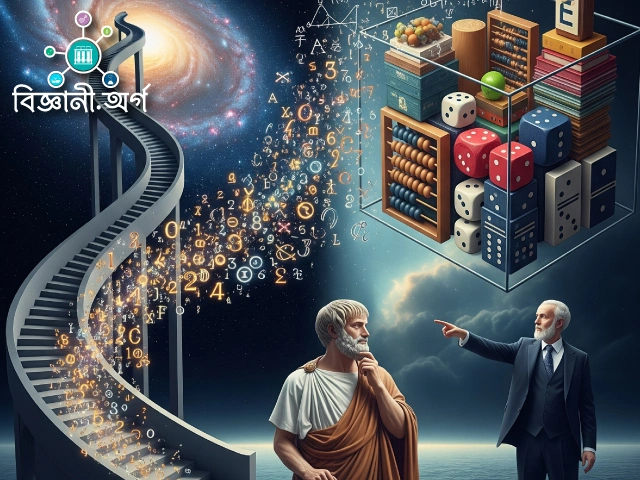
There are some questions in the history of mathematics that have ignited human imagination for thousands of years. Among them is this—does infinity really exist? The ancient Greek philosopher Aristotle, while searching for an answer, said that we can understand infinity in two ways. On one hand, there is potential infinity—as in, if we keep counting numbers one after another, the process never ends, but always remains a possibility. On the other hand, there is actual infinity—which he outright rejected. The idea that nothing in the real world is infinite has long puzzled both philosophy and mathematics.
For a long time, mathematicians sidestepped infinity. In the late nineteenth century, German mathematician Georg Cantor dispelled this doubt. Through set theory, he demonstrated that infinite numbers can also be brought within the structure of mathematics. Since then, infinity has become an integral part of math. In school, we learn that the sets of natural numbers or real numbers are infinitely large, and that irrational numbers like π or √2 are also infinitely extended in their decimal places.
Yet, the debate did not end there. Even today, there is a group who call themselves “finitists.” According to them, every resource in our universe is limited—the ability to count is also limited—so what is the point of using infinity in mathematics? They have proposed an alternative mathematical framework that deals only with finite things. Interestingly, some modern physicists are also experimenting with this finitist idea—hoping that finite mathematics might explain nature even more precisely.
Simplistically, set theory is like a bag or pouch where numbers, functions, or any objects can be placed. To compare two bags, you take out the items together—the one that empties first is smaller. Cantor’s fundamental contribution was that, with this simple process, he could compare infinite sets of numbers. And the surprising result— not all infinities are equal, some are bigger than others.
Based on this idea, in the early twentieth century, Abraham Fraenkel and Ernst Zermelo established a new foundation for mathematics. They proposed nine basic axioms. Among them is the ’empty set’—the existence of an empty bag everyone accepts, but another axiom asserts the certainty of an infinite set’s existence too. This is where the finitists object. They argue that mathematics is possible without infinity, and might even be more logical that way.
Finitists do not only raise philosophical objections. They point out that many results derived from infinity are unusual. For example, the Banach–Tarski paradox says—that if a sphere is broken into pieces, those pieces can be reassembled into two spheres of the same size. Although impossible in reality, set theory makes it mathematically possible. The finitists’ reasoning is—if such results emerge, then there is an error in the fundamental axioms.
Their straightforward logic: a mathematical object only exists if it can be constructed step by step from natural numbers. For this reason, irrational numbers standing on infinite sequences are not acceptable to them. Numbers like √2 are derived from formulas that are in essence the result of infinite processes. Therefore, finitists do not accept them.
This brings up another major issue. Aristotle’s “law of excluded middle”—which says every statement is either true or false—does not apply here. In finite mathematics, some statements remain undecidable, because certain numbers have not yet been computed. Take, for example, the number 0.999…. With infinite nines, it equals 1, but without infinity, this equation is no longer true.
Naturally, the question arises—could an entirely new mathematical world be formed with finite mathematics? Most mathematicians believe that this would be a path more complicated than reality. Still, some physicists support it. Nicolas Gisin of the University of Geneva argues that if the universe has a limited capacity to store information, then working with infinite numbers becomes meaningless. In that case, only finite mathematics can accurately describe nature.
This effort is still in its early stages. But the thought itself is significant. Modern physics is stuck on many fundamental questions—how did the universe begin, how are the fundamental forces interconnected—answers to these questions remain unknown. Perhaps finite mathematics could open the door to a new beginning.
Ultimately, the matter comes down to belief. Some may accept that infinity truly exists, while others think everything is finite. This debate within mathematics will persist into the future. But to us, this debate is not merely a mathematical theory—it is an eternal quest about the boundaries of human imagination. Infinite or finite—in both cases, the journey of the human mind never ceases.
✍️ This article is based on a piece published in Scientific American, newly presented for Bangla readers.