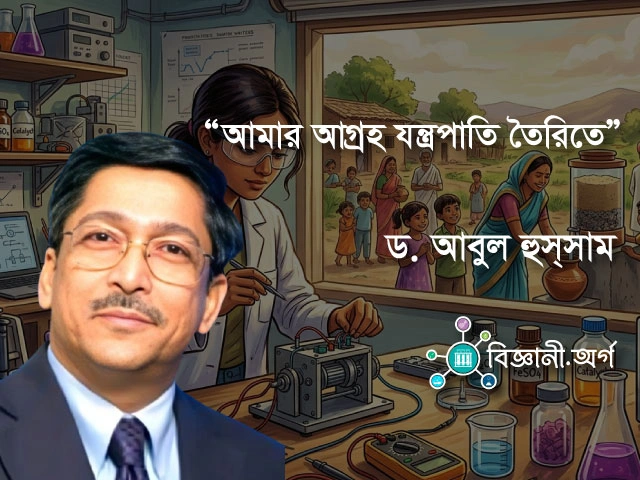
A scientist is usually recognized by their research papers, publications, or titles. But often, a small passion sows the seed for a major innovation in the future. In the case of Dr. Abul Hussam, that seed was his fascination with building instruments. In his own words, “My passion lies in making instruments.” Within this single phrase lies the philosophy of his research career—science is not just about theory, but also about the ability to create devices that solve real problems.
From childhood, Dr. Hussam was fascinated by instruments. Seeing glass flasks, pipettes, colorful solutions, and various testing devices in his father’s laboratory, he would wonder—how do these things work? How can they detect the presence of invisible substances? These questions led him to try building small devices himself. The simple laboratory he created as a teenager eventually steered him toward the instrument-driven field of analytical chemistry.
In analytical chemistry, the role of instruments is crucial. Answers to questions like whether there is arsenic in water, or how much pollutant is in the air, come from precise measurements. Dr. Hussam did not just settle for using existing devices; he designed new ones or improved the old as needed. Many of the instruments developed in his lab have gone on to become useful in the field.
This passion for building instruments led him toward a socially impactful innovation like the Sono Filter. In tackling the problem of arsenic contamination, he realized that simply detecting the problem in the lab was not enough; rural people needed a simple device they could use themselves. As a result, he brought technology out of the complex world of laboratories into the everyday lives of people. Thus, the Sono Filter is not just a research product—it is a practical device that enables rural communities to access safe water on their own.
This example reminds us that innovation is not only about working in a high-tech laboratory. True innovation happens when a technology becomes useful in people’s real lives. Dr. Hussam’s instrument-based research shows how curiosity and hands-on making can turn a scientist into a problem-solver for society.
Due to the lack of equipment or limited hands-on opportunities in the Bangladeshi education system, students often see science as solely theoretical. Dr. Hussam’s life story carries an important message for the youth—if you develop the habit of building instruments, you can bridge the gap between theory and practice. Today’s curious student can become tomorrow’s innovator, with inventions that simplify people’s lives.
For this reason, “My passion lies in making instruments” is not just a statement of personal preference; it is a kind of scientific philosophy. This philosophy teaches us that science is not only about understanding, but about creating—and using those creations to benefit society.
Read the full interview with Dr. Abul Hussam: