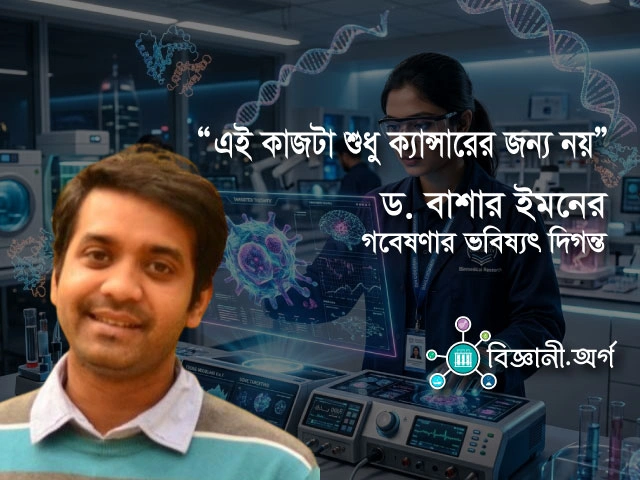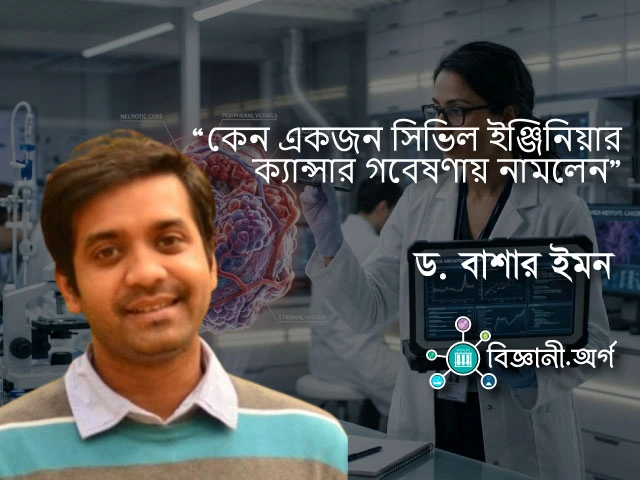
We’re used to seeing blueprints for buildings, bridges, or structures in the hands of an engineer. Research on a complex disease like cancer—that seems like the domain of doctors. But the reality of modern science is that solving big problems is no longer confined to a single field. Bangladeshi researcher Dr. Bashar Emon is a living example of this truth.
After studying civil engineering at Bangladesh University of Engineering and Technology (BUET), he first entered the teaching profession. As he pursued advanced research in structural engineering, he began to realize that research isn’t just about formulas or mathematics; there’s a deep joy in discovering the unknown. This curiosity gradually led him down a different path.
Dr. Bashar Emon says, “If I can do this work, it might help many people.” This single sentence contains the real motivation behind his dive into research. Despite extensive research on cancer worldwide, we have yet to find a ‘definitive solution’ to cancer. In many cases, treatment works, but the disease returns or spreads to other organs. These limitations made him wonder—can someone from outside medicine offer a new perspective?
To find the answer, he began to look at cancer from an engineer’s perspective. Just as we analyze the strength, pressure, or load-bearing capacity of a structure in engineering, he analyzes the environment of cancer cells in the same way. To him, a tumor isn’t just a mass of cells; it’s a kind of “biological structure” where forces, stresses, and stiffness change within.
This viewpoint led him into the relatively new field of cancer mechanics. Researchers here investigate how the physical environment inside a tumor affects the behavior of cancer. For example, in the early stages, tumors are soft, but over time they become stiffer. This hardening isn’t caused by cancer cells alone—neighboring cells also play a role. Understanding this process could lead to new ways to stop the spread of cancer in the future.
Just as a civil engineer focuses on identifying a bridge’s weak points, Dr. Emon’s goal is to find cancer’s “vulnerable moments.” While his research might not directly develop a drug, it is laying the foundation for future treatments. Because once the inner structure of the disease is understood, the ways to target it can also be discovered.
The journey wasn’t without challenges. Changing fields meant learning a new language, mastering new research methods, and adapting to complex concepts in medicine. Still, he took this risk for a greater purpose—the hope of helping people.
Dr. Bashar Emon’s story reminds us that science is not about being confined within a single subject. Rather, when engineering, physics, and biology come together, new solutions to major problems emerge. For Bangladesh’s young generation, his journey gives a clear message—the true role of a scientist begins when you look beyond the boundaries of your studies and turn toward greater humanitarian challenges.
🔗 Read the full interview: