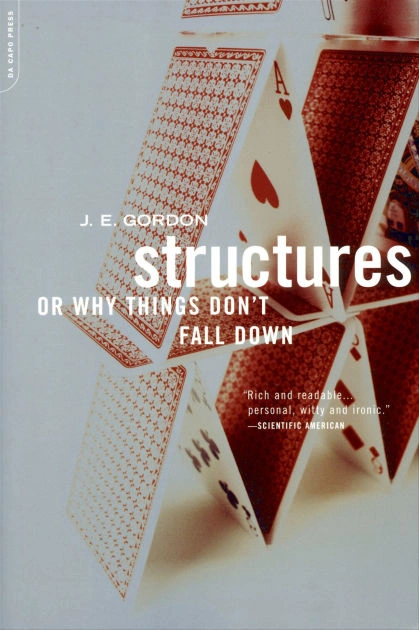
Every day, we pass by thousands of things, sit on them, stand on them, walk—across bridges, inside buildings, on chairs, even beside an airplane’s wing. But why don’t these things fall down? How do such massive structures handle their own weight, endure wind, earthquakes, or the weight of people? The question sounds simple, but its answer lies not just in engineering textbooks, but also in our curiosity and imagination. J.E. Gordon’s book Structures: Or Why Things Don’t Fall Down seeks to answer this very simple yet profound question for us.
One of the best things about this book is that it isn’t written just for students of physics or engineering. Rather, anyone—a general reader—who doesn’t even know the difference between ‘tension’ and ‘compression’ can read it and understand why the vast roof of a cathedral doesn’t collapse or why a tiny design flaw can cause a catastrophic accident. Gordon’s writing offers a certain brilliant simplicity, turning even complex subjects into stories anyone can grasp.
He explains that the essence of engineering is balance—a subtle interplay between tension and compression. A structure isn’t simply a physical object, but a conceptual image of how forces flow through it. For example, Gordon describes how a bridge not only bears its own weight, but also withstands the mass of moving cars, wind pressure, and even temperature changes—so vividly that you can almost see with your own eyes how the stress breaks apart or disperses across steel beams.
He also takes us into the pages of history—Roman arches, Gothic cathedrals, Leonardo da Vinci’s sketches, or 19th-century bridge designs. Through this journey, we realize that thinking about structures isn’t only a modern scientist’s concern; rather, it is a human quest spanning thousands of years, rooted in the pursuit of making our world habitable.
Another unique aspect of the book is Gordon’s sense of humor. Engineering can so often feel tedious to the general reader. But Gordon presents the topics with such wit that, almost without realizing it, the reader absorbs complex ideas. When he explains why the ribcage is one of the most important engineering feats of our bodies—it is not just a scientific fact, but fosters a sense of wonder that nature itself is a master engineer.
This brings us to another important idea—every advance in human civilization is a story of structures. At the dawn of agricultural society there were mud houses, then, with the evolution of civilization, came bricks, iron, steel—and now we talk about future architecture made from nanotubes. But at its core remains the same principle: how can materials be arranged so they don’t collapse or fail? This science of not falling down is a fundamental basis of our progress.
In a developing country like Bangladesh, where buildings, bridges, and flyovers are constantly being erected, the lack of structural knowledge can at times be fatal. We often hear news of building collapses, mismanagement, or major accidents resulting from poor construction. This book reminds us—engineering isn’t just about numbers and machinery; it is a kind of ethics, where every design holds the responsibility of protecting human lives.
But the book doesn’t just dwell on disasters; it also teaches us how to use this knowledge to build a beautiful and sustainable world. It’s particularly inspiring for young readers—those wondering how to choose science, mathematics, or engineering as a path in life. The book makes it clear that being an engineer is not just a technical job, but a way to use your intellect to tackle the world’s biggest challenges.
According to Gordon, ‘structure’ is not limited to buildings or bridges; it is a metaphor for life itself. Our social structures, political frameworks, even our ways of thinking all rely on a similar balance. When a debate falls apart, it is a kind of structural collapse as well. Through this rich metaphor, the book becomes a profound humanistic lesson.
A book like this is especially relevant to the youth of Bangladesh. While the demand for engineering education is growing, there is also a gap in practical knowledge. Students may score well in exams by memorizing theory, but they struggle to apply that knowledge in real-life situations. This book provides a medium where the learning process is both joyful and deeply human.
In conclusion, Structures: Or Why Things Don’t Fall Down is more than a book—it is a philosophy. It teaches us how to look at the world through the lens of structures—with new perspective and new wonder. In Gordon’s words, engineering is “organizing the world in such a way that it doesn’t harm us, but helps us”—and this philosophy can lead us towards a safer, more beautiful, and more mindful society.
Therefore, for anyone who wants to understand the world around them a bit deeper—how a chair holds our weight or how a bridge stands tall year after year without collapsing—this book is a must-read. And perhaps after finishing it, they won’t be an ‘ordinary’ reader anymore, but will become a connoisseur of structures, an inquirer, someone who understands why the world doesn’t fall apart.
PDF link to the book: Structures: Or Why Things Don’t Fall Down