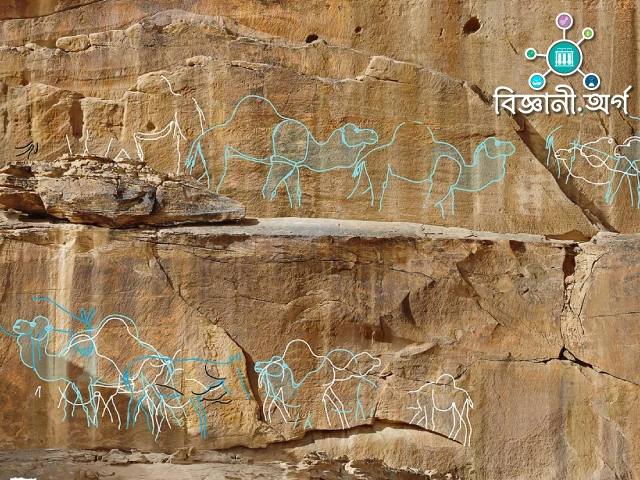
A composite drone photograph of the Jebel Mismaar petroglyphs captures 19 complete camels and 3 horses. The ancient figures are marked in white, while the comparatively newer ones are highlighted in blue. A human figure has been added on the left for scale. — Sahout Rock Art and Archaeology Project
A composite drone photograph of the Jebel Mismaar petroglyphs captures 19 complete camels and 3 horses. The ancient figures are marked in white, while the comparatively newer ones are highlighted in blue. A human figure has been added on the left for scale. — Sahout Rock Art and Archaeology Project
The Arabian Peninsula is the heartland of our Muslim civilization. This is where Islam was born, where the footprints of prophets and messengers remain, where the revelation of Allah descended. But the history of this land is not limited to just fourteen centuries—it carries the legacy of a civilization thousands of years old. Recently, archaeologists have discovered artwork near the Nefud Desert that stands as a priceless testament to our long cultural heritage.
On four remote rocky cliffs, nearly 130 engraved animal figures have been found. Among them are over ninety camels—each as large as a human, one and a half to two and a half meters in length. Every camel has been carved with incredible precision, as if the artists drew inspiration directly from living animals. The camels’ shaggy bodies and postures in mating season—all are vividly captured within these artistic lines.
Allah says in the Qur’an:
“Do they not look at the camels and how they are created?”
(Surah Al-Ghashiyah (88), Ayah 17).
This symbolic animal of the desert served as a teacher of patience, endurance, and survival for humans. So it is no surprise that, even thousands of years ago, the people of the desert chose the camel as the central figure of their art. Archaeologists say these engravings were not merely art; they also served as maps pointing the way to water sources. If you follow the path of the carvings, you find a lake hidden behind the mountains. In other words, the inscribed stone was itself a map of survival for the people of that era.
The Qur’an mentions the ‘Ad and Thamud peoples—who carved homes out of mountains, built advanced civilizations, yet were destroyed for their transgressions. (Surah Hud, Ayah 50-68). Today’s archaeological discoveries are a scientific echo of that story. Twelve-thousand-year-old camel art proves that, long before the advent of Islam, the Arabian land was a center of culture, knowledge, and civilization.
Most astonishingly, the artists created these massive figures while balancing on the slightest of ledges atop sheer cliff faces, dozens of feet high. All they had were stone tools. Through countless blows, limitless patience, and vivid imagination, they produced art that endures even today. Research indicates these engravings are at least 12,000 years old—contemporaneous with Europe’s famed cave paintings.
This discovery is not just about archaeology; it is deeply rooted in Muslim heritage as well. Allah commands in the Qur’an: “Travel through the land and observe the outcome of those before you.” (Surah Ar-Rum, Ayah 42). The rock carvings of camels in the desert remind us of that lesson—civilizations rise, flourish, and eventually fade away, but their traces remain as lessons for future generations.
For today’s young Muslim generation, this discovery is a new source of inspiration. It proves that the land of Islam is not only a spiritual center, but it also carries the legacy of thousands of years of knowledge, art, and culture. Islam has illuminated this ancient cultural current anew—shaping it into a true human civilization under the shadow of Tawheed.
The camels carved into the desert stone seem to still be watching us today—as if saying, “Look, how rich your past once was.” It is our duty to know that heritage, to understand it, and to teach it to the next generation. For a nation that forgets its history can never show the way to the future.