The Wonders of 21st Century Neurotechnology
On a morning in 2025, a 65-year-old man slowly walks into a neurosurgery clinic in the United States. His hands are trembling, his face bears a look of helplessness—the living embodiment of Parkinson’s disease. Yet he wasn’t always like this. He was once a teacher, writing on the board and lecturing for hours on end. That freedom now seems halted by an endless battle within his own brain. But his story has taken a turn thanks to a new discovery—‘Adaptive Deep Brain Stimulation,’ or aDBS.
Parkinson’s disease is a progressive neurodegenerative disorder—meaning it gradually destroys parts of the nervous system. The problem primarily lies in a brain region called the basal ganglia, which controls movement and mobility. As a result, patients suffer from symptoms like uncontrolled tremors, stiffness, and sluggishness of movement.
At the root of this issue is a unique kind of signal disruption, known in scientific terms as Oscillopathy—an imbalance in the brain’s oscillatory signals. Research shows that in people with Parkinson’s, these signals can spike to abnormally high levels, leading to symptoms such as shaking hands, a stiffened expression, or freezing of the body.
Nearly three decades ago, scientists developed a treatment called Deep Brain Stimulation (DBS). This involves an implantable device that sends electrical pulses to specific regions of the brain to balance out the problematic signals. However, the earlier DBS devices were “static”—they sent the same signal at all times, without reacting to the real-time fluctuations happening in the brain.
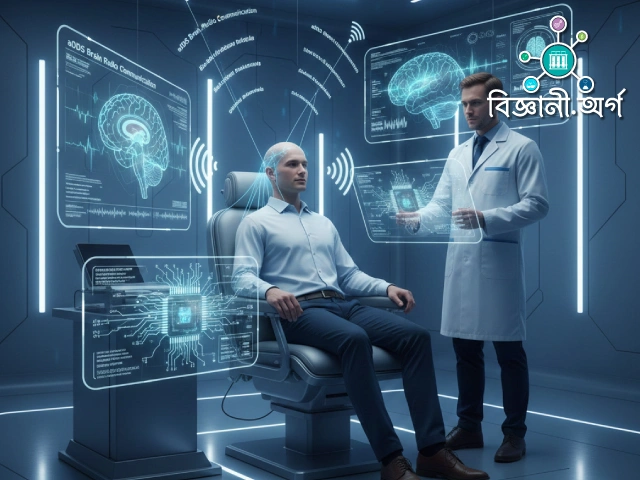
Overcoming these limitations, scientists created Adaptive Deep Brain Stimulation (adaptive DBS or aDBS, in short). This technology incorporates a tiny chip known as the “brain radio,” which listens to the brain’s waves and adjusts the electrical signal in real time. It’s like a live radio broadcast from the brain, treating the patient as it ‘hears’ what’s happening—in other words, harmonizing with the brain’s rhythm.
This technology has two main components: first, a thin electrode wire that reaches into precise regions of the brain to deliver electrical pulses; second, a small chip that senses fluctuations in brain waves and adjusts stimulation accordingly. For example, if the device detects abnormal tremor activity, it automatically increases stimulation; in calmer moments, it reduces it.
The revolutionary aspect of this technology is that it responds autonomously to the patient’s needs, engaging in a continuous “dialogue” with the brain. As a result, the risk of side effects seen in standard DBS—like weakened speech, sudden falls, or involuntary movements—is significantly reduced.
Currently, about one million people in the United States and 1.2 million in Europe are affected by Parkinson’s disease. Although reliable statistics are unavailable for Bangladesh, considering population size and limited healthcare facilities, it is estimated that the number of patients there exceeds hundreds of thousands. While this technology is still a distant prospect for the country, looking at global developments provides a glimmer of hope.
In the United States, the Mayo Clinic and UCSF (University of California, San Francisco) are conducting in-depth research on aDBS. In the UK, Oxford, and in Germany, the University of Freiburg are testing software algorithms and long-term side effects of the technology. Its potential is not limited to Parkinson’s—it is also being explored for Tourette’s Syndrome, Obsessive Compulsive Disorder (OCD), and even depression.
However, like any new technology, this too faces controversy. While it is a blessing for many patients, ethical questions have arisen—is it acceptable to have a device permanently implanted in the brain? Does it amount to “controlling” the mind? Furthermore, the cost of this device is significant—an implant can cost up to $30,000, making it nearly inaccessible for patients in developing countries.
Still, there is hope that as technology advances, costs will decrease and effectiveness will increase. Researchers say that within the next 5–10 years, these devices will become even more “mini,” wireless, and usable even in diagnosis—for example, if someone shows early signs of Parkinson’s, the aDBS chip could detect and alert doctors at an incipient stage.
For a relentless disease like Parkinson’s, this technology is like a modern-day melody, bringing a new rhythm to patients’ lives. What’s in research labs today could soon become a key to freedom for ordinary people. If Bangladesh and other South Asian countries can create avenues for research and access to this technology, perhaps one day our very own ‘brain radio’ will play its tune in the fight against Parkinson’s.
May this groundbreaking treatment be not just a cause for doctors but a collective mission—ushering in a new chapter in understanding and befriending the brain.