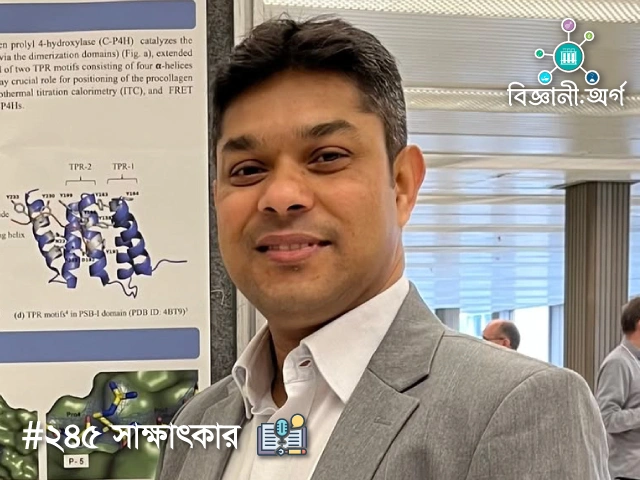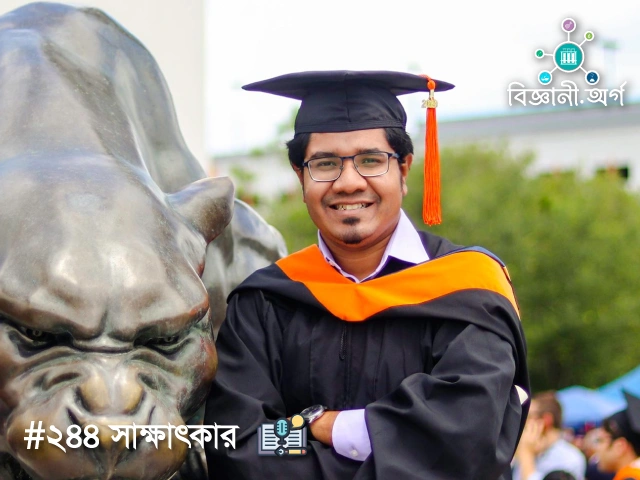
Bangladeshi researcher Professor Hossain M. Javed is currently teaching and conducting research at the School of Life Sciences, Guangzhou University, China. Born into a poor family on the remote island of Sandwip in Chattogram, he overcame numerous socio-economic barriers to become a respected scientist in the field of biotechnology. He is among the world’s top 2% most highly cited scientists. In a recent discussion, Professor Javed spoke about his academic and professional journey from Sandwip to Guangzhou, explained his research areas of synthetic biology and biomanufacturing, shared insights on the challenges facing higher education and research in Bangladesh, and offered valuable advice to students. He illustrated important messages in a light-hearted manner using examples from the Kung Fu Panda animation and the comedic character Mr. Bean. He also shed light on why and how to conduct research, and how research experience can benefit those considering alternative careers like the Bangladesh Civil Service (BCS). He discussed his work’s relevance to climate change, efforts to create valuable products from carbon dioxide, and how artificial intelligence (AI) could revolutionize biotechnology in the future. In this article, we present Professor Javed’s life story, the underlying philosophy of his research, and his inspiring message to the next generation, all based on that discussion.
From the Struggles of Childhood to the Pursuit of Higher Education
Professor Javed was born and raised in Sandwip, a coastal upazila of Chattogram, in an impoverished family. His childhood was shaped by struggles against river erosion and natural disasters; losing one’s homestead to the river was commonplace in his area. After starting at a local primary school, he completed his SSC from Sandwip Kargil High School. Like many, societal and family pressures initially pushed him toward the dream of becoming a doctor. He enrolled at Chittagong College and took medical entrance coaching, but ended up on the waiting list and did not get admitted to medical school. He first joined the Chemistry Department at the University of Chittagong, but after a few semesters, he lost interest. Taking a one-year break, he then enrolled in Microbiology the following year, where he completed his honors and master’s. During this period, he supported his studies through tutoring, which sparked his interest in teaching.
After his master’s, Professor Javed worked for four years as a researcher at Incepta Pharmaceuticals, one of Bangladesh’s leading pharmaceutical companies. He acknowledges that it was at Incepta, through hands-on practical work, that he learned much about research that is often difficult to pick up in university labs in Bangladesh due to limited resources. This hands-on experience served as a foundation for him. However, while working in the industry, he longed to return to academia. When an opportunity arose, he joined Primeasia University, a private institution, as a lecturer. Within a few months, aiming for further education, he moved to the University of Malaya, Malaysia, to pursue a PhD in late 2012.
The beginning of his PhD research in Malaysia was not easy for Professor Javed. He openly admits that due to a lack of strong foundational research knowledge from university, he spent nearly two years in uncertainty at the start. However, through determination and hard work, he gradually found his path—learning on his own how to plan research, organize laboratory work, and analyze experimental results. He successfully completed his PhD in four years, publishing an impressive seven international-standard scientific articles. These publications played a key role in establishing his global scientific reputation. After completing his PhD, motivated by patriotism, he returned to Bangladesh and rejoined Primeasia. However, due to the lack of a suitable research environment and economic stability, staying in the country became difficult.
Then came another turning point in Professor Javed’s life: an opportunity for postdoctoral research in China. He received an offer to join a project and, without overthinking the future, seized this “God-gifted opportunity.” In that laboratory, he was the first foreign researcher and made significant contributions with his skills. Upon completing his postdoc, he was immediately appointed as an associate professor (professor) in China. After three years of research and teaching, in July 2023, he joined the School of Life Sciences at Guangzhou University, where he continues to work with distinction. His journey from Sandwip’s eroded landscapes to the global stage of research stands as a remarkable testament to perseverance, adaptability, and indomitable will.
Research Field: Synthetic Biology and Green Biomanufacturing
Professor Javed’s research focuses on synthetic biology, a modern branch of life sciences. Simply put, synthetic biology involves redesigning various biological systems (such as microorganisms or cells) for desired purposes. The core idea is to alter or enhance natural organisms for human benefit, with applications spanning healthcare, environmental protection, agriculture, and more. Professor Javed specializes in a subfield called industrial biotechnology, or biomanufacturing. The goal is to discover ways to produce chemicals and fuels—currently industrially derived mostly from petrochemicals (i.e., fossil fuel-based raw materials)—using biotechnology in environmentally friendly ways. Synthetic biology offers a promising alternative: making essential products from renewable sources, leveraging microbes and enzymes—what can be called green manufacturing. In his words, their work is “an attempt to move away from petroleum and fossil fuels, using the tools of synthetic biology to advance toward green production systems.”
An example may clarify the matter. Take the production of ethanol (biofuel). Traditionally, fermented beverage or ethanol is produced by fermenting sugar-rich crops (like grape juice) with yeast bacteria—a primitive example of biomanufacturing. In that case, the biological process (the yeast) was entirely natural. Modern synthetic biology now redesigns those natural microorganisms via genetic modification to greatly enhance their production capacity. In other words, bio-producers (biological production organisms) are artificially improved to maximize yields of targeted products. Thanks to synthetic biology, we can now enhance everything from the microbes making yogurt and bread to those producing fuels.
Synthetic biology thrives on two main pillars: protein/enzyme engineering and metabolic engineering. Firstly, enzyme engineering refers to technologies that slightly modify the structure of a protein/enzyme to boost its performance. Industrial reactions often need to be conducted at high temperatures or abnormal pH, where natural enzymes lose effectiveness. Nobel laureate Frances Arnold’s “Directed Evolution” technique in the 1990s introduced minor genetic changes across enzymes, revealing that some modifications resulted in higher heat tolerance and better functionality. For instance, if you substitute an alanine with a valine within the amino acid sequence of an enzyme and see improved performance or stability, that mutation is deemed successful. Through repeated transformations in the lab, improved enzymes can be created, making industrial manufacturing faster and cheaper. Secondly, metabolic engineering means modifying the internal biochemical pathways (metabolic pathways) of a microorganism so it can produce new desired substances. Sometimes this involves tweaking specific biochemical processes; other times the metabolism of the entire cell is reconstructed—termed “systematic metabolic engineering.” For example, a bacterial genome can be altered to consume sugar and produce lots of ethanol, or conversely to consume harmful CO₂ and generate other compounds. Both protein and metabolic engineering underpin synthetic biology’s innovations.
In his PhD and subsequent research, Professor Javed has emphasized biofuel and biobased chemical production. His doctoral work focused on generating bioethanol from sugarcane juice. However, he now considers this field matured and highly applied, and his recent research has shifted from biofuels to higher-value biochemicals or new biomanufacturing innovations. He is conscious of centering his work on timely and demand-driven topics. Nevertheless, his work on renewable alternatives to fossil fuels remains important from an environmental perspective.
Notably, Professor Javed has already published numerous international papers—two of his review articles during the PhD, published in the prestigious journal Renewable and Sustainable Energy Reviews, continue to be cited hundreds of times each year. His total scientific publications now number over 80. This prolific research output has placed him among the world’s most highly cited researchers. Yet, he sees this achievement as the result of a continuous learning journey—each step from Sandwip to Guangzhou has taught and prepared him along the way.
Higher Education and Research in Bangladesh: The Reality of Challenges
As someone who has studied and taught at Bangladeshi universities, Professor Javed knows firsthand the problems faced by those pursuing higher education and research in the country. In his analysis, the issues are twofold: (a) structural and institutional problems, and (b) problems with our own mindset and preparedness. Due to infrastructural deficiencies, key research equipment and lab facilities required for modern research are absent or inadequate in Bangladeshi universities. He notes that many labs lack even basic spectrophotometers, yet we expect world-class research results. Where countries like China began state-planned investment in research in 1978 and have now reached the top, Bangladesh still lacks a long-term plan prioritizing research. Without governmental and institutional support, individual efforts alone cannot yield desired progress.
However, alongside structural obstacles, he emphasizes students’ attitudes and outlook as a major challenge. Many students feel confused about how or where to start research. A lack of clear goals (Defined Goal) often brings their progress to a halt at the outset. Professor Javed jokingly compares this to a Mr. Bean comedy sketch where Mr. Bean rushes into a January sale ahead of everyone else but gets lost, unsure where to go because he had no mental preparation. The same holds for many Bangladeshi students: even when opportunities arise, their lack of clear planning causes them to fall behind.
It’s not just a lack of goals; students often avoid hard work and self-development, instead staying trapped in formalities. Professor Javed observes that while there is no shortage of seminars, workshops, or even religious sermons in the country, those rarely translate into practical change. He remarks caustically, “Nowhere else in the world are there as many religious sermons as in Bangladesh, and yet you still need to carry your shoes into the mosque”—meaning plenty of knowledge-sharing, little actual practice. This highlights that lectures or rote learning are of little use unless we make personal efforts toward improvement. Most of us lack the habit of learning new things beyond the university curriculum.
Professor Javed believes the most crucial thing for students is developing confidence in their own abilities. Fix your goals and commit wholeheartedly, he repeatedly emphasizes. In his words, “You have to believe that only you can bring change in yourself.” Citing the story of Kung Fu Panda, he insists that neither physical build, environment, nor disadvantaged background can hold you back if you’re determined. The film’s protagonist, a chubby panda, dared to dream of becoming a kung fu master and finally attained the Dragon Warrior title through tough training and self-belief. The “secret scroll” in the film is actually blank—the panda sees his own reflection in it, meaning there’s no magic, the strength lies within. Professor Javed uses this story to convey that many students have untapped potential, but realizing it takes strong resolve, personal initiative, and self-confidence.
Professor Javed is very optimistic about the talents of Bangladeshi youth. Through working with students from various backgrounds in Malaysia and China, he has seen that Bangladeshi students are exceptionally smart and quick learners. The problem is, we do not harness or channel that talent effectively. Without proper guidance and initiative, our potential remains unrealized. The overall environment is also not research-friendly; if students themselves do not try, improvement is impossible. Therefore, changing students’ mindsets is as important as infrastructure development: becoming self-reliant rather than dependent, making use of even small opportunities instead of waiting for external encouragement, and persevering. Only then, creativity in research will be possible despite limited resources.
From Interest to Achievement: Practical Advice for Students Starting Research
To students eager to enter the world of research, Professor Javed’s core message is: Set your goals and start learning—less talk, more action. He says, “Just be a worker, not a speaker”—don’t get bogged down in speeches and big ideas; focus on learning by doing. From his experience, he advises aspiring researchers to follow several steps:
- Choosing a Topic: First, you must select a specific field or problem for your research. Choose something related to your core subject and broadly applicable. Professor Javed suggests that if you’re a life science student, start with comprehensive foundational topics like protein engineering or metabolic engineering. Learning these basics will not only solidify your understanding but also allow you to contribute to any area of life sciences in the future. He says, if you master these two, you’ll never get “stuck” in any research field—just a little adaptation will let you contribute anywhere. Therefore, rather than starting with a very narrow topic, pick something foundational for multiple research areas.
- Start with Simple Readings: Instead of diving right into complex thesis papers, begin with general overviews. Professor Javed gives his new students easy-to-read review or practical articles first. For instance, he assigned one student a paper on how biofuel raw materials can be produced from agricultural waste. Such writings are often story-like—presenting real problems and solutions—which makes understanding even complex science straightforward. Begin with simple texts to break the initial fear and spark curiosity and interest. Don’t jump into deep theory at the outset; start with accessible articles, popular science pieces, or general reviews to build your knowledge base.
- Reading: Depth and Patience: Once you’re interested, start reading research articles in your chosen field, and stick with it patiently. At first, much will be difficult to grasp—this is normal and all students face it. Complex vocabulary, abstract concepts, or unfamiliar methods may seem overwhelming. Here’s Professor Javed’s mantra: don’t give up. He says, if you read an abstract once and understand nothing, read it ten times! The first read may feel like “an unknown mountain,” the second time something will click, the third time will be much clearer. Repetition and persistence will gradually untangle the theme. Such careful reading takes time, so undergraduate students—who usually have more spare time than in later life—should make full use of it for serious study.
- Use of Supportive Technology: Compared to the past, today there are plenty of digital tools to support learning. To overcome linguistic or technical hurdles, students can use AI-based translation and analysis tools. Professor Javed notes that modern AI systems can now repeatedly explain unfamiliar words or concepts until you get it. So, don’t let weak English or tough topics deter you. Tools like Google Scholar, various open-source resources, or AI assistance like ChatGPT can make virtually any journal paper accessible. Even with technological help, you must do the real work—reading attentively and striving to understand.
- Extracting Essence from Content: It’s not enough just to read—you must extract what you’ve learned. Professor Javed emphasizes that reading should be “output-oriented.” After reading a paper, try to synthesize its key findings on your own. For example, after reading a paper on enzyme engineering, see what problem it addressed, which methods were used, and how modifications led to improvements. Suppose the paper says that a certain amino acid change in a particular enzyme improved thermal stability by 20%, achieved via site-directed mutagenesis. Your takeaway would be: “The activity of a given enzyme can be improved through genetic modification, and I learned a method for doing it.” For every article you read, identify take-home points. If you don’t understand something, note your questions and investigate later. By doing so, your grasp of the field will increase, and you’ll gradually detect the “research gap.” In fact, constantly asking yourself, “What is still unknown, could it be done another way, what problems remain unsolved?” will help you find new research questions. The ability to frame research questions is the most crucial skill for a novice researcher, and you can build it at this stage.
- Practice Writing: Alongside acquiring knowledge, learning the “craft of scientific writing” is essential, especially for those pursuing academia. Professor Javed advises developing creative writing skills alongside reading. For instance, after reading an abstract, try rephrasing it in your own words—first by looking, then from memory. Then compare with the original to see what you missed or misunderstood. This practice gives you two benefits: (1) checks whether you truly understood the content, and (2) helps you master scientific writing style. Many wish to do research but struggle to express their ideas because of a lack of writing practice. So, start small: summarize reviews, keep a research blog, or write notes. This will boost your critical analysis and expressive abilities, both vital for long-term original research and publication.
- Persevere and Keep Questioning Yourself: Feeling frustration at the beginning of research is very normal, especially if repeated readings still leave you confused. Many give up at this point. Professor Javed says, “Read an abstract ten times”—in other words, break through impatience and try again. When you feel, “I can’t do this, I don’t understand,” that’s the exact moment to give it another shot. Only then will your brain start getting used to this new language. Always challenge yourself: “Why was this done this way? Could it have been done differently? How far have we progressed so far?” Searching for these answers will enrich your knowledge and help you determine the next steps. He insists that fundamental improvement has no shortcut—listening to a hundred lectures is useless if you don’t practice hands-on. Many students just attend seminars or collect certificates and realize two years later that they’ve gained nothing. Instead of making this mistake, start with a small topic but do something real.
In summary: Deeply study your field of interest, learn, and practice expressing your knowledge in writing; you must develop yourself—no one else will do it for you. Professor Javed says, “You don’t need to listen to any kind of lecture… If you want to develop yourself, you must start, and starting should be hands-on.” In other words, instead of drifting in elders’ wisdom, start your own work, however small. Research isn’t just about handling fancy equipment in a lab—it’s a way of thinking, which anyone can begin even with limited resources. For example, if you don’t get access to advanced labs during your studies, don’t despair; turn the library or internet into your lab. Write a good review paper, analyze some real data at home, or email seniors for advice if needed. With open-access information nowadays, much research can be done from home. Unless you do something tangible, you’re not on the path of a researcher—that’s his main point.
The Role of Research in Career Advancement: Not Just for Professors
Some believe that research is only for those who aspire to become lifelong scientists or professors. But Professor Javed challenges this, showing that research experience is beneficial across all careers. First, from a practical perspective, research is an essential part of his own career—as a university professor, he is expected to publish a specified number of research papers and secure project funding every year. In other words, research is inseparable from both his livelihood and his life. Perhaps in Bangladesh he would have only taught classes, but overseas he is professionally required to do regular research. Beyond this, his dedication to research comes from a passion for knowledge and a desire to contribute to society—though he places this as a secondary reason. Livelihood first, knowledge service second—together, these have kept him on the research path.
Now consider a student whose goal is different—say, a government job (BCS) or a career in banking. Is research relevant? Many think academic research has no bearing. Professor Javed clearly states that this is a misconception. If someone spends some time during undergraduate studies doing research or publishing something, while it may not directly answer BCS exam questions, it will sharpen the mind in ways that are invaluable. Being involved in research teaches critical thinking, how to break down problems, how to absorb new things quickly, and master the art of learning the unknown. These are transferable skills essential for any profession. Whether you become a BCS cadre or a corporate officer—if you have analytical skills, the ability to learn quickly, and can extract vital information even under stress, you’ll stand out from others. In his words, “If you’ve been involved in research… all the things installed in your brain… will unknowingly help you in the workplace.” In other words, research will quietly make you a more effective professional.
However, he also notes the need to be clear about your aims and priorities. If your main need is to get a job quickly after graduation to support your family, you may not have the time or ability for large research projects. In that case, it is best to focus on your primary goal (e.g., BCS preparation). Professor Javed says, if someone takes on research right before BCS exams and becomes so engrossed they neglect preparation, that would be an unrealistic decision. So, always weigh your time and opportunities carefully. Early or midway through student life, when you have some spare time, is the best time to get research experience. Once you’re in a job, or under end-of-degree pressures, it will become nearly impossible to make time for research.
There is another career-related bonus to research—it gives you an extra backup option. Many students are unsure what they will do in the future. Even a little research experience keeps the door open for higher studies or scholarships abroad, or for taking up research as a career. And even if you end up in administration or business, research experience is never wasted; you’ll be better equipped to think creatively in any information-centric job.
In short, while Professor Javed encourages youth to pursue research, he doesn’t urge anyone toward unrealistic dreams. Your situation, responsibilities, and dreams—balance all three and engage in research as much as possible, that’s his advice. If you want to be a full scientist, no question—dive in using the techniques above as soon as you can. If you pursue another career, at least get a taste of research while you can as a student, so your brain stays sharp a bit longer.
Climate Change and a Sustainable Future: The Broader Impact of His Research
In the current global context, climate change is a major concern, and Professor Javed’s research holds the potential to help address this problem. He notes that his work focuses on green manufacturing or sustainable production technologies—in short, reducing carbon footprint. By producing fuels and chemicals from bio-based renewable sources instead of fossil fuels, we can help tackle climate change and achieve Sustainable Development Goals (SDGs). But the question is: how effectively are these research outcomes being applied in reality?
Let’s begin with biofuels. In the US, ethanol (biofuel) is made from corn, and in Brazil from sugarcane juice—these are classified as first-generation biofuels. However, they are controversial for using food crops for fuel—the “food vs. fuel” debate. To avoid this, scientists have attempted to use lignocellulosic biomass—like rice husks, straw, wood chips, and other agricultural and forestry wastes—for second-generation biofuels. Such raw materials are cheap and abundant (virtually every country, including Bangladesh, generates huge amounts of straw post-harvest). The problem is, producing ethanol or other fuels from them is technically complex and expensive. For example, the enzymes needed to break down cellulose are costly, and the overall process is still more expensive than producing fuel from oil. Private investors have remained uninterested. In some countries, the government maintained this technology with subsidies so that food crops wouldn’t be necessary. But when subsidies were withdrawn, many second-generation biofuel factories shut down. In other words, no matter how prepared we are to save the climate, green technologies do not establish themselves unless they are economically viable.
Yet hope remains; science never stops. Professor Javed reports that research is moving toward even more innovative fields—transforming carbon dioxide (CO₂) gas itself into valuable products. This is truly like turning an enemy into a friend—if we can use the most harmful gas in the environment as a raw material to produce fuels or chemicals, we could “kill two birds with one stone.” He shares that current studies have already managed to use CO₂ to make acetate (a two-carbon compound) via bioprocessing, and then convert that into various products using microbes. While this is still in the lab, if successful, in the future we could capture CO₂ from factory emissions or the environment and turn it into liquid fuels or other useful chemicals. For those concerned about climate change, this technology can be seen as a game-changer.
In his discussion, Professor Javed also spoke about another future trend—the entry of artificial intelligence (AI) into research and its revolutionary impact. He explained that in the past, work such as protein engineering relied on “trial and error”—making thousands of mutations in the lab to see which improved performance. This required huge time and labor. Now, AI algorithms can instantly analyze vast datasets and predict whether a given amino acid change will improve enzyme stability. What used to take a year can now be predicted in seconds with AI. Likewise, mining gene and metabolic pathway databases with AI might uncover entirely new ways for microbes to consume CO₂ and produce desired products. So in the next 5–10 years, the fusion of synthetic biology and AI may bring seismic change. Research directions could shift dramatically—problems that stumped hundreds of scientists for years might be solved overnight with AI support.
Yet while hopeful about AI and synthetic biology, Professor Javed keeps his feet on the ground. He notes that as long as green technologies can’t compete on cost, fossil fuels will continue to dominate. As a scientist, his job is to develop technical solutions, but economic and policy support is essential for real-world adoption. Thus, while research to reduce climate change is ongoing, industry and governments must step up to make these solutions affordable and implementable.
In sum, Professor Javed’s research is part of a global effort toward long-term decarbonization. Reducing greenhouse gases, expanding renewable energy, and achieving sustainable industrial production are worldwide aims to which his work is directly linked. For a child of a developing country to contribute knowledge toward solving global problems is a source of pride for Bangladesh. His work shows that with the right opportunities and talent, Bangladeshi researchers, too, can lead the world, even in tackling complex issues like climate change.
Multidisciplinary Learning and International Collaboration: Lessons for Bangladeshi Students
Another main theme in Professor Javed’s discussion was multidisciplinary knowledge and international networking. He insists that today’s top research no longer happens within the confines of a single discipline; working in one field inevitably requires knowledge from others. For example, in biotechnology research, you’ll need to know chemistry—analytical chemistry to understand instrument methods, statistics to analyze results, and even computer programming or machine learning to manage complex data. Therefore, those content with only their “own field” will fall behind. He advises that students should build complementary skills beyond their main area. For example, after starting with a microbiology background, he moved into synthetic biology, which combines genetic engineering, biochemical engineering, and computational biology. He tells his students, if you master protein or metabolic engineering, you can work in everything from medicine to industrial science. Even social science researchers may need to learn statistics or machine learning to analyze survey data. Twenty-first century researchers must be multidimensional—able to cross boundaries of knowledge. Bangladeshi students are talented, but many are unwilling or afraid to step outside their niche. If they can overcome this narrowness, they will excel globally.
Professor Javed is also enthusiastic on international collaboration. Having studied in Malaysia and China, he is connected to the global research community and encourages young Bangladeshis to seek overseas opportunities. In China, he observed that major research groups take on multiple projects together, combining talents from various countries and fields to create results. Chinese research groups leverage foreign researchers’ English expertise, while foreigners gain access to cutting-edge equipment and supervision—a win-win situation. Bangladeshi scientists, too, need to join such teams. He himself was the first foreign researcher in his Chinese lab, contributing successfully and earning promotion to professor, proving that with merit and hard work, one can secure a place internationally.
Incidentally, even while abroad, Professor Javed continues collaborating with research teams in Bangladesh. He shared that some students from the Chemistry Department at Chittagong University have conducted research and published papers with him. This means that talented local youth can do international-caliber work by partnering with Bangladeshi expatriate scientists. The only requirement is building a communication bridge. In today’s interconnected world, reaching world-class experts is not hard—you just need to send an email or connect on social media. There are Bangladeshi scientists and professors worldwide; in addition, many foreign professors welcome proposals from students from emerging countries if they see interest and dedication. Our students need to overcome their hesitation and lack of confidence to claim their place on the international stage.
A big takeaway for Bangladesh’s education system is to promote international research cooperation at the policy level. Professor Javed’s success demonstrates that with the right contacts and qualifications, gaining senior positions at foreign universities is possible. Domestic universities should also facilitate overseas study and joint research initiatives and send students and teachers to international conferences. Such global knowledge exchange can help compensate for some deficiencies at home. Equipment or specialized expertise lacking in Bangladesh may be accessible through overseas partnerships. Thus, cross-discipline and cross-cultural cooperation is not a luxury for resource-limited countries like ours, but rather a survival strategy.
Watch Dr. Md. Javed Hossain’s interview on YouTube via the link below: 👇👇👇
Conclusion
The life story of Professor Hossain M. Javed stretches from a humble house in Sandwip all the way to cutting-edge international laboratories—a true saga of struggle and success. The journey contains lessons in finding alternative paths when faced with obstacles, and examples of unwavering commitment to learning amid uncertainty. Students can glean powerful lessons from his experience: dream big, but never fall short in hard work and perseverance to achieve those dreams. From a riverside house in Sandwip that was lost to erosion, a boy now stands among the world’s leading scientists—what greater inspiration could there be for young people?
Professor Javed’s conversation makes it clear that Bangladeshi youth have talent and the potential to move the country forward, but this requires courage and determination. Research should not be seen as something intimidating, but instead as the joy of discovery. University students should be motivated to ask their own questions, to read on their own, to take initiative. The stagnation in our educational culture can only be overcome by students themselves—if you waste time waiting for teachers or government, personal progress will remain elusive. Professor Javed’s call to Bangladeshi students is clear: “You have to make your own change”—even if the external environment is challenging, move ahead on the strength of inner resolve.
He has shown that knowledge is power, even in tackling major crises like climate change. Bangladesh is among the most vulnerable countries to climate disaster, but when a Bangladeshi scientist finds new ways to reduce carbon emissions, it shows how far-reaching the global impact of intellectual effort can be. If the new generation can follow the path shown by Professor Javed—with a fixed aim, tireless effort, acquiring multidimensional skills, and a global outlook—then we, too, can achieve notable success in science and technology on the international stage.
This piece, written in polished, standard Bengali, is at once a story and a lesson. The story is of one man’s success, but the lesson is for everyone—if he can do it, why can’t you? With his feet in the soil of Sandwip and eyes on the sky, Hossain M. Javed dreamt big; today, his sky-high achievements will inspire countless young hearts to dream new dreams—this is our hope.
The event was hosted by Tahsin Ahmed Supti, a volunteer at Biggani Org. It was held online on December 20, 2025. Special thanks from the Biggani Org team to Mohiuddin for overall coordination of the event.