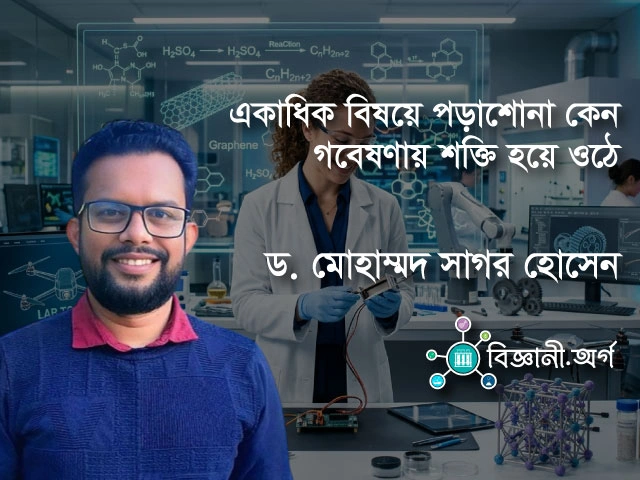
In a recent interview with biggani.org, Dr. Mohammad Sagor Hossain shared his academic journey, illustrating how studying multiple subjects or acquiring knowledge from diverse fields can become a powerful asset in research. He began with Applied Chemistry, later pursued a PhD in the environment of Mechanical Engineering, and ultimately established himself as a specialist in Materials Science and Engineering. Through this multifaceted journey, he finds a roadmap for the future of research.
In the interview, he explained that focusing on a single subject leads to depth in a specific area. However, possessing knowledge of multiple disciplines broadens a researcher’s perspective. He compared this to a geometric example: on one hand, if the base is small but the height is great, and on the other, if the base is wide but the height is somewhat less—both create a certain volume. In his words, alongside depth, a broad base is also essential in research. When both are present, a researcher not only understands the technicalities inside the laboratory but also learns the language to apply those findings on a larger industrial scale.
Dr. Sagor Hossain explained that his knowledge of applied chemistry helped him understand the molecular structure and chemical transformations of materials. Conversely, his experience working in an engineering environment taught him how to translate small-scale research into real-world applications on a larger scale. With both experiences combined, he can communicate effectively with both laboratory scientists and industry engineers.
He further stated in the interview that much of future research will take place at the intersection of various fields. The junctions—such as between chemistry and environmental science, or between computer science and biology—are where new research frontiers are emerging. Therefore, his advice to students is to study different but interconnected subjects at the bachelor’s, master’s, and PhD levels if possible. This allows researchers to learn to approach problems from multiple perspectives.
His remarks given to biggani.org convey an important message for us. In modern research, expertise in just one subject is not enough; rather, the ability to integrate knowledge from different fields sets the future researcher apart. Dr. Mohammad Sagor Hossain’s experience shows that a multidisciplinary educational journey not only widens the path of research but also creates opportunities to connect research to real-world problems.
To learn more about this discussion, readers can view the full interview with Dr. Mohammad Sagor Hossain published on biggani.org.