


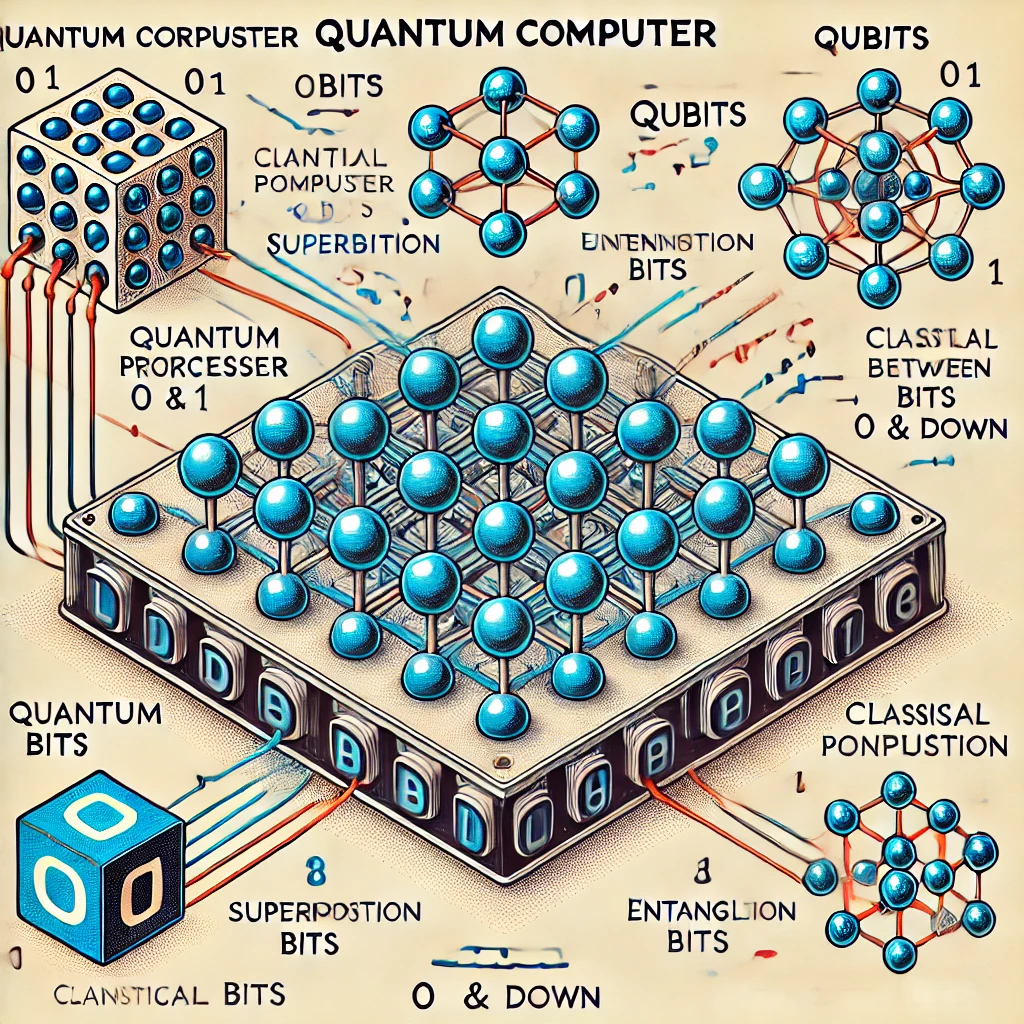
Quantum technology is a field built upon the principles and theories of quantum mechanics. At its core, it primarily uses quantum bits, or qubits, which can store far more information than classical bits. Through quantum technology, we can achieve more powerful computing, enhanced security systems, and faster data processing capabilities. This technology is being used in various fields such as quantum computers, quantum cryptography, and quantum sensing.
A new chapter has begun in the world of quantum technology. In recent years, scientists have made significant progress in quantum communication—introducing “qudits.” This breakthrough promises to spark a revolution in quantum computing and secure communication. With this new technology, it will be possible to create even more complex and high-capacity quantum systems by using advanced qudits instead of the traditional qubits.

What are Qudits?
Qudits are an advanced version of quantum bits that can simultaneously exist in multiple states. While qubits can only exist in two states (0 and 1), qudits can be in many states at once, which increases the capacity for storing and processing quantum information.
Applications of Qudits
Researchers have developed a method to encode quantum information using qudits, which will help enable high-speed quantum internet. This allows for secure transmission of massive amounts of data over long distances. The method uses higher-dimensional states of photons to encode and transmit more information.
Advantages of Qudits
- 1. Enhanced data density: A single qudit can represent more information, making quantum computation more efficient.
- 2. Improved noise resistance: Qudit-based systems show better resistance against noise and errors in quantum communication.
- 3. Higher mathematical precision: Especially useful in implementing quantum Fourier transform algorithms, where precision benefits from the increased size of qudits.
Real-World Applications of Qudits
Security and Encryption
This technology will help enhance quantum encryption protocols, making them impossible to break with conventional computers. As a result, data can be transmitted more securely and efficiently. Researchers are currently focusing on improving the accuracy of qudits and scaling the technology for higher-level operations.
Using silicon-photonic integrated circuits, researchers have developed programmable qudit-based quantum processors. These processors can initialize, manipulate, and measure quantum quart (ququart) states, which are four-level qudit systems.
Use of Qudits in Quantum Cryptography
Qudit-based systems significantly enhance the security and efficiency of quantum cryptography. For example, with a four-level qudit system, the maximum secret key rate per pulse for data exchange can be increased from 1 bit to 2 bits.
Use of Qudits in Quantum Algorithms
Using qudits, scientists have implemented advanced quantum algorithms—including generalized Deutsch-Jozsa, Bernstein-Vazirani, quantum phase estimation, and fast factorization algorithms.
Recent Advances
- 1. Flying Qudit: This innovative idea opens up new dimensions in quantum communication, creating new possibilities for information transfer.
- 2. Microlaser Chip: Researchers at Penn Engineering have created a chip that communicates with qudits and doubles the quantum information space compared to any previous on-chip laser.
The Impact of Qudits on Quantum Computing
The use of qudits can lead to more powerful and efficient quantum computers which, compared to their qubit-based counterparts, will be able to solve complex problems more quickly. This advancement brings us a step closer to achieving large-scale practical quantum computers.
The Future of Secure Communication
Qudit-based quantum cryptography provides a physical barrier against data theft instead of a mathematical one. This means it could remain unaffected by future computational threats. The technology is crucial for creating a secure quantum internet and maintaining long-term data security.
Challenges of Qudits
Despite their great potential, there are some challenges in implementing qudits. These include:
- 1. Complex control: Due to their many possible states, controlling qudits is much more challenging than qubits.
- 2. Decoherence: Qudit systems may interact with their environment more, increasing the risk of losing their quantum state.
- 3. Readout errors: With a higher number of possible states, accurately reading the state of a qudit can be more difficult.
Despite these challenges, researchers are working hard to advance qudit technology.
Qudit Technology Can Have Far-Reaching Impact in Various Fields:
- 1. Data Security: Qudit-based cryptography can provide a new level of security for banking, government communications, and personal data protection.
- 2. Scientific Research: From simulating complex molecules to climate modeling, qudit-based quantum computers can greatly accelerate scientific research.
- 3. Artificial Intelligence: Advanced quantum machine learning algorithms can be developed using qudits, increasing the power of AI systems.
- 4. Logistics and Optimization: Complex logistics problem-solving and large-scale optimization can be significantly improved by qudit-based systems.
The Future of Qudits
The emergence of qudits marks a significant advancement in quantum communication. They offer enhanced capabilities, improved security, and greater computational power. As research progresses, we can expect to see more practical applications of qudit-based quantum technology in the near future.











Leave a comment