One Bottle, a Thousand Years…
You threw your plastic bottle into the dustbin. Then what?
Typically, the bottle will slowly disappear under the ground or get lost in ocean waves. But is it really gone? The answer is: no. According to scientists, it can take up to a thousand years for plastic to fully decompose. On one hand, this plastic is destroying our biodiversity, and on the other, it is returning to our dinner tables through the food chain, entering our bodies as microplastics.
Globally, about 380 million tons of plastic are produced every year, and 90% of it is not recyclable. Every minute, one million plastic bottles are purchased, most of which are never recycled.
But what if there was a way to break down plastic quickly?
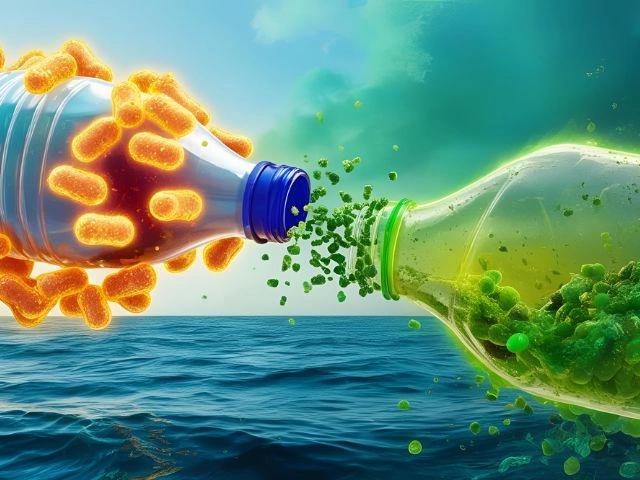
This question is being tackled by Epoch Biodesign—a London-based startup that has used artificial intelligence (AI) to create enzymes that can break down plastic 25 times faster!
Accelerating Nature’s Pace
The idea of plastic-eating enzymes is not new. Scientists have previously discovered enzymes capable of breaking down plastics. But there’s always been one problem—speed.
“We know that some enzymes can break down plastics, but they do so so slowly that it’s not industrially viable,” said environmental scientist Dr. Adam Foster.
Epoch Biodesign addressed this problem with AI. They used artificial intelligence to create and test millions of enzyme variants, ultimately designing an enzyme capable of breaking down plastic 25 times faster.
“Here, AI has worked as a partner to nature. What evolution would take millions of years to achieve, AI can do in just a few months,” says Epoch Biodesign founder Jacob Nathan.
The enzyme breaks the plastic polymers into small fragments, which microorganisms can easily digest. As a result, the decomposition process of plastic accelerates hundreds of times over.
Why is this important?
For years, plastic recycling has been a massive challenge. It is expensive, time-consuming, and energy-intensive. Moreover, most plastics are not reused because the process is not efficient enough.
This new AI-designed enzyme creates the possibility for environmentally friendly and low-cost plastic recycling. Traditional plastic recycling uses high-temperature processes that consume lots of energy. But the enzyme-based process could significantly reduce this cost, making it less harmful to the environment.
The Fashion Industry and Epoch’s Big Deal
One of the largest sources of plastic pollution is the fashion industry. Most of our clothes are made of polyester and nylon, which themselves are derived from plastic. When we wash these clothes, tiny plastic particles mix with water and eventually end up in the ocean.
To address this problem, Inditex, the parent company of Zara, has recently signed a multi-year deal with Epoch Biodesign. Their goal is to turn old clothes into new ones—a major first step toward creating a genuine circular economy.
“It’s not just about preserving the environment; it will transform the very outlook of the industry,” said a spokesperson from Inditex.
Global Competition and Research
Besides Epoch Biodesign, other research institutions around the world are searching for solutions to destroy plastic. Scientists in Japan and the United States are already working with plastic-consuming bacteria. However, so far, Epoch Biodesign’s AI-designed enzyme is considered the fastest solution.
The Potential for Bangladesh
Plastic pollution has become a severe issue in Bangladesh. In Dhaka, around 6,000 tons of waste are generated each day, a significant portion of which is plastic. If this enzyme-based technology is introduced in the country, it could have a huge positive impact on the environment.
A member of Bangladesh Poribesh Andolon (BAPA) said, “This is promising news. But the question is, when will this technology actually arrive in our local context?”
If enzyme-based plastic recycling technology can be successfully implemented in industries, it could become the most powerful tool against plastic pollution.
Final Words
This initiative, which began as a school science project, is now on its way to solving the global plastic problem. If Epoch Biodesign’s research is successfully implemented, perhaps one day, plastic will be a thing of the past.
What do you think? Will this new technology really be effective in curbing plastic pollution? Share your opinion on our Facebook page!
Science & Technology Desk | Biggani.org