News Desk, Biggani.org
18 July 2025
One of the most complex and fundamental questions of the universe is: Why do we, who are made of matter, exist at all, and why is the universe not just filled with emptiness? Scientists believe that at the birth of the universe, equal amounts of matter and its opposite, antimatter, were created. But whenever these two come together, they annihilate each other. So the question remains—how did any amount of matter manage to survive?
In search of this deep mystery, scientists have been tireless in their efforts, and now a new discovery from CERN’s Large Hadron Collider (LHC) has opened a whole new horizon in this investigation.
Strange Antimatter Behavior Detected in Baryons
At the LHCb (Large Hadron Collider beauty) experiment site on the outskirts of Geneva, Switzerland, scientists have, for the first time, found evidence of CP violation in a special class of particles. This rare event helps explain behavioral differences between matter and antimatter.
Generally, matter and antimatter are mirror images of each other—their properties are identical except for electric charge. But whenever they behave even slightly differently, scientists get excited. Because, if such differences can be proven significant enough, they could explain why matter survived while antimatter was destroyed.
What Are Baryons and Why Are They Important?
Baryons are a class of particles made up of three quarks—including protons and neutrons, the key building blocks of every atom. At LHCb, scientists have conducted research on baryons composed of up quark, down quark, and one ‘beauty quark.’
This experiment showed that these baryons containing a beauty quark decay at a different rate than their antimatter counterparts. This is direct evidence of CP symmetry breaking (violation of charge conjugation–parity symmetry).
How Significant Is This Discovery?
Shueting Yang from Peking University, a member of the LHCb team, says, “Detecting CP violation in baryons for the first time is a major milestone. Our world is made of baryons, and this difference might help us finally understand why matter persisted.”
Renowned theoretical physicist Edward Witten says, “This is an excellent measurement. Discovering such a discrepancy among the complex baryons is a great achievement.”
How Was the Experiment Conducted?
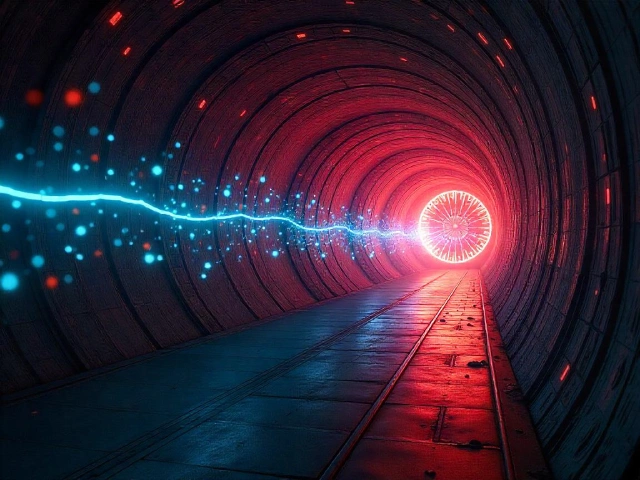
The LHCb is a colossal instrument, about 69 feet long and weighing 6,000 tons, capable of colliding nearly 200 million protons per second. The immense energy from these collisions creates various new particles—some of which are baryons.
To analyze the results of every such collision, LHCb uses a “four-dimensional camera” that records the position, momentum, and timing of every particle. Researcher Vincenzo Vagnoni notes, “This detector gives us all the data required to understand each particle’s origin, transformation, and decay history in full detail.”
Does This Discovery Solve All the Mysteries?
No. According to scientists, this newly found CP violation in baryons still fits within the current main theory of physics, the Standard Model. That is, it is not a major anomaly. However, the amount of difference observed is nowhere near enough to explain the abundance of matter in the entire universe.
Theoretical physicist Jessica Turner of Durham University says, “This result is not unprecedented. It’s entirely consistent with previous quark-based models.”
So How Will the Mystery Be Solved?
Researchers believe the matter–antimatter asymmetry observed in our universe may be due to particles or processes yet to be discovered. Perhaps, in the earliest moments of the universe, these unknown entities created the differences that saved matter from annihilation.
Vagnoni says, “We are searching for even the slightest deviation from the Standard Model. If we find any, it might reveal where the current model falls short.”
Looking to the Future
The significance of this discovery is that it has now opened new questions and avenues for scientific investigation. In the future, LHCb will collect about 30 times more data, which can be used to search for even rarer examples of CP violation. Perhaps one day, this will lead us to the answer to that profound question: “Why is there something instead of nothing?”
Conclusion
This research reminds us that physics is not just a game of theories—it is an ongoing effort to unlock the mysteries of our very existence and our universe. Research platforms like the Large Hadron Collider are rapidly expanding the boundaries of our knowledge. Perhaps one day, we truly will know why we are here in this universe—made of matter, full of life.
Sources:
- Clara Moskowitz, Scientific American
- LHCb Collaboration, Nature, July 2025
📩 Send questions or feedback: [email protected]
🌐 Read more science news: biggani.org