


Different Types of Battery Cells
Carbon-zinc cell: The most widely used battery, also known as dry cell. Used in lights, toys, radios, etc.
Materials: A cylindrical tube made of zinc, which acts as the cathode or negative terminal, containing a carbon rod covered with a mixture of manganese dioxide and carbon powder as the anode or positive terminal. A paste of water-dissolved zinc chloride and ammonium chloride is used as the electrolyte.

Alkaline cell: A more advanced technology than zinc-carbon batteries, more expensive and longer-lasting. Used in watches, pocket calculators, toys, cameras, etc.
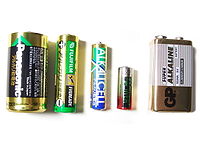
Materials: Zinc powder is used as the anode and manganese dioxide powder as the cathode. Potassium hydroxide is used as the electrolyte.
Nickel-cadmium cell: Nickel-cadmium batteries are similar to regular pencil batteries, but they are secondary batteries—they can be recharged and used repeatedly. These are mostly used in cordless phones, toys, emergency lights, etc. They have a voltage of 1.2 volts, so they provide less power compared to primary batteries.

Materials: Nickel oxide hydroxide is used as the cathode and metallic cadmium as the anode, with aqueous potassium hydroxide as the electrolyte.
Nickel metal hydride battery: NiMH, Nickel metal hydride battery is an improvement over NiCd; instead of cadmium, a hydrogen-absorbing alloy is used as the negative electrode. NiCd Compared to NiMH batteries, these can have 2–3 times more ampere-hours, enabling longer power supply. Where NiCd batteries have a capacity of 600–700 mAh, NiMH batteries have 1100–2900 mAh. They are used in electric cars, toys, and many other applications.

Materials: In NiMH batteries, the negative electrode is made of rare-earth or nickel alloys [an alloy of lanthanum, cerium, neodymium, praseodymium to absorb hydrogen], and nickel hydroxide is used as the cathode. The electrolyte is potassium hydroxide.
Lithium-ion battery: Currently the most common type, widely used in mobiles, digital cameras, laptops, palmtops, battery-powered cars, etc.
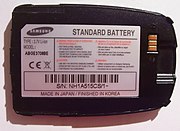
Materials: Lithium oxide is used as the cathode and carbon compounds or graphite as the anode.
Button/Coin Cell: Used in watches, pocket calculators, hearing aids, CPUs, various mini toys, etc. They usually range from 1.5–3 volts.
Button cells

Button cell inside

Materials: Zinc, lithium are used as cathodes, while manganese dioxide, silver oxide, carbon monofluoride, cupric oxide/mercuric oxide are used as anodes.
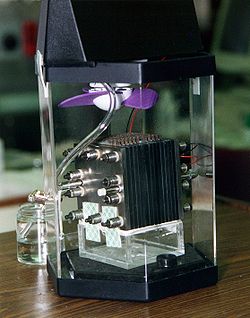
Fuel cell: This type of cell is still experimental; in its electrolyte, a fuel [anode] and an oxidant [cathode] react chemically to produce electricity. As long as fuel [usually hydrogen] is present, it can run continuously. Research is ongoing for its use in spacecraft, vehicles, meteorological stations, and remote areas. It is being used on a very limited scale.
Materials: Various types of hydrogen compounds [hydrocarbons, alcohol] are used as the anode or fuel, and cathodes [chlorine, chlorine dioxide], such as in a hydrogen fuel cell where hydrogen is the anode and oxygen is the cathode.
Battery Output
In a series connection, the voltages of the batteries are added, but the amperage remains the same.

In parallel connection, the voltage remains the same, but the amperage is added.










I guess that to get the mortgage loans from creditors you should present a good reason. But, one time I’ve received a car loan, because I was willing to buy a house.