Every phase of the industrial revolution has reshaped human society. Once, mechanical power transformed factories, and later, electricity and computers accelerated industry further. Today, at the core of Industry 4.0, stands the “Digital Twin”—a technology that is transforming the real world into its digital reflection.
The concept of the digital twin was once confined to limited research labs. But now, it is turning into a strategic weapon in global industry. In 2022, the global digital twin market was just $418 million. According to IoT Analytics forecasts, by 2027, it will climb to $1.5 billion. An annual growth rate of over 29% is proof of the technology’s explosive adoption. From manufacturing and logistics to healthcare and smart cities—everywhere, digital twins are paving new pathways.
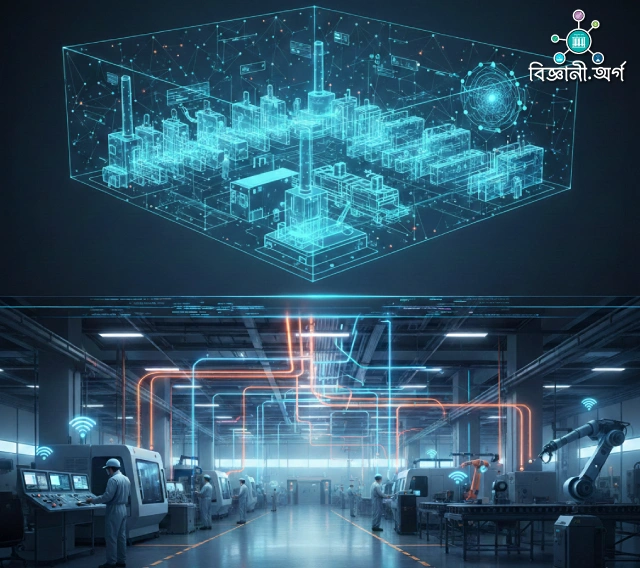
However, there is a lot of confusion about what “digital twin” actually means. Many think it is just a 3D design or a separate piece of software. In reality, its true strength lies in its functionality, not its form. A digital twin is a living digital replica that continuously collects information from the real world and updates itself based on that data. Whether it’s a factory machine, hospital equipment, or city traffic flow—the function of a digital twin is to create an accurate digital reflection of any real-world asset.
A complete digital twin has three main pillars. First, the digital definition or virtual model, which provides the design of an asset or process. This is created through CAD or PLM software, but on its own it’s only a static model—not a “twin.” Second, the integration of real-time and historical data, collected from IoT sensors, telemetry, or previous records. Without this data, a digital twin cannot be dynamic. Third, the layer of analytics, artificial intelligence, and simulation, which analyzes the data, predicts outcomes, and provides automated solutions if necessary. This is where the twin becomes the driving force of industry.
Not all digital twins are equally powerful. They operate at different levels. A digital model is the most basic stage, serving only as a design without actual data. Next is the digital shadow, where real-world data flows one-way into the digital model. This is effective for monitoring or maintenance, but no feedback reaches the real world. The final stage is the true digital twin—where data flows both ways. That is, changes in real assets are reflected in the digital twin, and analyses or decisions from the twin impact the real world. Tesla’s ability to monitor every car in real time and improve performance through software updates is a great example.
To understand this technology, we need to look at the manufacturing industry’s Manufacturing Execution System, or MES. MES essentially tracks every step in the factory, ensures quality control, implements production plans, and maintains the link with the supply chain. Many try to create a “digital twin” by purchasing separate software. In truth, a well-designed MES automatically creates a factory’s digital twin. If data such as temperature, speed, or output from every machine is connected in real time, if artificial intelligence is used for analysis and error detection, and if automated responses are generated—then that is an effective digital twin.
It’s important to break a major misconception here. Shiny 3D visualization isn’t essential for a digital twin. The foundation is data and connectivity. 3D models can be used for training or simulating complex setups if desired, but the real power of a twin lies in data flow and real-time responsiveness. Just as a quality MES automatically synchronizes data, updates process maps, and takes action according to set rules or AI analysis, similarly, it creates a two-way connection with the real world.
The question is, what does this mean for Bangladesh? Our industries are still largely labor-dependent. To boost productivity, tech-driven transformation is inevitable. In garments, pharmaceuticals, and even agro-processing industries—a digital twin can bring about a revolution. If a garment factory can track machine health and workflow in real time, errors can be resolved before they occur. This not only increases productivity, but also makes quality assurance easier.
The digital twin isn’t limited to industry alone. In healthcare, it enables real-time patient monitoring. In city planning, smart city models use it to reduce traffic congestion, and in power management, its application is increasing to boost efficiency. If Bangladesh’s healthcare system could integrate hospital equipment, medicine supply, and patient information into a single digital twin, it would improve treatment quality and reduce resource wastage.
Therefore, there is no scope to consider the digital twin as some dream of the future. It is today’s reality, adding a new dimension to industry, healthcare, and urban life. If Bangladesh doesn’t want to fall behind on the road to Industry 4.0, preparations to embrace this technology must start now. The competition of the twenty-first century cannot be won by labor-intensive production alone; what’s needed are information-driven, intelligent, and automated systems. And at the core of that is this new technology—the digital twin.