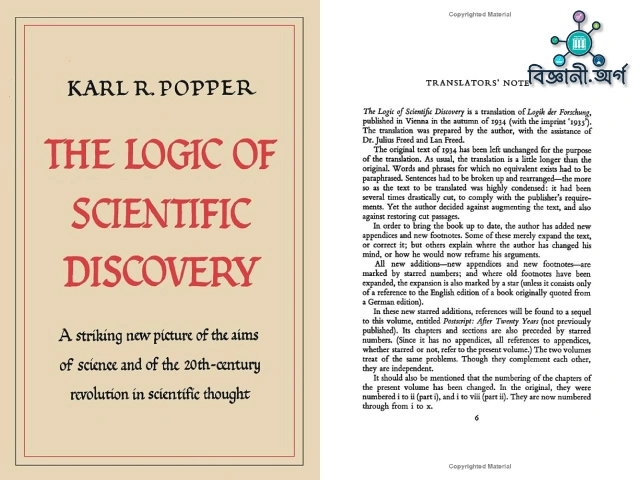
Science is a continuous and uninterrupted process, one that persistently expands the boundaries of our knowledge. But how do these significant contributions occur? How does science develop, and what criteria allow certain theories to be accepted as scientific? In seeking answers to these questions, one of the most influential philosophers of the twentieth century, Karl Popper, introduced a new concept in his book ‘The Logic of Scientific Discovery’—namely, ‘falsifiability’ or the testability of theories. Through his theory, Popper shed new light on the advancement of modern science, the variability of theories, and their inherent complexities. Popper’s ideas remain equally important among today’s scientific community, as they help us understand how theories are proven or rejected in science and offer a perspective on the very nature of scientific inquiry.
The fundamental principle Popper presented is the importance of testable theories. He argued that if a theory cannot be refuted through testing, it does not qualify as science. In other words, any scientific theory must be compared with nature, and if the evidence fails to confirm the theory’s validity, it should be discarded. Conversely, theories that withstand testing are accepted by the scientific community. Through this, Popper depicted science as a stable and flexible structure, where new theories and concepts are regularly subjected to testing and revision. This continual evaluation acts as a guiding light for scientific progress, enabling theories to become more refined through mutual scrutiny, ensuring that knowledge is never static, but constantly changing.
Popper’s theory is significant not only for scientific theories themselves but also reshapes our approach to critical thinking. He argued that science can never be fully conclusive. It is an ongoing process in which new information and experiments continuously refine theories. By promoting the concept of ‘falsifiable’ theories, Popper enabled scientists to test and revise one another’s work, thereby steering science along a specific path. True scientific achievement lies in this continuous process of change and progress.
This is not only relevant to science but also impacts other spheres of society. Popper highlighted the depth of the relationship between scientists and society, showing that scientific discoveries are not merely reactions to reality but that they also shape the way discoveries permeate society and influence people’s attitudes. For example, after a new scientific finding, changes in the attitudes or behaviors of the relevant society or population become significant. In this context, Popper believed that scientists, as members of society, are responsible for the results of their work and that these outcomes should be evaluated from the perspective of how they contribute to social improvement.
Popper’s thinking has helped us perceive the importance of science and technology in society in a new way. According to his concept, science is not a singular, absolute truth but rather a progressive and developing process that advances through self-examination, revision, and re-evaluation. He emphasized that before any scientific theory is fully validated, it must be repeatedly tested and, through this process, becomes increasingly refined and reliable. This ongoing process continually shapes the thinking of scientists and the structure of knowledge within society.
Whether in university classrooms or scientific laboratories, the significance of Popper’s theory is immense. He not only advocated for validating a theory’s testability but also elevated the structure of the entire scientific community and the assessment of research to a new dimension. Popper strengthened and clarified our trust in science. As scientists, if the theories we hold are not scrutinized through testing, their acceptability will inevitably be questioned.
Popper’s philosophy provides a reliable and rigorous foundation for the scientific method. When a theory fails a test, it does not mean that science has failed; instead, it compels scientists to seek more refined and improved theories. Through this approach, science brings about changes in nature, enriching the thought processes of our society. In reality, science constantly expands and deepens our knowledge through ongoing experimentation.
In conclusion, ‘The Logic of Scientific Discovery’ teaches us that science is not a final destination but a continuous journey, where theories are repeatedly tested, and only those proven true give rise to new ideas, research, and advanced technology. Through his theory, Popper opened a new horizon in reconceptualizing the dynamics of science and the framework for future research—one that will continue to inspire both our present and future scientific endeavors.