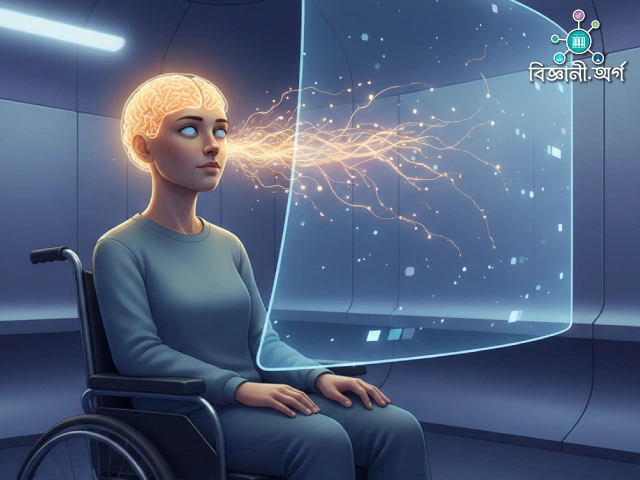
In the 1990s, French journalist Jean-Dominique Bauby was almost completely paralyzed by a brain stem stroke. Though he could neither speak nor write, he managed to tell his story in a remarkable way—an assistant would recite the alphabet repeatedly, and he would select the correct letter simply by blinking his left eye. The story of that patience and struggle has come to us as the book The Diving Bell and the Butterfly. But today, three decades later, technology has advanced a great deal. Those who have lost the ability to speak due to ALS (Amyotrophic Lateral Sclerosis) or brain stem stroke can now communicate much more quickly and comfortably—sometimes by just moving their eyes, sometimes by subtle muscle twitches. At the forefront of all this is brain-computer interface, or BCI technology.
Recently, scientists have gone a step further—not even trying to speak, but simply thinking a sentence allows the computer to write it in real time. This new “inner speech” or mind-language decoding technology could fundamentally change the way we communicate. Until now, BCI devices depended on “attempted speech,” requiring users to mimic speaking, which was often exhausting. These devices convert signals from sensors placed in the motor cortex into words. The user would have to mimic breathing and mouth muscle movements as if speaking, even though no sound was produced. Due to respiratory issues or physical limitations, it sometimes took several breaths just to “speak” a single word. Moreover, facial contortions and unintentional sounds could be uncomfortable for users.
However, the motor cortex is not only active during attempts to speak; some parts also activate when we imagine speaking or engage in inner speech. Stanford University researcher Erin Kunz and her colleagues leveraged this trait to create a new “inner speech” decoder. In a recent Cell journal publication, four participants took part—three ALS patients and one person affected by brain stem stroke—each of whom already had sensors implanted in their motor cortex. The experiments showed that when they merely thought of a sentence, it instantly appeared on the screen. Whereas previous technology supported only a limited vocabulary of a few dozen words, the new system enabled the use of a dictionary with 125,000 words.
The biggest achievement has come in terms of speed. While earlier only a handful of words could be spoken per minute, the new technology allows for 120 to 150 words per minute—the equivalent of regular conversation. And all that’s needed is to construct the sentence in the mind, no additional effort to move facial muscles or breathe. One participant joked that, because of the previous slow pace, they never had a chance to interrupt others in a conversation, but now they can finally do it again.
However, this technology does not work for everyone. As Berkeley University researcher Alexander Huth explains, the natural process of speaking begins with an idea in the mind, which is then translated into a plan for the movements necessary for speech, and lastly those plans are executed. For many patients, the planning stage remains intact, but the step from planning to muscle movement is lost. The new “inner speech” technology can tap into that first step, so those who can reliably transform ideas into plans are the ones who will benefit the most.
Kunz’s personal connection to this research runs deep. Her father lost his speech due to ALS. In his final days, Kunz herself became his personal “speech translator,” as she understood his language best. This experience led her into brain prosthetics research. So she knows firsthand the value of restoring a lost voice.
Of course, the ability to read the thoughts of the mind raises questions about mental privacy. For this reason, the research team has included a special “code phrase”—such as “chitty chitty bang bang”—which, when thought silently, starts or stops the device from writing. This allows users to choose when they want their thoughts to be revealed.
The researchers say that the greatest contribution to this research has come from the participants themselves. Though they might not immediately benefit greatly, they have given their time and effort voluntarily for the future, to change the lives of people with paralysis. In Kunz’s words, “They are extraordinary people, and their contribution to the development of this technology is unique.”
This innovation is not only a milestone in medical technology, but is also redefining the very idea of human communication. In the future, we may reach a point where voices are no longer required to speak—simply thinking will deliver the message to others. Yet with it will come complex ethical and privacy questions that scientists and society will need to solve together. The more advanced the technology becomes, the greater the real challenge will be to maintain this delicate balance.